SAN FRANCISCO — In a major expansion of its cloud storage capabilities, Amazon Web Services (AWS) has announced the rollout of cross-account copy functionality for Amazon Elastic Block Store (Amazon EBS) Volume Clones. Building upon the foundational instant volume cloning technology introduced last year, this new feature allows cloud architects, developers, and DevOps engineers to securely share and copy production-grade EBS volumes directly across separate AWS accounts.
By integrating with AWS Resource Access Manager (AWS RAM) and AWS Key Management Service (AWS KMS), the capability addresses a long-standing workflow bottleneck: the secure, friction-free replication of live production data into isolated development, testing, and staging environments residing in different organizational accounts.
Main Facts: What is Cross-Account Amazon EBS Volume Cloning?
Amazon EBS Volume Clones enable users to generate instantaneous, point-in-time, block-level copies of existing EBS volumes within the same Availability Zone. Until now, these clones were confined to the boundaries of a single AWS account.
With the latest update, AWS has unlocked cross-account capabilities, fundamentally changing how enterprises handle data governance and environment synchronization. The core mechanics of the feature rely on two foundational AWS services:
AWS Resource Access Manager (AWS RAM): Used by volume owners to securely share specific EBS volumes with designated target accounts, either individually or across an entire AWS Organization.
AWS Key Management Service (AWS KMS): Allows target accounts to optionally re-encrypt newly copied volumes using custom encryption keys native to the secondary environment, ensuring that strict compliance and data-isolation policies remain unbroken.
The capability is tailored for modern enterprise workflows where production environments are strictly segmented from development and staging accounts for security and auditing purposes. Engineering teams can now pull the exact state of a production database or application volume and spin it up in a sandbox account within minutes, eliminating the need for slow, traditional snapshot-and-restore cycles.
Chronology: The Evolution of EBS Cloning Technology
To understand the significance of today’s announcement, it is helpful to look at how AWS has iteratively improved its block storage portfolio over the past several years:
The Snapshot Era: Historically, duplicating an EBS volume required taking a point-in-time Amazon EBS snapshot, which incrementally backed up data to Amazon S3. While reliable, creating a new volume from a snapshot in a cross-account scenario involved a multi-step process: sharing the snapshot, copying it to the target account, and then provisioning a brand-new volume from that copied snapshot. This method could introduce latency depending on dataset size.
The Introduction of Volume Clones (Previous Release): AWS revolutionized this workflow by introducing native EBS Volume Clones. Rather than routing data through S3 or performing full block-level duplications upfront, clones leveraged metadata pointers and a copy-on-write mechanism. This allowed users to instantiate identical working volumes instantly. However, their utility was restricted to single-account architectures.
The Cross-Account Integration (Current Release): Recognizing that modern enterprise applications rarely run out of a single AWS account, AWS bridged the gap between instant cloning and multi-account security boundaries. By marrying volume cloning mechanics with AWS RAM, AWS has streamlined cross-account data provisioning, marking a significant milestone in hybrid and multi-account cloud management.
Supporting Data: Workflow and Implementation Mechanics
Executing a cross-account volume clone involves a precise, permission-driven sequence of events designed to maintain strict security boundaries. Below is a breakdown of how the workflow functions in practice within the AWS Management Console:
1. Initiating the Share (Source Account)
The journey begins in the source account—typically the production environment.
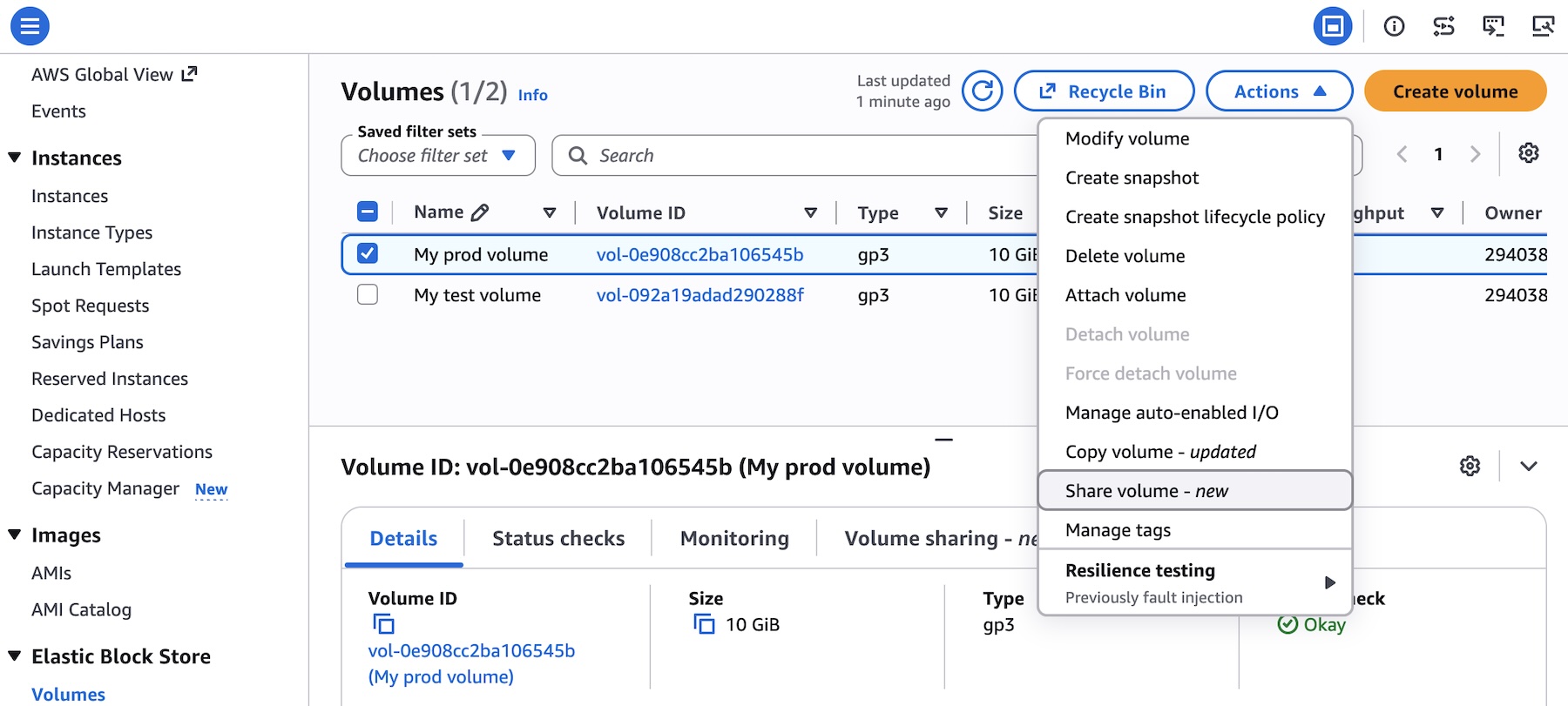
The volume owner navigates to the Amazon EBS console, selects the target volume, and chooses the Share volume option.
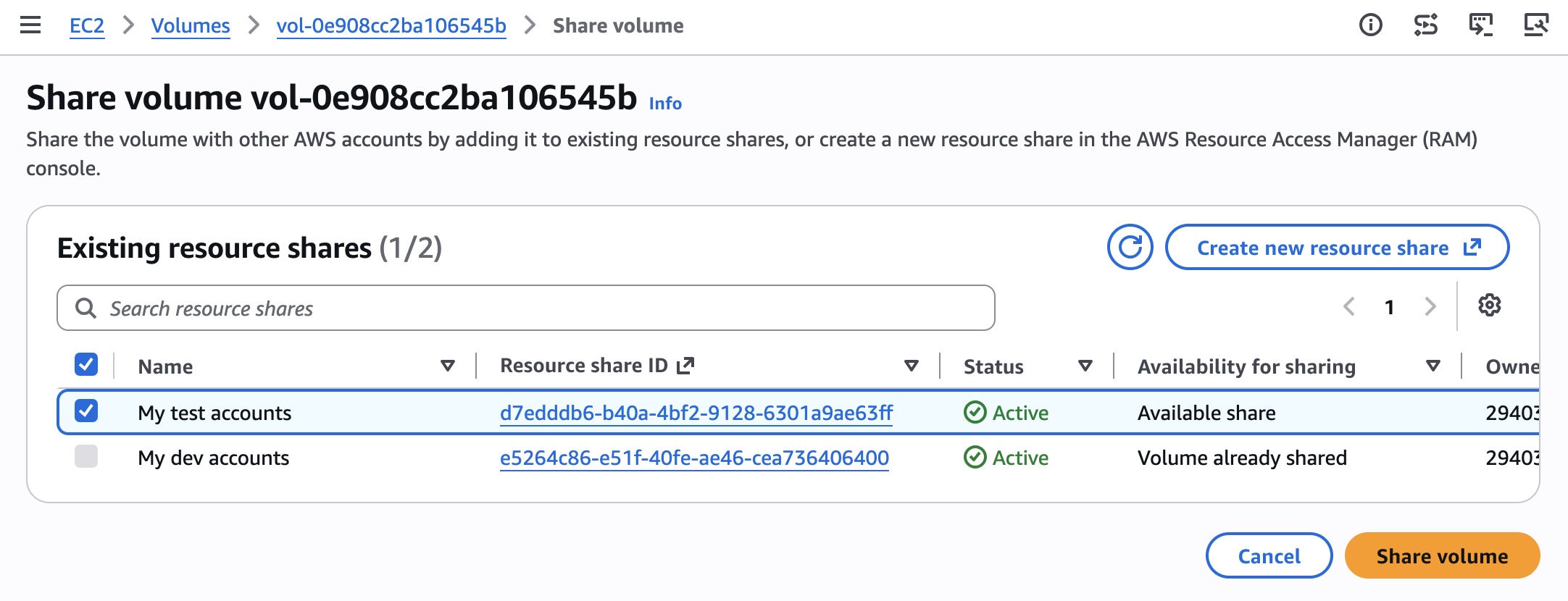
The user then links the volume to an existing resource share or creates a new one via the AWS RAM console. AWS RAM orchestrates the secure sharing boundary, ensuring that only authorized accounts or AWS Organizations can view the resource.
Once configured, a confirmation status appears under the Volume sharing tab on the volume’s detail page, verifying that the asset has been successfully exposed to the exterior target account.
2. Accepting and Copying (Target Account)
Once shared, the process shifts to the secondary environment:
An administrator or authorized user in the target account logs into the AWS RAM console and accepts the incoming resource share invitation.
Upon acceptance, the shared volume automatically populates within the EBS volume dashboard of the target account, clearly marked as a shared asset.
The user selects the shared volume and clicks Copy volume. During this step, the target account administrator can choose to apply a distinct AWS KMS key to re-encrypt the volume, ensuring that data sovereignty and encryption key segregation rules are strictly enforced.
Programmatic and AI-Driven Integration
For organizations relying heavily on infrastructure-as-code (IaC) and automation pipelines, AWS has ensured that cross-account volume operations are fully accessible via API calls. Furthermore, teams utilizing modern AI coding assistants can leverage the AWS MCP Server and associated plugins to query documentation, write automation scripts, and manage cross-account EBS workflows programmatically with minimal friction.
Official Responses and Strategic Implications
Industry analysts and early enterprise adopters have praised the update for aligning with AWS’s broader "Well-Architected Framework," specifically regarding security, reliability, and operational excellence.
"Enterprise customers have long struggled with the dichotomy between wanting developers to work with production-accurate data and needing to maintain airtight security perimeters around production environments," said a senior cloud architect at a major financial services firm. "By enabling secure, encrypted cross-account volume clones via AWS RAM and KMS, AWS has solved a persistent operational headache. It drastically reduces the time it takes to debug production-specific bugs in staging."
From a compliance standpoint, the integration of AWS KMS is being highlighted as a critical win. In heavily regulated sectors such as healthcare, finance, and government contracting, data leakage between accounts represents a severe compliance hazard. By forcing data re-encryption upon arrival in the target account using localized keys, AWS ensures that security teams maintain cryptographic control over their respective environments without compromising developer agility.
Furthermore, the operational efficiencies are profound. Traditional methods of refreshing a 5-terabyte test database via standard snapshot restoration could take hours and consume significant administrative overhead. Instant volume cloning, combined with cross-account sharing, compresses this timeline dramatically, allowing CI/CD pipelines to ingest fresh production datasets almost instantaneously.
Looking Ahead: Regional Availability and Future Roadmap
AWS has confirmed that cross-account volume clones for Amazon EBS are generally available starting today. The feature has been deployed across all AWS Regions that currently support standard Amazon EBS Volume Clones.
Organizations eager to check specific Regional rollouts or view the upcoming feature roadmap can consult the AWS Capabilities by Region documentation portal.
Cloud administrators are encouraged to test the new functionality today using the Amazon EC2 console. Feedback, feature requests, and operational queries can be directed to the official AWS re:Post for Amazon EBS community forum or channeled through standard enterprise AWS Support touchpoints.
As multi-account strategies—such as AWS Control Tower deployments—continue to dominate enterprise cloud architecture, features like cross-account EBS volume cloning represent a vital step forward in making complex, distributed cloud environments feel as cohesive and manageable as a single-server setup.

 By Raul Delapena Setiawan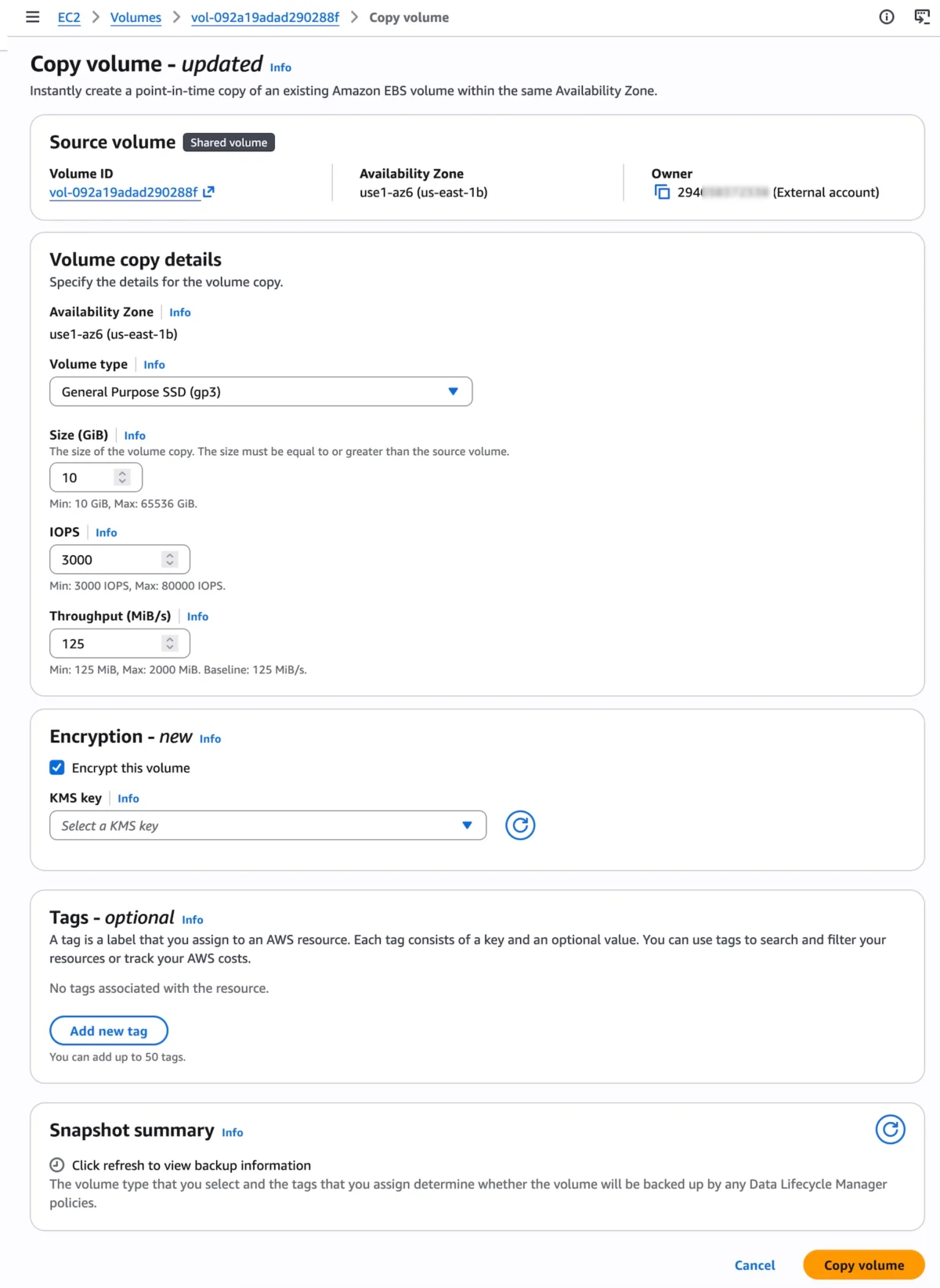


 Neng Nana
  Suro Senen
  Lina Hope