
 By Ali Ikhwan
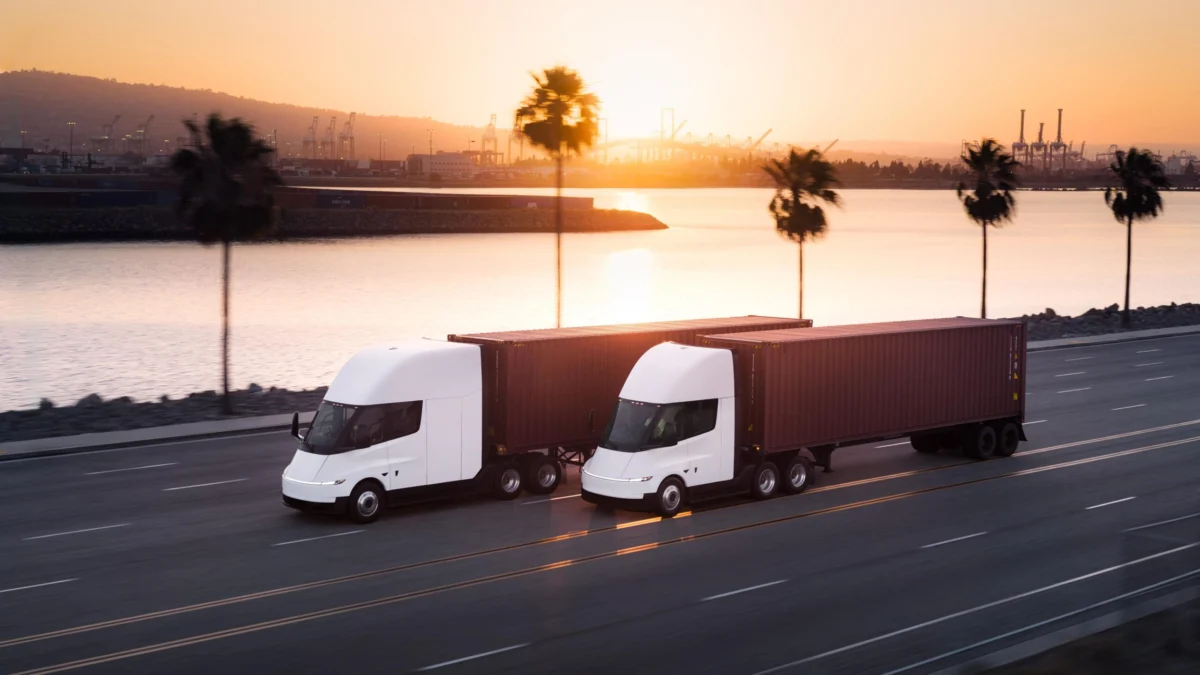
Nearly a decade after its initial concept unveiling in November 2017, the Tesla Semi has officially entered volume production. Tesla marked the milestone with a high-profile launch event at its newly constructed Semi facility, situated adjacent to Gigafactory Nevada in Sparks. The facility is designed to output up to 50,000 heavy-duty electric trucks annually—translating to roughly 1,000 units per week.
While the event successfully showcased engineering refinements, performance metrics, and a burgeoning roster of corporate clients, it also highlighted lingering questions regarding official pricing, total order volumes, and the commercial viability of nationwide high-power charging infrastructure.
Main Facts
The transition from a hand-built pilot line to full-scale manufacturing represents a monumental step for Tesla’s commercial vehicle division. The production-ready lineup features two primary configurations:
- Standard Range: Offers an estimated 325 miles of range at a full 82,000-pound gross combination weight rating (GCWR).
- Long Range: Delivers up to 500 miles of range under maximum load conditions, with engineering executives noting that lighter cargo loads (around 60,000 pounds) could push the vehicle’s operational range to approximately 600 miles.
Tesla used the event to parade a comprehensive client list, confirming prominent corporate fleets such as PepsiCo, US Foods, DHL, WattEV, ABF Freight, Einride, IMC Logistics, and OK Produce. Most of these partnerships had leaked prior to the event via drone footage captured above the Nevada facility. Deliveries to waiting customers commenced the week of the event.
Despite the pomp and circumstance, critical financial figures remain opaque. Tesla refrained from updating official pricing figures or disclosing total accumulated order backlog numbers during the presentation. Industry tracking and third-party reports, such as Electrek’s earlier quotes, suggest the 500-mile Long Range variant carries a price tag of roughly $290,000.
Chronology: The Long Road from Concept to Production
The timeline of the Tesla Semi is a study in iterative engineering delays, global supply chain bottlenecks, and ambitious promises.
- November 2017: Elon Musk formally unveils the Tesla Semi concept, promising a 300-mile range model for $150,000 and a 500-mile range model for $180,000, with production slated to begin in 2019.
- 2019–2021: Production dates slip repeatedly. The delays are compounded by the onset of the COVID-19 pandemic, severe global semiconductor shortages, and competing internal demands for battery cell supply across Tesla’s passenger vehicle and energy storage divisions.
- December 2022: Tesla delivers a small, pilot-line batch of hand-built Semi trucks to PepsiCo, providing the industry with its first real-world operational data.
- February 2026: Tesla officially freezes and reveals the final production design, confirming structural updates, weight reductions, and the division of the lineup into Standard and Long Range trims.
- April 2026: The first production-line Semi rolls off the assembly line at the new Sparks facility, marking the formal initiation of volume manufacturing.
- September 2026: Tesla hosts its major customer and investor event at the Nevada Semi factory, officially kickstarting large-scale deliveries and rolling out commitments for thousands of units across major logistics providers.
Supporting Data: Battery, Engineering, and Powertrain Innovations
Tesla dedicated a significant portion of the presentation to detailing the hardware and efficiency updates that allowed the company to shed nearly 1,000 pounds from the vehicle’s total mass over the past three years.
Battery and Chemistry Evolution
The production Semi transitions away from the purchased 2170 battery cells used in early test mules, adopting Tesla’s in-house 4680 battery cells. Through these cell upgrades and vehicle-level aerodynamic and mass-reduction efficiencies, the truck’s energy consumption has dropped to roughly 1,700 Wh per mile, a marked improvement over the initial 2,000 Wh/mile target. This efficiency gain enables the use of a smaller, lighter, and more cost-effective battery pack without sacrificing the promised 500-mile range.
Powertrain and Mechanical Redesigns
Engineers overhauled nearly every critical component of the drive unit:
- Rotors and Stators: The earlier carbon-fiber-sleeved rotor was replaced with a more robust steel-caged rotor. The bar-wound stator is now shared with the Cybertruck.
- Drive Axle: Redesigned to be roughly 80 kilograms lighter, the new axle eliminates the three separate oils used in the original concept. It features a single, common oil shared between the motor and gearbox, engineered to last in excess of 250,000 miles.
- Steering and Maneuverability: Traditional hydraulic steering has been completely replaced by a redundant electric power steering system. Coupled with an increased wheel cut, the Semi boasts a turning radius comparable to a Tesla Model Y, designed to ease tight urban navigation and loading-dock operations.
- Thermal Management: The Semi leverages the indirect thermal management system—including pumps, compressors, and heat exchangers—pioneered by the Cybercab. This eliminates long refrigerant lines running to the vehicle’s front and allows intelligent heat-shifting between the cabin, battery pack, and drive units.
Official Responses and Executive Perspectives
While CEO Elon Musk was absent from the physical event due to a state dinner in Washington, D.C., with U.S. President Trump and Chinese President Xi, he appeared via a pre-recorded video message.
"This is really going to be a revolutionary truck," Musk stated. "That is capable of carrying the heaviest loads over very long distances. With ease of recharge, Megacharger that’s capable of a megawatt of power. This is really going to be a phenomenal truck."
Dan Priestley, Tesla’s Director of Semi Truck Engineering, and Lars Moravy, Vice President of Engineering, anchored the live technical briefings. Priestley stressed that the 500-mile benchmark is achieved while pulling maximum allowable loads rather than under idealized testing conditions with minimal cargo.
Addressing the economic realities of commercial freight, Moravy focused heavily on the Total Cost of Ownership (TCO). With historical volatility in fossil fuel markets driving diesel prices past $6.50 a gallon in various U.S. regions—nearly double historical averages—Tesla is aggressively marketing electricity as a stable, predictable operational expense.
"You know, volatility in the oil market and the diesel market goes up and down," Moravy remarked during the technical deep dive. "Typically, we’ve seen in the history of the last 20 years, electricity is pretty flat. And wouldn’t it be great to have a flat cost in your shipping rates?"
Implications: Charging Infrastructure and Market Challenges
The commercial success of the Tesla Semi will ultimately depend less on its engineering specifications and more on the deployment of supporting infrastructure and reliable operational uptime.
The Megacharger Rollout
Powering an enormous 822 kWh battery pack requires unprecedented charging speeds. Tesla is aggressively building out its proprietary Megacharger network, which is capable of delivering up to 1.2 Megawatts of power per charging stall. Demonstrations at the event showcased a Semi recovering from 3% to 60% state-of-charge in roughly 30 minutes. Tesla aims to deploy over 30 Semi charging stations representing more than 200 megawatt-capable posts by the end of the year, alongside commercial customer-installed overnight depot chargers.
Uptime and Fleet Integration
Commercial freight operators measure success through uptime. Tesla claims its pilot fleet has demonstrated greater than 98% operational uptime, far outperforming the industry average of 90% to 95% typically seen with traditional diesel Class 8 trucks. To maintain this reliability, Tesla is scaling out dedicated Semi mobile service units, remote diagnostics, and Over-The-Air (OTA) software update pipelines.
Market Demand vs. Execution Risk
The market appetite for zero-emission commercial transport is evident. In addition to individual fleet purchases, a coalition of major cargo-owning shippers recently selected Tesla to supply 2,500 trucks for zero-emission freight operations in California, complementing Einride’s reported 500-truck order.
However, Tesla faces immense pressure to execute. Having kept fleet operators waiting for nearly a decade, any additional manufacturing bottlenecks or infrastructure delays could strain customer relationships and open the door for legacy truck manufacturers and competing EV startups to capture ground in the lucrative heavy-duty logistics sector. For now, the factory floor in Sparks is humming, and the first wave of production trucks is finally hitting America’s highways.
 Nana Muazin
 Raul Delapena Setiawan
 Pevita Pearce
