
 By Jia Lissa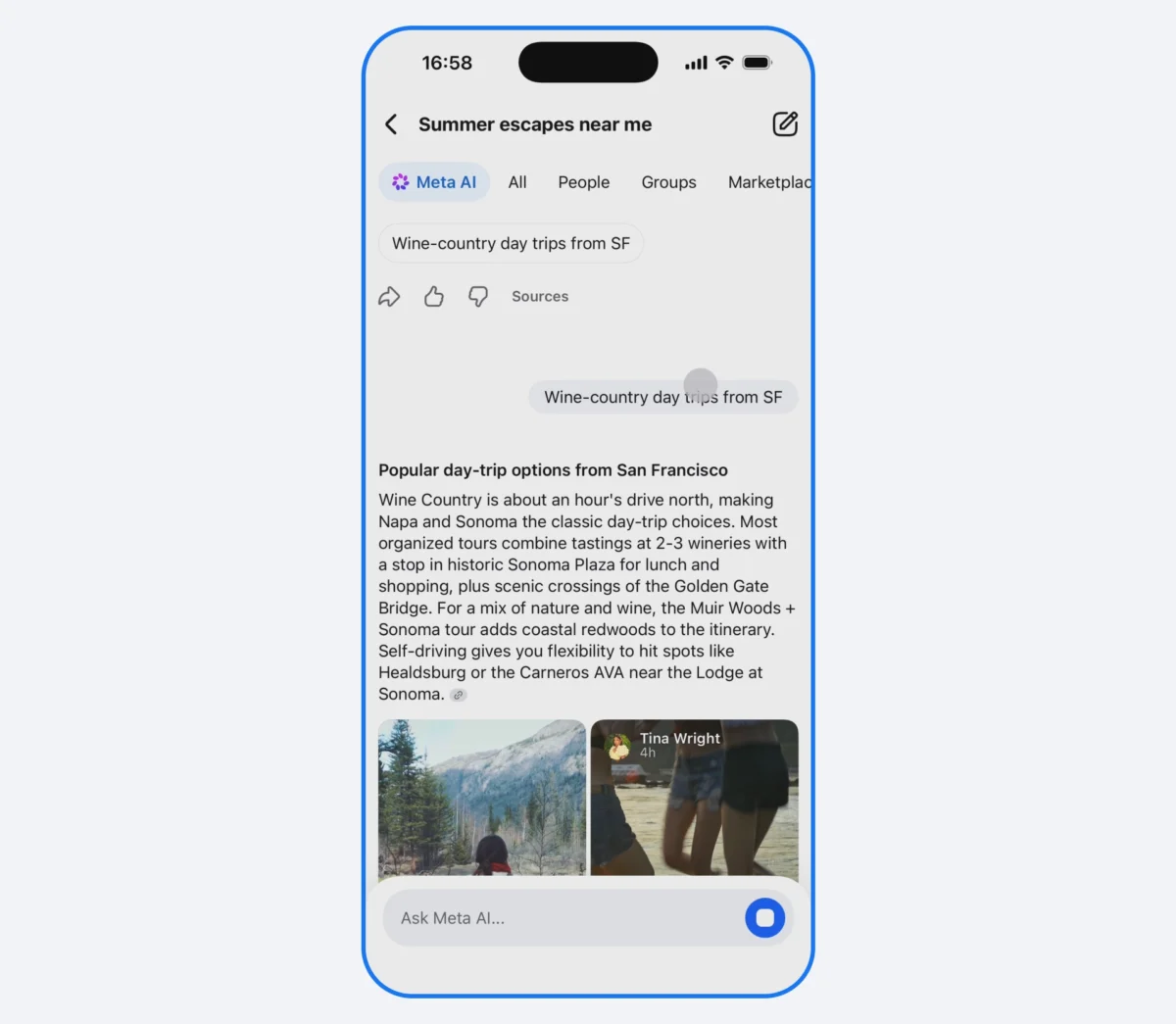
In a significant evolution of its search infrastructure, Meta has officially launched "AI Mode" within its flagship Facebook application. This new feature, powered by the company’s proprietary Muse Spark AI model, represents a paradigm shift in how users interact with the vast repository of public information hosted on Meta’s platforms. By transitioning from a traditional keyword-based search engine to an AI-driven, conversational interface, Meta is positioning Facebook as a primary destination for real-time information discovery, drawing heavily on the collective intelligence of its billions of users.
Main Facts: A New Frontier in Social Search
The core of the update is the integration of "AI Mode," a dedicated search toggle that appears alongside established filters like "People" and "Marketplace." When activated, this mode bypasses standard link-based results in favor of synthesized, AI-generated answers.
The underlying intelligence—the Muse Spark model—is designed to parse, synthesize, and present information gleaned from publicly shared content across the Meta ecosystem, including Facebook, Instagram, and Threads. Instead of forcing users to click through multiple external links to find an answer, Muse Spark aggregates data from public posts, comments, and discussions to provide a direct, human-readable summary. Furthermore, the interface supports multi-turn conversations, allowing users to ask follow-up questions to refine their search results, effectively turning a static search box into an interactive research assistant.
The Chronology of Meta’s AI Offensive
Meta’s journey toward this release has been methodical, reflecting a long-term commitment to integrating Generative AI across its suite of applications.
- Early Development (2025): Throughout the previous year, Meta signaled its intent to shift focus toward "AI-first" experiences. Development of the Muse Spark architecture began in earnest, with internal testing focusing on the model’s ability to summarize complex social discussions.
- The Forum Integration (Early 2026): Meta’s "Forum" app—a platform designed to emulate community-driven discussion boards like Reddit—served as the initial testing ground for this search technology. Lessons learned from how users interacted with AI-generated summaries in Forum were critical to the development of the broader Facebook implementation.
- Official Rollout (June 15, 2026): Meta announced the public release of the feature. Alongside the AI search integration, the company introduced a suite of creative AI tools, including photo presets that can realistically swap sports jerseys onto fans in images and automated collage templates, signaling a push to make AI a daily utility for the average user.
- The Future Roadmap: Looking beyond the current release, Meta has confirmed that Muse Spark will eventually evolve to provide more robust citations, explicitly linking recommendations back to the original threads and creators on Instagram, Facebook, and Threads.
Supporting Data and Technical Context
The shift to an "AI-first" search model is not happening in a vacuum. Meta is responding to a broader industry trend where search engines are increasingly becoming answer engines.

Google, for instance, has already begun integrating Reddit threads and other social media discussions into its "AI Overviews," recognizing that modern users are increasingly skeptical of SEO-optimized corporate websites and prefer "human-verified" consensus found in social media conversations.
Meta’s competitive advantage, however, is the sheer scale of its data. With billions of public-facing posts, the "social graph" provides a unique data set that traditional web crawlers struggle to replicate. By training Muse Spark on this content, Meta is effectively turning the "human experience" shared on its apps into a searchable database. Industry analysts suggest that this strategy effectively "closes the loop" on the user experience: users come to Facebook to see what friends are doing, and they stay on Facebook to get answers to their questions, reducing the need to navigate to external websites.
Official Responses and Strategic Vision
Meta has characterized the Muse Spark project as an effort to "help people make things happen on Facebook." In their official documentation, the company emphasizes that the AI is "grounded in what people are saying publicly," a phrasing designed to address concerns regarding the source material.
By focusing on "publicly posted content," Meta is attempting to sidestep the thorny issues of privacy that have plagued AI development. However, the company remains under pressure to ensure that the AI does not hallucinate or misrepresent the intent of the original posters. The company’s leadership has framed this as a way to "democratize expertise," where a user asking about the best travel routes or local restaurant recommendations gets the benefit of a thousand user reviews in a single, concise response.
Implications: The Web, Privacy, and the Future of Content
The rollout of Muse Spark has profound implications for the internet ecosystem, content creators, and privacy advocates.

The Death of the "Click-Through"
For publishers and websites that rely on search traffic, Meta’s new feature is a double-edged sword. If users are satisfied with the AI-generated summary provided by Muse Spark, they have no reason to visit the original source of the information. This could lead to a decline in traffic for external websites, forcing publishers to reconsider how they share content on Meta’s platforms. If the traffic is not driving users back to their own sites, the incentive to create high-quality, long-form content for the web may diminish.
The "Social Graph" as a Training Set
The use of public posts to train and inform the Muse Spark model raises questions about user consent. While these posts are technically "public," many users post with the expectation that their words will be seen by their social circle, not necessarily fed into a global model that aggregates their opinions for search results. While Meta has maintained that it adheres to its terms of service, the legal and ethical landscape regarding "public data for AI training" remains in flux.
The Personalization Advantage
Conversely, the primary benefit to the user is efficiency. The ability to ask "What is the general consensus on this new electronic device?" and receive an answer derived from thousands of real-user experiences is a significant upgrade over traditional search. It allows for a level of nuance—such as "what are people saying about the battery life?"—that standard keyword search fails to capture.
A New Standard for Community Engagement
By integrating these tools into Facebook, Meta is attempting to revitalize its platform for younger demographics who are increasingly turning to TikTok or Reddit for information discovery. If Facebook can prove that its AI is more accurate and more "human" than a standard search engine, it could see a significant resurgence in daily active usage.
Conclusion
Meta’s introduction of AI Mode via the Muse Spark model is a clear signal that the era of the "ten blue links" is drawing to a close. By leveraging the vast, organic, and real-time data of its social networks, Meta is transforming Facebook from a mere social feed into a powerful, conversational intelligence engine. While the move poses significant challenges for the traditional web and raises valid questions about the use of public data, it also offers a glimpse into a future where the sum of human digital conversation is accessible, synthesized, and actionable. As the feature rolls out, the tech world will be watching closely to see if Muse Spark can truly deliver on the promise of better, more human-centric search, or if it will simply accelerate the enclosure of the open web.
 Nana Muazin
  Raul Delapena Setiawan
  Nana Wu