
 By Azzam Bilal Chamdy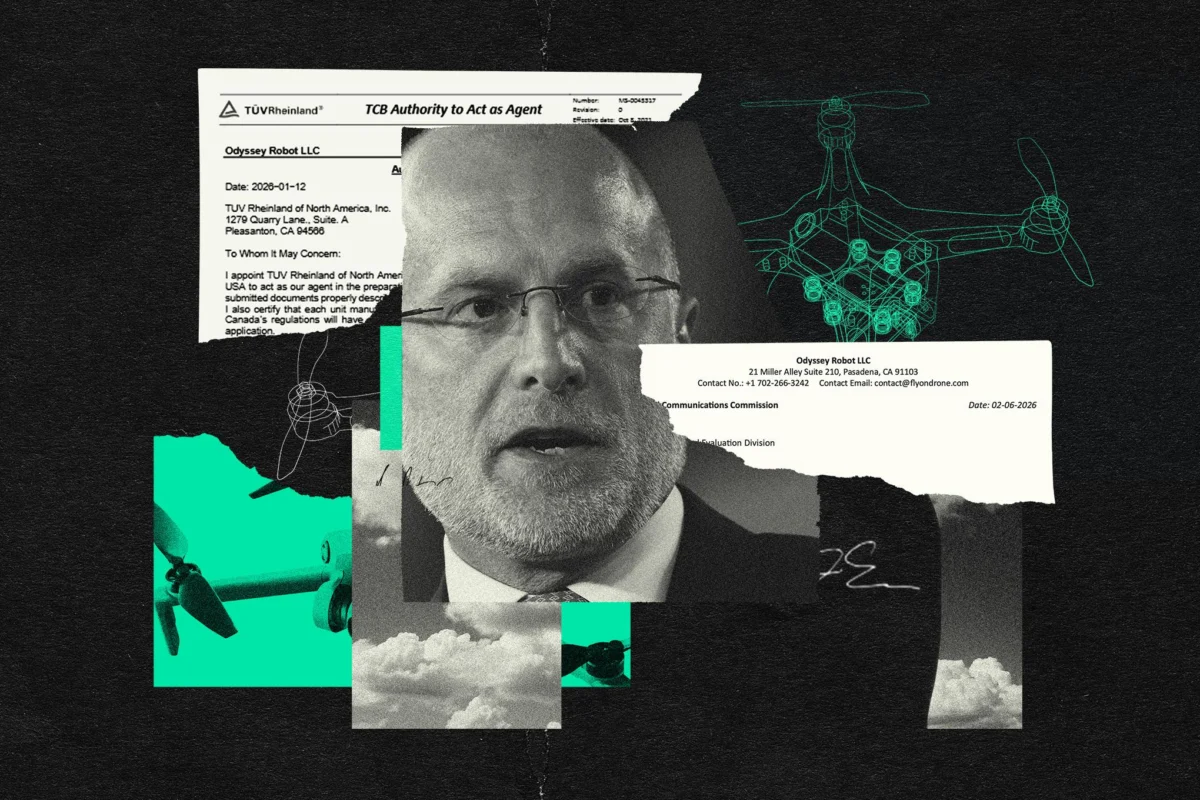
By [Your Name/Journalist Alias]
Reporting from Pasadena, California
In a sun-drenched, unassuming coworking space in Pasadena, California, a glass door opens onto a sparse, industrial hallway. Following the path to the very back of the building, one finds "Office 18." It is listed as the headquarters of Odyssey Robot, a company claiming to be a burgeoning American drone manufacturer.

There are no signs of industrial activity here—no humming servers, no assembly lines, no engineers, and certainly no drones. The office is a vacuum, containing only three desks, each topped with sealed, undisturbed cardboard packages. This room, more than any government memorandum, stands as a stinging indictment of the Federal Communications Commission’s (FCC) recent efforts to secure the American airspace. Despite a sweeping ban on foreign-made drones enacted in late 2025, the reality is that the agency’s safeguards are being systematically dismantled by shell companies and fraudulent paperwork.
The Illusion of Security: The 2025 Drone Ban
On December 22, 2025, the US government officially declared that foreign consumer drones posed an "unacceptable threat" to national security. Led by FCC Chairman Brendan Carr, the agency implemented a rigid framework prohibiting the entry of foreign-made drones into the United States market. The policy demanded that any foreign manufacturer wishing to operate in the US must provide a detailed plan for domestic production, proving they were investing in American soil.

However, as the months have passed, the "America First" initiative has devolved into a game of corporate charades. The application process for waivers and compliance has become a rubber-stamping exercise, lacking meaningful oversight. While companies like Netgear received waivers for internet routers despite maintaining Asian production, the drone sector has seen a surge of "ghost companies"—entities that exist only on paper to mask the origin of Chinese-manufactured hardware.
A Chronology of Deception
The strategy of the "DJI Front Company" has become an open secret among tech researchers. Since the 2025 ban, a wave of new, obscure brands has flooded the FCC database with applications for equipment authorization.

- Mid-2025: Software developer and security researcher Konrad Iturbe identifies a recurring "fingerprint" in FCC filings—specific radio frequency pairs associated with DJI’s proprietary OcuSync technology.
- July 2025: The Verge exposes "Skyrover," a brand that launched a budget drone nearly identical to the DJI Mini 4 Pro. Despite evidence of DJI code in its app, the company remained opaque.
- October 2025: Investigations reveal "Xtra," another front company facilitating the entry of DJI camera technology into the US market.
- February 2026: A mysterious individual named "Randolph Howard Eason" submits an attestation to the FCC, claiming Odyssey Robot manufactures its drones in the United States.
- March 2026: Odyssey Robot (doing business as Galiview Tech) becomes the first DJI-equipped brand to receive FCC approval post-ban.
- June 2026: Independent investigators discover that Galiview’s website explicitly lists DJI’s trademarked "OcuSync" as a feature, despite claiming to be a US-based innovator.
The Anatomy of a Lie: Supporting Data
The ease with which these companies bypass federal scrutiny is staggering. Odyssey Robot’s official paperwork claimed they were operating out of a facility in Pasadena. A cursory Google search, however, reveals that the address belongs to a coworking space that explicitly prohibits manufacturing.
Furthermore, the company cited eTak Worldwide Corporation in Grand Prairie, Texas, as its assembly partner. While eTak boasts the square footage for industrial work, the company is, in fact, a specialized e-waste recycler focused on dismantling old batteries. When contacted, eTak’s founder, Richard Lee, expressed shock, stating he had never heard of Odyssey Robot and had no relationship with DJI.

"Why are people using our company name to do this kind of thing?" Lee asked. "It’s not fair for us; it’s not right."
The documentation provided to the FCC by these entities is frequently riddled with contradictions. Websites claim headquarters in San Francisco, while phone numbers are registered in Las Vegas or are altogether disconnected. The "compliance directors" signing these forms appear to be phantoms, untraceable in professional databases, acting as intermediaries for offshore firms that treat US trademark and compliance fees as a nominal cost of doing business.

The Regulatory Failure: TCBs and Lack of Vetting
The FCC’s failure to catch these bad actors stems from a reliance on Telecommunications Certification Bodies (TCBs). The FCC has effectively outsourced its authorization process to roughly 40 private, third-party companies.
Greg Kunkle, a partner at Keller & Heckman, notes that there is effectively no vetting of the "US agents" listed on these applications. "Once the TCB finishes its process, you’re good to go," Kunkle explains. "I don’t think the FCC or TCB is checking those actively. I’m not sure anybody is."

While the FCC issued guidelines in December 2025 requiring TCBs to perform due diligence—including validating physical addresses—the reality is that TCBs like TÜV Rheinland continue to process applications based on the applicant’s word. When confronted with evidence of potential fraud regarding Odyssey Robot, TÜV Rheinland maintained that, without direct intervention or evidence from the FCC, they had no reason to question their certifications.
Implications for National Security and Consumer Trust
The implications of this broken system are profound. By failing to stop these "front companies," the FCC is not just allowing banned technology into the country; it is actively incentivizing a shadow market.

- Evasion of Accountability: When a consumer buys a drone from a front company, they are left with no support, no warranty, and no recourse if the device fails or poses a security risk.
- The Whac-A-Mole Cycle: The FCC has begun issuing fines and "show-cause" orders, but these are often toothless. When a company is based in a jurisdiction outside the reach of US law, fines remain unpaid, and the company simply dissolves, only to reappear under a new name with the same underlying technology.
- Market Distortion: Legitimate US drone companies, which are currently pivoting toward high-end surveillance and defense contracts, are being undercut by cheap, disguised Chinese hardware that successfully mimics the user experience of market leaders like DJI.
A System in Need of Reform
The FCC’s recent attempts to crack down on these labs and front companies—such as the July 2026 proposed fines and the threat of retroactively banning products—show that the agency is beginning to recognize the depth of the deception. However, the reliance on journalists and independent researchers to provide the necessary intelligence for enforcement is an admission of systemic failure.
As the industry stands, the FCC’s drone ban is little more than a "bad joke." Without a mandatory, rigorous, and physical verification process for US agents and manufacturing facilities, the agency will continue to be outmaneuvered by actors who understand that a small fee and a creative lie are all it takes to bypass the strongest security measures.

The story of Office 18 in Pasadena is not just about a few empty desks. It is about a government agency that has allowed its regulatory authority to be hollowed out, proving that in the modern digital age, the most dangerous threat to national security isn’t just the foreign technology itself—it’s the absolute ease with which it can hide in plain sight.
 Raul Delapena Setiawan
  Siti Muinah
  Asro
Asro 