
 By Jia Lissa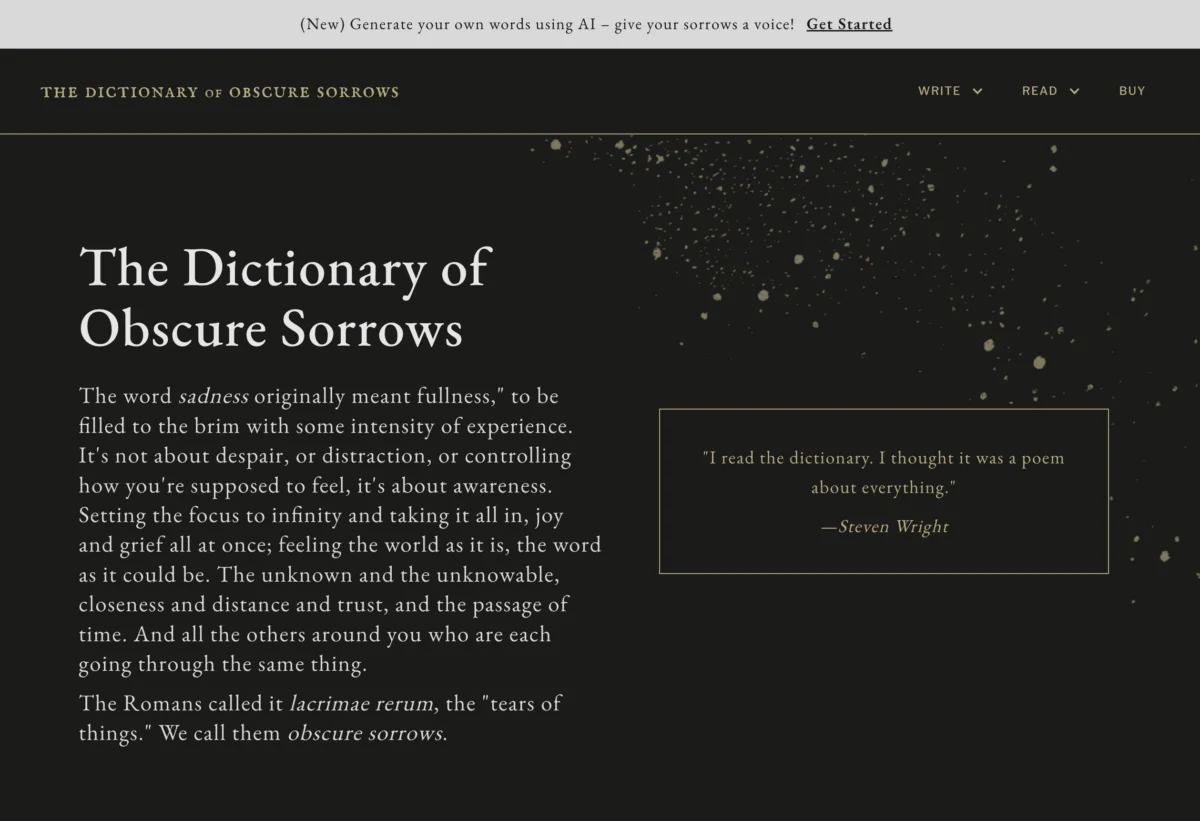
In the landscape of modern digital culture, few projects have captured the collective imagination quite like The Dictionary of Obscure Sorrows. Since 2009, John Koenig has painstakingly curated a lexicon of neologisms—made-up words for complex, universal emotions that lack a formal name in the English language. From "sonder" to "anemoia," Koenig’s work has transcended its humble origins on Tumblr to become a cultural touchstone, even earning a spot as a New York Times bestseller.
However, a jarring development has recently cast a shadow over this decade-long endeavor. An unauthorized, highly polished website—using the domain thedictionaryofobscuresorrows.com—has emerged, appearing to be an official hub for Koenig’s work. In reality, it is a sophisticated bootleg, populated by AI-generated imagery and a dubious "sorrow generator" that uses large language models (LLMs) to mimic Koenig’s unique linguistic craft. This incident serves as a troubling case study in the intersection of intellectual property, AI-driven content scraping, and the erosion of digital provenance.
A Chronology of Confusion
The saga began to unfold last week when a user on the community forum MetaFilter shared a link to the new website. At first glance, the site appeared to be the legitimate, long-awaited overhaul of Koenig’s original Tumblr-based project. It was slick, fast, and feature-rich, offering an author biography, a press archive, and direct links to purchase the physical book on Amazon.

But as readers delved deeper, the facade began to crack. While the site claimed to be a tribute, it featured the entire text of Koenig’s copyrighted book, stripping away the original, carefully curated photo-collages and replacing them with DALL-E 2-generated art. These images were rife with the characteristic artifacts and nonsensical details typical of early generative AI.
Crucially, the site introduced an interactive "Submit A Sorrow" feature, powered by OpenAI’s GPT-4, which allows users to generate their own neologisms in the style of Koenig. This feature was accompanied by a gallery of "User-Generated Sorrows," further blurring the line between the author’s original, human-crafted work and the AI-generated mimicry. When compared to the original domain, dictionaryofobscuresorrows.com, the subtle addition of "the" to the URL provided the only clear indication that this was an impostor site.
The Architect of the Mirage
The unauthorized site was not the work of an anonymous troll, but of Qontour (formerly known as Prompt Digital), a San Francisco-based web design and marketing agency. In their own portfolio, Qontour proudly touted the project as a showcase for their technical expertise, describing how they used Webflow to build an "interactive digital platform" and implemented AI-powered image libraries and content integration.

They attempted to frame the project as a fan tribute, stating, "The site gives fans (like us) one place to find everything… instead of searching across a dozen platforms." However, this narrative of benign fandom clashes sharply with the site’s commercial reality. Qontour embedded their own Amazon affiliate codes throughout the site, ensuring that every book purchase made through their platform funneled a commission directly into their pockets.
Legal and Ethical Implications
The situation highlights a fundamental misunderstanding—or perhaps a blatant disregard—of copyright law. In the site’s footer, Qontour included a notice claiming that all "Dictionary Content" belongs to John Koenig, while simultaneously attempting to license all user-generated submissions under a CC Zero public domain license.
Legal experts and observers note that one cannot simply republish an entire book under the guise of a "fan project" to showcase web development skills. Even more egregious is the agency’s attempt to relicense content they do not own. In a bizarre contradictory statement, a "Copyright Info" link on their site warns visitors that "it’s someone else’s work so you can’t copy it or edit it," yet the agency itself has already violated those very principles by copying, editing, and re-presenting the work in an AI-altered format.

John Koenig’s response to the discovery was one of weary disbelief. When contacted, he confirmed he had no involvement in the site, noting, "I had nothing to do with it. Don’t know what to think or do about that, as the site is pretty slick. Nicer than my own, really."
Despite the fact that Simon & Schuster, the book’s publisher, filed two DMCA takedown requests with Google last July, the bootleg site remains active. Worse, it has successfully usurped the original project in search engine rankings. A Google search for "Dictionary of Obscure Sorrows" or for specific words like "sonder" now consistently points users toward the Qontour site rather than the official source.
The AI "Laundering" Problem
The implications of this incident extend far beyond one author’s copyright woes. This is a clear example of how generative AI is being used to "launder" human-authored content. By feeding a body of work into an LLM and using it to generate "new" content that feels consistent with the original, agencies like Qontour are effectively siphoning traffic and authority away from the creator.

The agency’s own website reveals a philosophy of complete automation: "Every page on this site was written in Claude," using an AI persona they call "Q." This transition from human creative labor to "AI-first" content creation creates a feedback loop where the source material is stripped of its human context and repurposed to serve the business interests of tech-forward marketing firms.
The reliance on AI search tools—such as ChatGPT and Google’s Gemini—further complicates the issue. These models, which often prioritize information density over source verification, frequently cite the Qontour site as the "official" destination. They explicitly attribute the site to John Koenig, inadvertently spreading misinformation and legitimizing the bootleg in the eyes of the public.
The Uniquely Modern Sorrow
The tragedy of this situation is that it perfectly mirrors the very themes Koenig sought to explore in his work: the feeling of being misunderstood, the sense of being an extra in someone else’s story, and the quiet wistfulness of things left behind. The irony of an AI model—a machine incapable of experiencing human emotion—being used to "generate" new sorrows is perhaps the most biting aspect of the entire affair.

True, the internet has always been a place where fan labor and creative remixing thrive. But there is a distinct difference between a fan-made tribute and a commercial agency using the infrastructure of the web to hijack an author’s brand for lead generation.
As of this writing, the original author is left to watch as his life’s work is algorithmically eclipsed by a hollow, AI-generated simulacrum. It is a cautionary tale for the digital age, proving that even our most intimate, human expressions are not immune to being processed, optimized, and commodified by machines. If there is any solace to be found, it is in the awareness that the community has begun to recognize the difference between the genuine article and the cold, synthetic echo of the bootleg.
Perhaps, as the creator himself might suggest, there should be a word for the specific, hollow ache one feels when they see a beloved, soul-filled project turned into a sterile, AI-generated business asset. Until then, we must rely on our own discernment to ensure that the "fundamental strangeness of being human" remains in human hands, rather than in the databases of those who seek only to profit from the reflection of our own feelings.

For those wishing to support John Koenig’s work directly, his book, "The Dictionary of Obscure Sorrows," is available through reputable sources, including Powell’s Books, his publisher, Simon & Schuster, and local independent bookstores. Readers are encouraged to verify links to ensure their support reaches the original author.
 rifanmuazin
  Layla Zulfa
  Evan Lee Salim