
 By Iffa Jayyana
By Tech & Consumer Electronics Desk
Published: September 2026
Main Facts
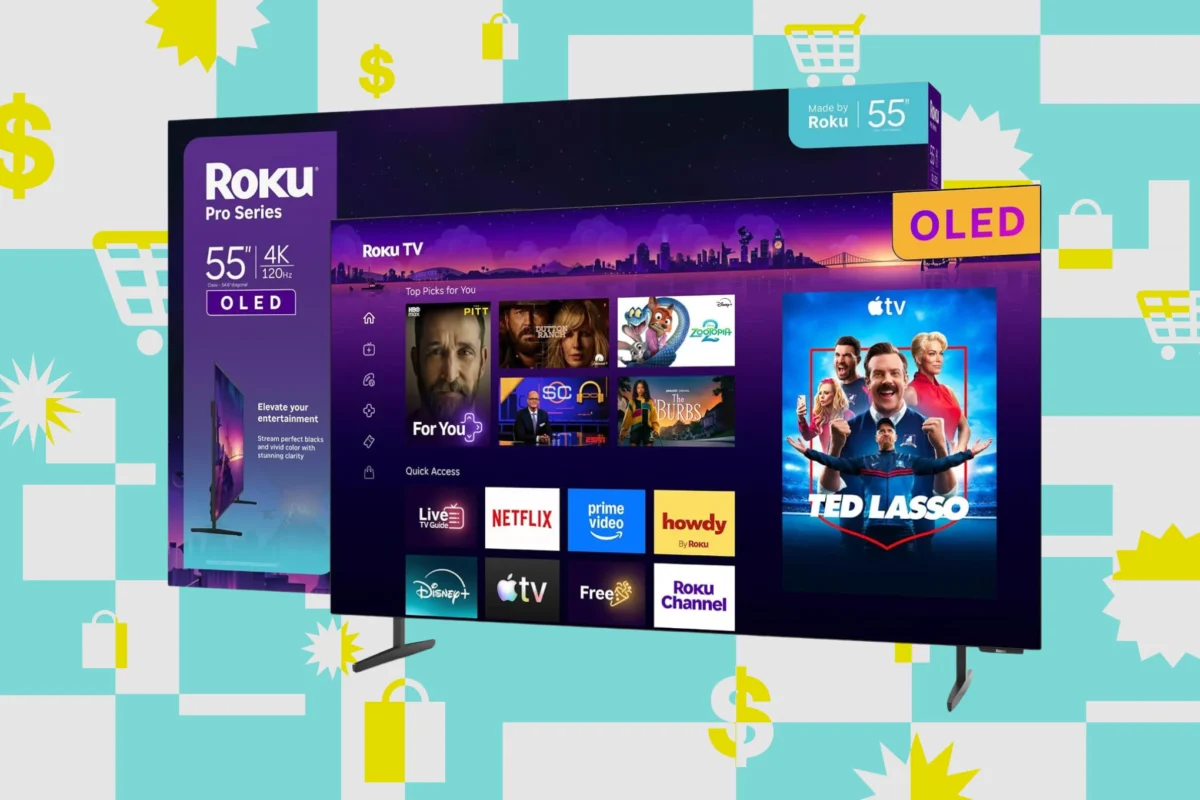
Roku, a household name historically synonymous with affordable, user-friendly streaming sticks and smart-platform licensing, has officially disrupted the television hardware landscape. The company has launched its very first line of OLED TVs—the Pro Series OLED—marking a monumental strategic shift into the premium display market.
Historically, OLED (Organic Light-Emitting Diode) technology has commanded a hefty premium due to its unmatched contrast ratios, true blacks, and pixel-level dimming control. Roku, however, is rewriting the rules of accessibility. The flagship lineup launched with an aggressively priced 55-inch model starting at $999, followed by a 65-inch variant at $1,299.
Yet, in a surprise move that has sent shockwaves through the consumer electronics space, Amazon has rolled out launch-window discount codes that make these panels astonishingly inexpensive.
- By applying the checkout code ROKUOLED300, buyers can slash $300 off the 55-inch model, driving its price down to an unprecedented $699.
- For those seeking a larger canvas, the code ROKUOLED400 knocks $400 off the 65-inch model, bringing its cost down to $799.
These steep introductory price cuts instantly position Roku’s Pro Series OLED TVs as the most affordable modern OLED displays on the market. Beyond the panels themselves, the TVs feature built-in Roku OS, a 120Hz refresh rate, four HDMI 2.1 ports, support for Dolby Vision and HDR10+, and specialized gaming enhancements like AMD FreeSync Premium and Auto Low Latency Mode (ALLM).
Chronology
To understand how Roku arrived at its first-ever OLED release—and why these sudden discounts are making waves—it helps to trace the timeline of the company’s hardware ambitions and the broader television market:
- Early 2020s (The Streaming Era): Roku establishes dominance primarily through third-party smart TV partnerships (such as TCL and Hisense) alongside its own line of budget-friendly Roku TVs. While functional, these models lean heavily on QLED and standard LED-backlit LCD panels to keep costs low.
- Mid-2023 to 2024 (Pushing Upmarket): Roku introduces its higher-end "Pro Series" branding, aiming to capture consumers looking for sleeker designs, better audio integration, and improved picture performance without stepping into ultra-luxury pricing.
- Early 2025 (The OLED Rumor Mill): Industry insiders and tech analysts begin reporting that Roku is developing proprietary OLED hardware to challenge mid-tier dominators from LG, Samsung, and Sony.
- September 2026 (The Official Launch): Roku officially unveils its first-ever OLED TVs under the Pro Series banner. The initial MSRPs of $999 (55-inch) and $1,299 (65-inch) are widely praised as competitive.
- Immediate Post-Launch (The Amazon Discount Window): Almost concurrently with the retail rollout, aggressive promotional codes (ROKUOLED300 and ROKUOLED400) surface on Amazon, triggering an unexpected price war and dropping the barrier to entry below the $700 mark for a current-gen OLED.
- Looking Ahead to October 2026: Roku prepares to launch an even higher-tier variant, the Pro Series LX, starting at $1,299, targeting high-end enthusiasts with a 144Hz refresh rate, anti-reflection polarizer, and doubled peak brightness.
Supporting Data & Technical Specifications
When evaluating the Roku Pro Series OLED, the spec sheet reveals that these units are not merely budget compromises; they are fully loaded modern displays equipped with the connectivity and performance features expected by modern cinephiles and next-generation gamers.
Display & Core Performance
- Panel Type: Organic Light-Emitting Diode (OLED), offering infinite contrast and pixel-level illumination.
- Sizes Available: 55-inch and 65-inch configurations at launch.
- Refresh Rate: 120Hz native refresh rate, ensuring buttery-smooth motion handling for sports and action films.
- HDR Support: Comprehensive compatibility with advanced high dynamic range formats, including Dolby Vision and HDR10+.
Connectivity & Gaming Features
- HDMI 2.1 Ports: The inclusion of four full-bandwidth HDMI 2.1 ports allows users to connect multiple current-generation consoles (PlayStation 5, Xbox Series X) and high-end PCs simultaneously without sacrificing bandwidth.
- Variable Refresh Rate (VRR): Complete with AMD FreeSync Premium certification to eliminate screen tearing and stuttering during high-frame-rate gaming sessions.
- Auto Low Latency Mode (ALLM): Automatically switches the display into a low-latency gaming preset the moment a game is launched.
Ecosystem & Accessories
- Integrated Software: Roku OS comes built natively into the hardware, providing instant access to thousands of streaming channels, live TV options, and smart home integrations without requiring an external streaming stick to occupy an HDMI slot.
- Upgraded Remote: Ships with a backlit Roku voice remote, solving a frequent user complaint about navigating streaming interfaces in dark home theater environments.
Official Responses & Industry Reactions
While independent tech reviewers and major consumer publications have not yet published formal hands-on benchmark testing for these exact panels, the industry response has been overwhelmingly focused on pricing disruption.

Industry analysts note that traditional OLED heavyweights—such as LG (with its acclaimed C-series) and Sony—have historically guarded the sub-$1,000 threshold fiercely, rarely discounting their newest generation 55-inch OLEDs below $800 until deep into their product lifecycle. Roku’s launch-window pricing of $699 for a 55-inch OLED shatters historical pricing floors.
A Roku spokesperson emphasized the company’s core mission during the product reveal: "We believe that premium picture quality shouldn’t be gated behind exorbitant luxury price tags. By leveraging our deep software integration and manufacturing scale, we are opening the door for millions of households to experience true blacks and vibrant OLED contrast for the first time."
Competitors have yet to issue formal statements regarding Roku’s pricing strategy, but retail analysts anticipate aggressive counter-promotions from brands like Vizio, Hisense, and TCL as they vie for budget-conscious home theater enthusiasts heading into the holiday shopping season.
Implications for Consumers and the Market
The arrival of Roku’s Pro Series OLED—and particularly the aggressive promotional codes currently slashing up to $400 off retail prices—carries several broader implications for the consumer electronics ecosystem:
1. The Democratization of OLED Technology
For years, budget-conscious shoppers looking for a new TV had to choose between the deep blacks of OLED and the lower price tags of LED/QLED. By driving a 55-inch modern OLED down to $699, Roku is effectively pushing OLED technology out of the "luxury enthusiast" category and into the mainstream consumer bracket. This move is expected to force legacy display manufacturers to rethink their entry-level pricing models.
2. Software-First Hardware Integration
Because Roku OS is baked directly into the television, buyers bypass the friction of third-party dongles, clunky proprietary operating systems, or slow smart-TV interfaces. Roku’s massive installed user base will find the learning curve virtually nonexistent, making this an attractive upgrade path for households already entrenched in the Roku ecosystem.
3. A Glimpse at the Upcoming Pro Series LX
While the current discounts make the standard Pro Series an incredible bargain, tech enthusiasts are already keeping one eye on the horizon. Roku’s upcoming Pro Series LX, slated for an October release starting at $1,299, promises a 144Hz refresh rate, a reflection-reducing polarizer, and double the peak brightness of the standard Pro Series. The aggressive pricing on the current baseline models may be a calculated strategy to build brand momentum and consumer trust before rolling out these higher-end, enthusiast-targeted variations.
Summary Recommendation for Buyers
If you are in the market for a high-performance display and refuse to compromise on picture quality, the current Amazon promotions using codes ROKUOLED300 (for the 55-inch at $699) and ROKUOLED400 (for the 65-inch at $799) represent an extraordinary value proposition. While independent lab reviews are still forthcoming, the combination of HDMI 2.1 connectivity, 120Hz gaming features, Dolby Vision, and rock-bottom OLED pricing makes this one of the most compelling tech deals of the year.
 Nana Muazin
 Raul Delapena Setiawan
 Pevita Pearce
