
 By Siti Muinah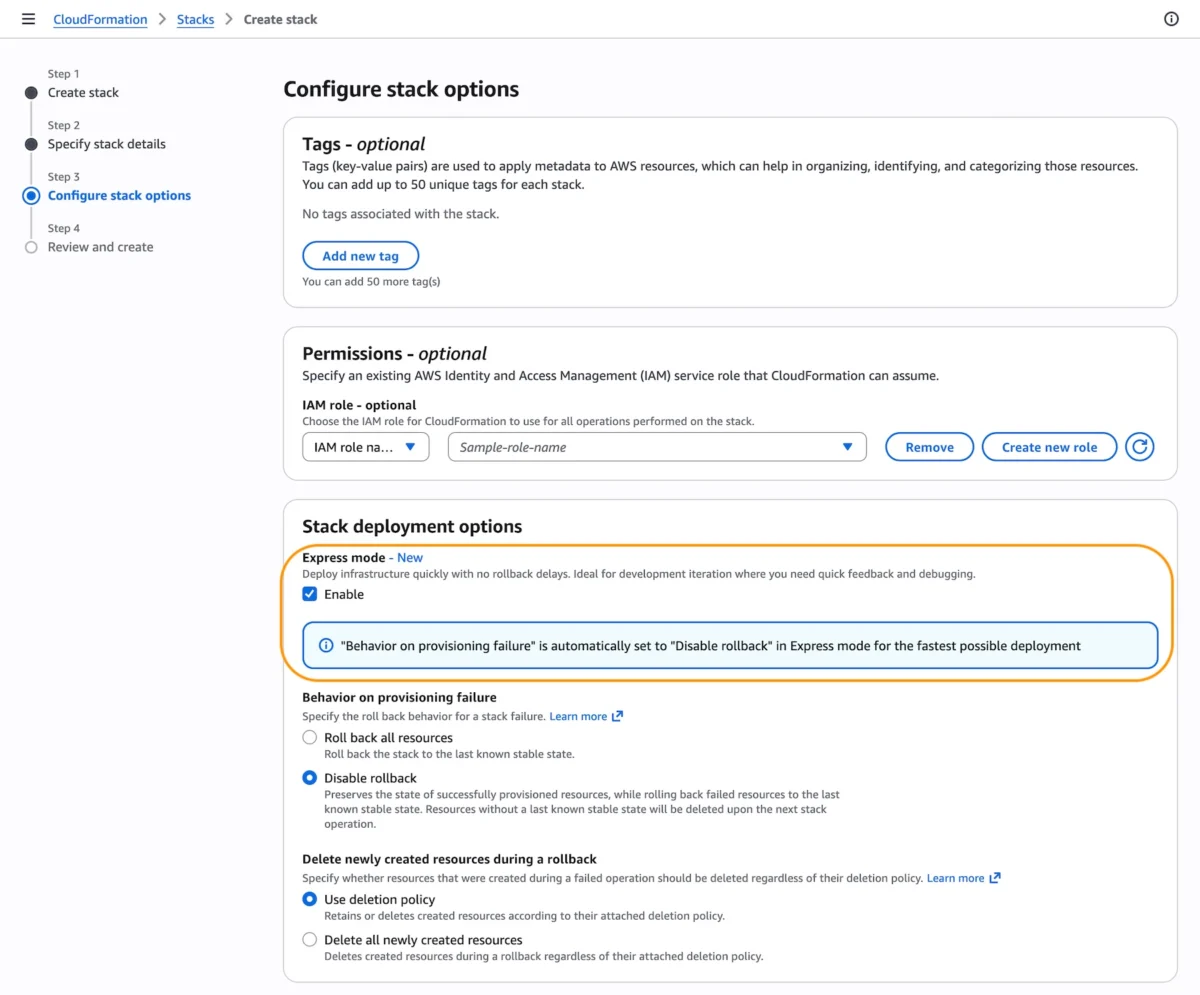
In an era where the velocity of software delivery is the primary currency of competitive advantage, Amazon Web Services (AWS) has unveiled a significant enhancement to its infrastructure-as-code (IaC) suite. Today, AWS officially announced the launch of CloudFormation Express mode, a transformative deployment capability designed to slash the time developers spend waiting for infrastructure provisioning. By decoupling resource configuration from the traditionally time-consuming "stabilization checks," this new mode promises to accelerate deployment cycles by up to four times, offering a massive productivity boost for engineers and AI-assisted development workflows.
The Core Innovation: Redefining Deployment Completion
For over a decade, AWS CloudFormation has been the bedrock of automated infrastructure provisioning on the cloud. A standard CloudFormation deployment is a methodical, cautious process: it provisions resources and then performs a "stabilization check" to ensure that every individual component—from load balancers to database instances—is fully operational, reachable, and ready to serve traffic before marking the stack as "CREATE_COMPLETE."
While this mechanism is invaluable for production environments where system integrity is paramount, it creates a bottleneck during the iterative development cycle. Developers testing minor configuration changes or AI-driven agents spinning up experimental environments often find themselves waiting minutes for the stabilization of complex stacks.
Express mode changes the fundamental contract of a deployment. Instead of waiting for a resource to reach a "steady state," CloudFormation now considers the deployment successful the moment the resource configuration request is accepted and applied. The actual stabilization process continues in the background, out of the critical path of the developer’s workflow. This is not a change to how resources are provisioned, but rather a change to when the service reports success.
Chronology and Context: The Evolution of Cloud Infrastructure
The journey to Express mode is the result of years of feedback from the AWS developer community.
- The Early Days (2011–2015): CloudFormation introduced a declarative way to define infrastructure. The primary goal was consistency and reliability, leading to the "safe-by-default" stabilization model.
- The Rise of IaC Tools (2016–2020): As developers began using the AWS Cloud Development Kit (CDK) and Terraform, the demand for faster feedback loops intensified. The industry moved toward rapid, incremental updates.
- The Generative AI Pivot (2023–2025): With the surge of AI-assisted coding tools like Amazon Q and Kiro, infrastructure development became significantly faster. However, the legacy deployment speeds of CloudFormation became a limiting factor for these agents, which often perform dozens of small, iterative updates in a single hour.
- The Launch (2026): Recognizing that "waiting for the cloud" was the new "waiting for the code to compile," AWS engineers developed Express mode to align the speed of infrastructure provisioning with the speed of modern AI-driven development.
Supporting Data: Quantifying the Efficiency Gain
The efficiency gains of Express mode are not merely incremental; they are structural. AWS internal benchmarking has highlighted significant performance improvements across common infrastructure tasks.
Case Study 1: The SQS Queue Configuration
Creating an Amazon Simple Queue Service (SQS) queue paired with a Dead Letter Queue (DLQ) is a standard architectural pattern. In standard mode, the system requires a series of handshakes to verify the queues are fully linked and ready, a process that takes approximately 64 seconds. With Express mode, the deployment command completes in roughly 10 seconds.
Case Study 2: Lambda Function Cleanup
The removal of AWS Lambda functions that have network interface (ENI) attachments has historically been a slow process, often taking between 20 and 30 minutes due to the complexity of detaching and deleting the underlying network infrastructure. Benchmarks indicate that Express mode reduces this wait time to just 10 seconds.
These metrics illustrate the "waiting tax" that developers have been paying—a tax that has now been effectively abolished for non-critical, iterative workflows.
Official Perspective: The Philosophy of "Fail Fast"
According to Channy Yun, Principal Developer Advocate at AWS, the motivation behind Express mode is rooted in the philosophy of developer velocity.
"Every CloudFormation deployment performs stabilization checks," Yun noted in the official release. "These checks serve an important purpose when you need to confirm resources can serve traffic. However, many workflows—specifically iterative development and testing—do not require full stabilization to proceed. We wanted to give developers the choice to opt for speed when the context allows for it."
AWS has also addressed the inherent risks of this speed. Because Express mode is designed for rapid iteration, it disables automatic rollbacks by default. This is a deliberate choice: if an engineer is tweaking a configuration ten times an hour, they do not want the system to trigger a lengthy rollback process for a transient error. For those who still require safety, AWS provides a toggle to re-enable rollback mechanisms, ensuring that the feature remains as flexible as the diverse needs of its user base.
Strategic Implications: What This Means for Developers
The introduction of Express mode has profound implications for how teams architect and maintain their cloud environments.
1. Accelerated AI-Assisted Development
The most immediate impact will be felt by those using AI agents. AI tools operate on feedback loops; the faster the agent gets a "success" signal, the faster it can move to the next iteration of the architecture. Express mode effectively allows AI to "work at the speed of thought," unblocking the feedback loop that previously kept the model waiting for infrastructure to stabilize.
2. Shift-Left Infrastructure
With the barrier to entry for testing lowered, teams are more likely to implement "Infrastructure-as-Code" testing earlier in the development lifecycle. Developers can now run full stack deployments as part of their local testing suites without incurring the time penalty that previously discouraged frequent, small-scale deployments.
3. The New Resilience Model
While Express mode ignores the stabilization check, it does not ignore errors. CloudFormation includes built-in, automated retries for transient failures. If a resource fails to provision due to a temporary hiccup, the system attempts to reconcile the state automatically. This ensures that even in "fast mode," the stack eventually reaches the desired state without requiring manual intervention from the developer.

4. Integration with the Ecosystem
AWS has ensured that Express mode is not a siloed feature. It is fully integrated into the AWS CLI, SDKs, and the Cloud Development Kit (CDK). For CDK users, the transition is seamless: a simple --express flag on the cdk deploy command is all that is required. This low-friction implementation ensures that organizations can adopt the feature without massive refactoring of their existing CI/CD pipelines.
Best Practices and Recommendations
While Express mode is a powerful tool, it requires a change in mindset. AWS recommends its use primarily for:
- Iterative Infrastructure Development: Building or modifying resources in a development/sandbox account.
- Testing Individual Components: Validating that a specific resource change (e.g., updating an IAM policy or changing a queue setting) works without waiting for the entire application to be ready.
- AI-Driven Workflows: Allowing automated tools to provision infrastructure as part of a rapid development loop.
For production environments, AWS advises caution. While Express mode can technically be used in production, developers must understand that the "success" message from CloudFormation does not guarantee that the resource is fully operational at that exact millisecond. If an application requires a 100% guarantee that a database is ready before a web server connects to it, the standard, slower deployment mode remains the gold standard.
Future Outlook
The availability of CloudFormation Express mode across all AWS commercial regions signifies a major shift in how the cloud provider views the relationship between control and velocity. As the cloud continues to become more complex, the ability to manage that complexity through faster, more responsive tools is no longer a luxury—it is a requirement.
As organizations look toward the future, the integration of features like Express mode into the wider AWS ecosystem, including potential future support in AWS Control Tower or service-specific deployments, will likely redefine the standard for infrastructure management. Developers are encouraged to visit the official AWS CloudFormation Documentation to begin exploring the feature and to contribute their feedback through the AWS re:Post community.
In the high-stakes world of cloud computing, every second counts. With the launch of Express mode, AWS has effectively bought back thousands of hours for developers globally, ensuring that the cloud remains a space for innovation, not waiting.
 Neng Nana
  Suro Senen
  Lina Hope