
 By Evan Lee Salim
By Smashing Editorial
Published in Tech, Design & UX Insights
Main Facts
The contemporary technology landscape is dominated by a singular, persistent corporate assumption: that every human being on the planet is actively waiting for more artificial intelligence injected into every conceivable nook and cranny of their daily existence. From enterprise software suites and consumer refrigerators to banking apps and children’s literature, organizations operate on the belief that slapping a “Powered by AI” label onto a product automatically constitutes a compelling value proposition.
However, emerging industry data, workplace analytics, and user experience (UX) studies reveal a starkly contradictory reality. People do not want more AI—at least not in the uninvited, disruptive, and hyperbolic way corporate leadership envisions it. Rather than inspiring unbridled consumer delight, artificial intelligence features frequently suffer from abysmally low adoption and retention rates. They come at an extraordinarily high cost of delivery, introduce significant reputational risks, and, most importantly, often exacerbate the very workplace inefficiencies they were ostensibly deployed to solve.
Instead of treating AI as a universal panacea or a standalone product category, real-world data demonstrates that users prefer tools that remain subtle, dependable, and deeply integrated into existing workflows. The ultimate promise of automation should not be the wholesale replacement of human creativity, but the silent, ambient elimination of tedious, mentally exhausting labor.
Chronology
To understand how the tech industry arrived at the current apex of AI fatigue, it is helpful to trace the trajectory of recent technological adoption:
- The Generative AI Gold Rush (2022–2023): Following the public democratization of large language models, tech giants and startups alike rushed to market with standalone chat interfaces, prompt-driven assistants, and "AI-first" products. Speed of delivery became the primary metric of success for software developers across industries.
- The Integration Backlash (2024–2025): As corporations forced these standalone tools onto employees and consumers, early friction emerged. Users quickly realized that jumping between fragmented legacy systems and new, unpredictable AI chat boxes created more friction than it removed. Studies tracking workplace productivity began to show counter-intuitive spikes in administrative overhead.
- The "AI-Second" Awakening (2026 and Beyond): Industry analysts, UX designers, and workplace psychologists began documenting widespread resistance to change. A growing consensus emerged that AI must pivot from being a loud, intrusive focal point to a humble, background utility—giving rise to the philosophy of "AI-second" interface design.
Supporting Data: The Hidden Costs of Forced Automation
Corporate leadership often frames AI deployment through the lens of pure acceleration. Yet, recent comprehensive workplace productivity studies paint a much more nuanced, and often alarming, picture of how AI impacts daily professional life.
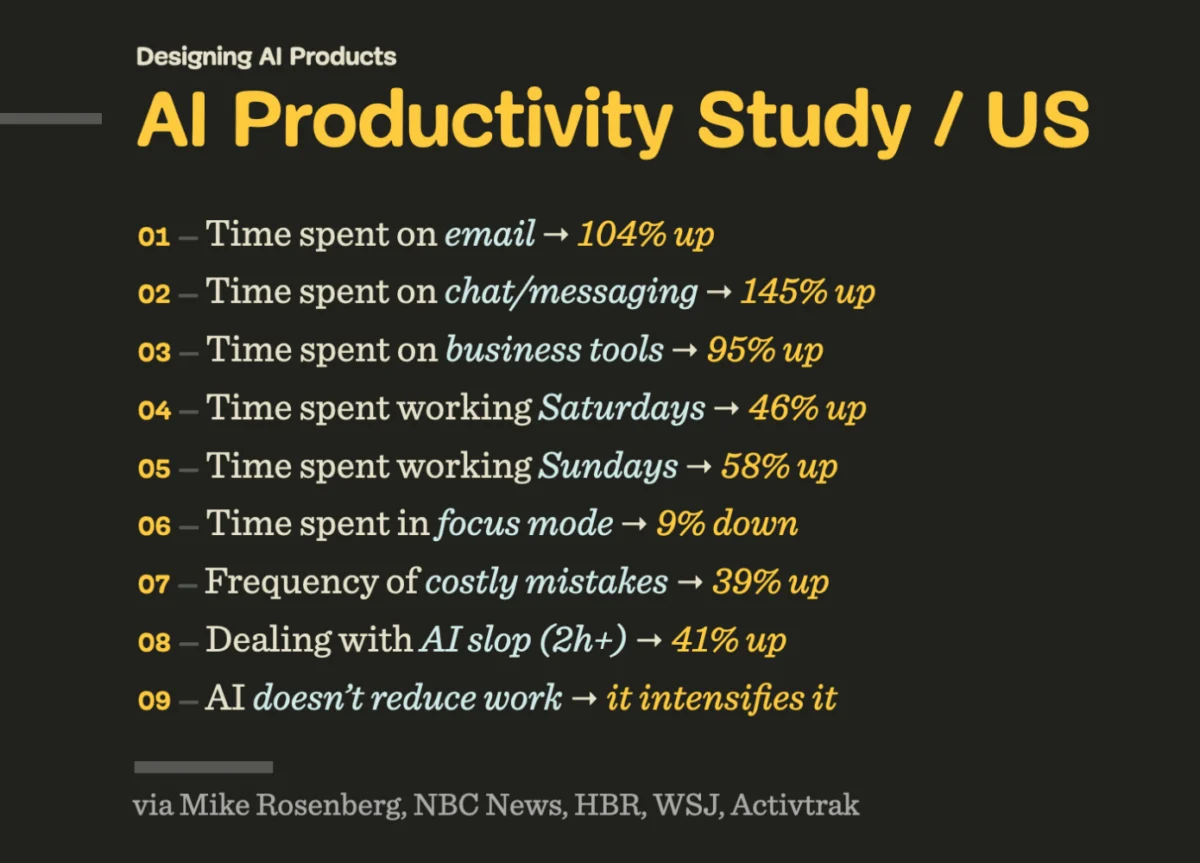
Data compiled from multiple labor and productivity trackers—including insights highlighted by NBC News, Harvard Business Review, and the Wall Street Journal—reveals that injecting unrefined AI tools into existing workflows can actually intensify work rather than reduce it:
- Surge in Communication Overhead: Time spent managing emails has climbed by 104%, while chat and messaging tool usage has surged by 145%.
- The Weekend Creep: Business tool utilization has jumped by 95%, bleeding into personal time with professionals reporting a 46% increase in Saturday work and a 58% increase on Sundays.
- Erosion of Focus: Deep-focus mode has dropped by 9%, replaced by constant micro-management of notifications and half-baked tool outputs.
- The Cost of "AI Slop": Dealership with low-quality, AI-generated content has spiked by 41%, while costly human errors resulting from unverified AI hallucinations have risen by 39%.
Furthermore, vulnerabilities mapped out by organizations like GovAI and the Brookings Institution (as highlighted by The Washington Post) demonstrate that while jobs exposed to AI automation span broad sectors—from software developers to public relations specialists—the human element of taste, intuition, and emotional intelligence remains irreplaceable. When automation attempts to bypass this human core rather than support it, productivity plummets.

Official Responses and Expert Perspectives
As the gap between corporate ambition and user preference widens, thought leaders across technology, UX design, and organizational psychology are pushing back against the prevailing narrative.
Vitaly Friedman, renowned UX designer and creator of specialized educational resources like Design Patterns For AI Interfaces, argues that organizations fundamentally misunderstand how software evaluation works.
"People don’t compare software with other people," Friedman notes. "They compare features with features—and if one feature in one product is unreliable, while a similar feature works flawlessly in another, they choose the latter. It’s not about AI or not AI, but rather what works consistently and reliably, and what doesn’t."
This sentiment is echoed by corporate strategist and executive Bo Young Lee, whose widely shared perspective encapsulates the growing cultural pushback against misplaced automation:

"I don’t want to read books written by AI. I don’t want to gaze upon paintings by AI. I don’t want AI to teach my children. I don’t want to have an AI therapist. I don’t want AI making my medical decisions. I want AI to do all the physical and mental labor that taxes me so I can read books written by humans and go to art galleries to engage with art made by humans. I want AI that makes my life easier rather than forces me to change myself."
These responses highlight a crucial disconnect: while tech executives view AI as a disruptive value proposition that redefines markets, end-users view it as utility software that must justify its presence through absolute reliability.
Implications for the Future of Work and Design
The widespread friction surrounding current artificial intelligence implementations carries profound implications for software architects, product designers, and enterprise leaders alike.
1. AI is Not a Value Proposition
As highlighted in business model frameworks by innovation experts like David Bland, AI belongs strictly in the realm of Key Activities and Key Resources, never in the Value Proposition itself. Customers do not buy a product because it contains neural networks; they buy it because it solves a specific problem reliably. Shifting AI from a front-and-center gimmick to a backend operational engine is essential for long-term retention.

2. Amplifying Organizational Dysfunction
AI acts as an organizational mirror. It cannot magically fix years of technical debt, poor data governance, broken corporate culture, or conflicting internal politics. Instead, it amplifies these shortcomings, handing inconsistencies directly to users and forcing them to navigate corporate disorganization on top of managing unpredictable software outputs.
3. The Rise of "AI-Second" Design
The future belongs not to "AI-first" applications that demand constant conversation and prompt engineering, but to "AI-second" architectures. These are subtle, ambient, and calm interfaces that take a supportive role in the background. They automate dull, repetitive tasks—such as data entry, formatting, and logistical scheduling—without disrupting human workflows or requiring users to completely alter how they think and make decisions.
Conclusion
Ultimately, people do not harbor an inherent animosity toward technology. They simply cherish their time, their mental energy, and authentic human connection. If the technology sector pivots away from shoving uninvited chat bots into every aspect of life and focuses instead on eradicating genuinely tedious labor, artificial intelligence can finally fulfill its true promise: making human life simpler, quieter, and vastly more enjoyable.
 Iffa Jayyana
 Azzam Bilal Chamdy
 Nila Kartika Wati
