
 By rifanmuazin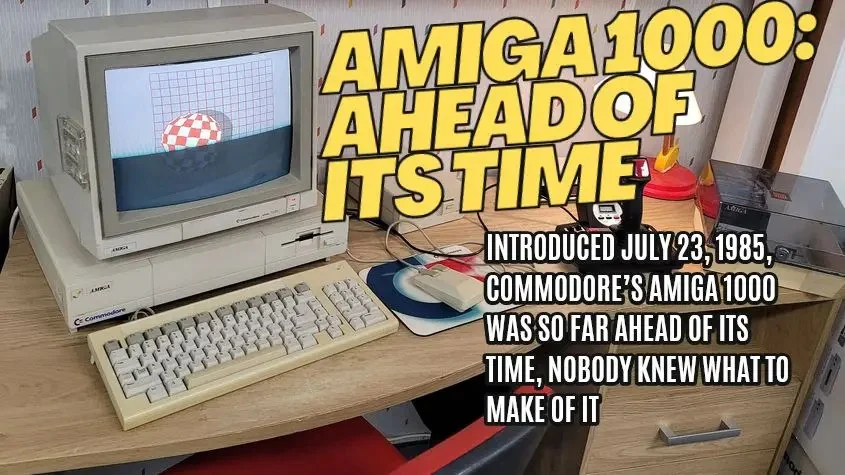
On July 23, 1985, the technology landscape shifted in a way most observers didn’t fully grasp at the time. At the Vivian Beaumont Theater in New York City, Commodore officially introduced the Amiga 1000. It was a machine that defied the rigid categorization of the era. As Dave Haynie, a legendary engineer who would later become synonymous with the platform’s development, famously remarked: “There was no such thing as a 1980s computer. There were 1970s computers and 1990s computers.” The Amiga was the bridge, the technological catalyst that essentially dragged the entire personal computing industry kicking and screaming into the next decade.
A Technical Marvel: The Architecture of Tomorrow
To look at the specifications of the Amiga 1000 today is to witness a masterclass in efficient engineering. At its heart sat the Motorola 68000 CPU, clocked at a modest 7.14 MHz. To the uninitiated, those numbers suggest a machine of limited capability, yet the Amiga was anything but. Its secret weapon was a sophisticated custom chipset designed to offload the heavy lifting of graphics and sound from the CPU.
While the competition struggled with monochromatic text or primitive blocky graphics, the Amiga offered a palette of up to 4,096 colors. It featured native stereo sound and, most revolutionary of all, a fully preemptive multitasking operating system. While other machines of the mid-80s could barely handle one task without freezing, the Amiga could manage multiple processes simultaneously. It could boot and run from a single floppy drive with a mere 256 KB of RAM, an feat of software efficiency that remains impressive nearly four decades later. By the time it hit the shelves in late 1985, it was already a polished, shipping product—a rarity for the era.
Chronology: From Concept to Commercial Arrival
The genesis of the Amiga is a story of rapid iteration and visionary ambition. The project began long before the 1985 launch, with a high-profile demonstration at the Consumer Electronics Show (CES) in January 1984. At that time, the hardware existed only as prototype circuit boards, yet the potential was undeniable.
- January 1984: The Amiga prototype is unveiled at CES, shocking attendees with its graphical capabilities and sound.
- April 1985: Atari releases the ST series, providing the first real competitive threat to the Amiga’s graphical interface aspirations.
- July 23, 1985: The official launch of the Amiga 1000 in New York City.
- 1986–1989: The platform begins to gain traction in creative circles, notably through high-profile collaborations with figures like Andy Warhol, who used the machine to demonstrate the marriage of fine art and digital processing.
- 1991: The machine continues to feel “futuristic” to power users, allowing for complex tasks like background BBS downloads while running productivity software or games.
- 1994: The decline accelerates as Commodore faces insurmountable financial mismanagement.
- 1994–1995: The broader PC market finally begins to standardize on the multitasking capabilities that the Amiga had pioneered a decade prior.
Supporting Data: The High Cost of Innovation
Living in the future was, by all accounts, an expensive endeavor. The base configuration of the Amiga 1000 launched at $1,295. However, this was a "barebones" price; it excluded a monitor, which was essential for a system built around color graphics. A quality color monitor added $300 to the bill, and savvy users quickly realized that the 256 KB of base RAM was insufficient for serious work. Upgrading to 512 KB or a full megabyte, along with a second floppy drive, pushed the total investment toward the $2,000 mark.

Despite the high price tag, it was arguably a bargain. The Apple Macintosh, which lacked color, multitasking, and stereo sound, was retailing for $2,495 at the time. The Amiga offered significantly more performance per dollar, yet it lacked the marketing machine that Apple leveraged to capture the public consciousness.
The Multitasking Secret: Preemption vs. Cooperation
In the summer of 1985, the Graphical User Interface (GUI) was already established, thanks to the Apple Lisa and the Macintosh. However, the Amiga’s superiority lay in its kernel. While Windows 3.0 and 3.1 relied on "cooperative multitasking"—a fragile system where one poorly written application could freeze the entire machine—the Amiga utilized preemptive multitasking.
This meant the operating system sat in control, distributing CPU cycles to various programs regardless of their status. It was the same architecture that would later define Windows 95 and Windows NT. The Amiga’s OS, which drew its lineage from the TRIPOS system developed at Cambridge University, was designed for professional stability, not just aesthetic appeal. While it lacked memory protection—a trade-off made to keep costs down—it remained a generation ahead of its peers for years.
Official Responses and Corporate Mismanagement
The tragedy of the Amiga is not found in the machine itself, but in the boardroom of its parent company, Commodore. While engineers were busy pushing the boundaries of what was possible, Commodore’s leadership was characterized by a lack of vision. Unlike Apple’s Steve Jobs, who excelled at selling a "philosophy" of computing, or the aggressive marketing of Microsoft, Commodore’s leadership was largely defined by Irving Gould.
Gould, an oligarch who gained control after the departure of founder Jack Tramiel, viewed the company as an asset to be liquidated rather than a brand to be nurtured. Commodore lacked a coherent marketing strategy. They spent little on advertising, failing to communicate why the Amiga was fundamentally better than the competition. The most effective "marketing" occurred when a potential buyer sat down and experienced the machine for an hour. Once a user saw the power of a preemptive multitasking system, the sale was almost guaranteed. Unfortunately, the company failed to scale this experience to a mass audience.

The Long-Term Implications: A Decade of "Kicked Teeth"
For those who owned an Amiga, the period between 1985 and 1995 was a frustrating experience of "living in the future" while the rest of the world caught up. When Commodore finally declared bankruptcy in 1994—less than nine years after the Amiga’s debut—the community felt betrayed. The subsequent purchase of the company by Escom, which itself failed within 15 months, was the final insult.
Users were eventually forced to transition to the Wintel (Windows/Intel) ecosystem or the Macintosh. For a veteran Amiga user, moving to a PC in 1994 felt like a step backward. The instability of early Windows, combined with the loss of the Amiga’s intuitive multitasking, made the transition painful. It took until 1995 for the PC market to finally achieve the level of reliability and functionality that Amiga users had taken for granted since the mid-80s.
Conclusion: A Legacy of Excellence
The Amiga 1000 remains a profound example of what happens when engineering excellence is divorced from effective corporate stewardship. Commodore sold roughly 4.91 million Amigas over the life of the platform, a figure that is significant but ultimately insufficient to sustain the company against the massive, well-funded marketing juggernauts of its rivals.
For the engineers, the Amiga was a triumph of the possible—a machine that utilized every cycle and every bit of memory to its absolute maximum. For the users, it was a glimpse into a digital future that was snatched away far too soon. Today, as we look back on the history of computing, the Amiga stands not as a failure, but as a monumental success that simply happened to arrive at a time when the world wasn’t quite ready to appreciate the scale of its innovation. The Amiga did not just compute; it changed the definition of what a computer could be, leaving a permanent mark on the history of technology.
 Layla Zulfa
  Evan Lee Salim