
 By Lina Irawan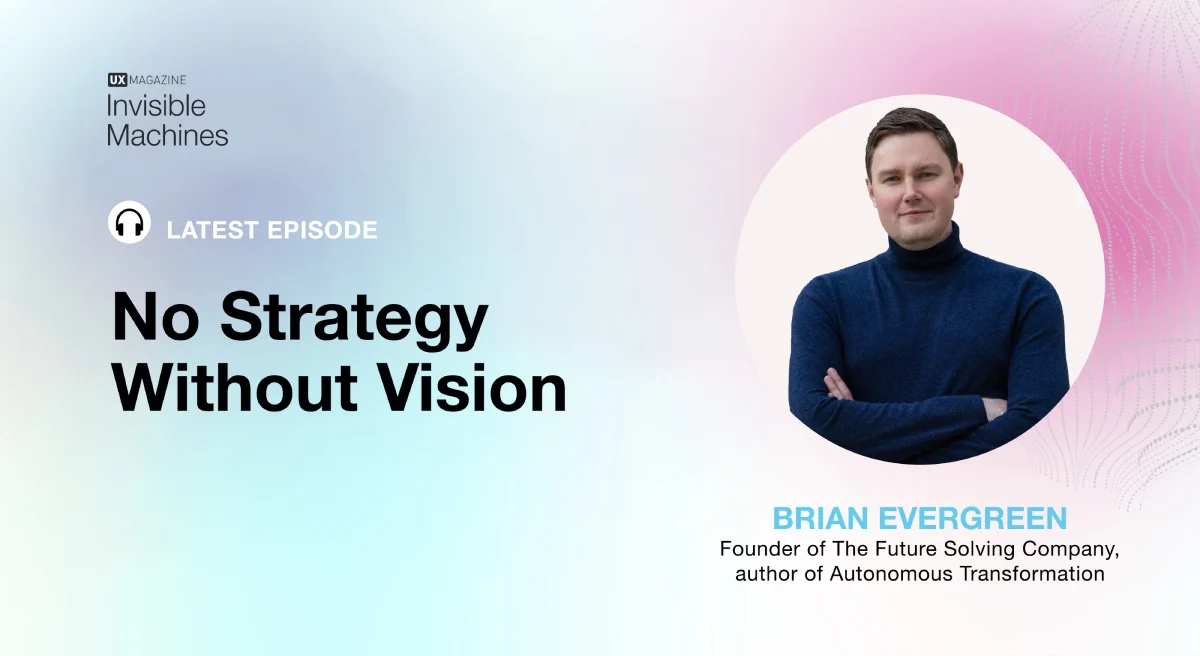
In the modern corporate boardroom, the phrase "we need an AI strategy" has become the equivalent of a distress signal. It is often a frantic, two-step maneuver: first, executives scramble to acquire enough technical literacy to sound credible in a slide deck; second, they rush to curate a list of use cases and a shortlist of vendors.
However, according to Brian Evergreen, founder of The Future Solving Company and author of Autonomous Transformation, this process is fundamentally flawed. In a recent appearance on the Invisible Machines podcast, Evergreen argued that the modern Request for Proposal (RFP) process is a relic of a bygone era, designed to procure commodities in a world where software is no longer a static product, but an evolving, agentic force.
The Mirage of the Vendor Bake-Off
The primary failing of current AI adoption strategies lies in the obsession with "literacy" as a prerequisite for "sprinting." While Evergreen acknowledges the importance of understanding the technical differences between generative AI, classical machine learning, and agentic systems—likening it to a painter needing to understand pigments—he warns that this knowledge is being weaponized as a justification for speed without direction.
The RFP Fallacy
Organizations have spent decades perfecting the art of procurement: RFPs, analyst quadrants, feature matrices, and oral defenses. This machinery works exceptionally well when the goal is to purchase a SKU—a defined product with known parameters. However, agentic AI is not a SKU; it is a capability that is still being defined.
Evergreen argues that the traditional procurement cycle is inherently incompatible with the pace of AI evolution. "Common features across vendors are not interchangeable capabilities," he notes. "With AI, the missing capability might ship as a side effect of a model update before your procurement cycle even ends." By treating innovation as a "science fair" where the winning vendor is the one who checks the most boxes, companies are essentially building plans that are "busy, intelligent, and hollow at the center."
Chronology of a Misguided Strategy
The trajectory of a typical corporate AI failure often follows a predictable path:
- The Literacy Phase: Leadership mandates a crash course in AI terminology. The focus is on jargon mastery rather than systemic transformation.
- The Use-Case Scramble: Departments are polled for "low-hanging fruit." The goal is to prove ROI as quickly as possible, often by automating trivial, siloed tasks.
- The Procurement Trap: An RFP is issued. A vendor is selected based on a static feature matrix.
- The Pilot Plateau: A pilot is launched. It may succeed on its own merits, but it fails to integrate into the larger organizational architecture.
- The Stagnation: The project is labeled a "success" (in terms of adoption) but fails to shift the company’s competitive posture, leading to "wide usage of the wrong future."
Evergreen and his co-host, OneReach.ai CEO Robb Wilson, describe this as an anti-pattern. It is the pursuit of motion without architecture, an exercise in "problem solving" rather than "future solving."
The Case for "Future Solving"
The distinction between problem solving and future solving is the conceptual spine of Evergreen’s thesis. Problem solving is an exercise in elimination: it trims waste and optimizes existing value. It is inherently backward-looking. Future solving, conversely, begins with appetite. It asks: What do you want to exist that does not exist yet, and what would have to become true for that to happen?
The "Duomo" Metaphor
Evergreen uses a vivid, if provocative, analogy: if you train everyone in a city to swing hammers, you might produce sturdier houses, but you will not stumble into the Duomo. Mass literacy in AI, combined with a relentless hunt for tactical use cases, produces a flurry of activity that leaves the fundamental architecture of the organization unchanged.
Supporting this is the necessity of a "governed knowledge layer." Citing Morgan Stanley’s early work in AI, Josh Tyson emphasizes that a company cannot simply dump PDFs into a model and hope for insight. Success requires a system of ownership, freshness, and accountability. Without this "truth layer," the AI acts on stale or incorrect information, leading to hallucinations that are amplified by the scale of agentic systems.
Lessons from History: Blockbuster vs. Bell Labs
The history of corporate transformation serves as a stark warning. The failure of Blockbuster to pivot to streaming is often simplified as a lack of vision, but the reality was structural. Their "customer-of-record" was the franchisee, not the renter. A streaming initiative appeared to cannibalize the very people the balance sheet depended upon.
Evergreen argues that technology was never the missing piece for Blockbuster; alignment was. Without a future-solved model that accounted for the entire ecosystem, the technology was viewed as a threat rather than an opportunity.
Conversely, the 1952 Bell Labs strategy offers a blueprint for breakthrough. Faced with the obsolescence of their own inventions, leadership forced an exercise in total reconstruction: they assumed the existing telephone network was destroyed and demanded a rebuild based on contemporary science and economics. The goal was to convene a breakthrough cadence that could not be achieved by incremental improvements.
The Emotional Work of Proof
A core takeaway from the Invisible Machines discussion is that a vision must be visceral. Executives often default to scoreboard metrics like "increased profitability," but those are outcomes, not visions.
A successful vision is something that can be pictured in a room. It is the advisor answering in real-time, the clinician staying present with a patient, or the partner who trusts the system so implicitly that they no longer rely on shadow IT. If employees cannot "feel" the outcome of the transformation, they will abandon the change as soon as the pilot period concludes.
This is the "emotional work of proof." It requires leadership to step away from the spreadsheets and define a future that is legible to the people who will actually inhabit it.
Strategic Implications: The Death of the Roadmap
If your organization is not defining the future, a platform company will do it for you.
Friction as a Symptom
Evergreen warns that "friction is infinite without a direction." Organizations often spend enormous energy mapping friction in their current workflows. However, if that mapping is not tied to a north star, it becomes a bottomless pit of optimization. A clear vision acts as a "steamroller," cutting through the inertia of existing organizational politics.
The End of the Interface
The ultimate implication for product design is the collapse of the interface. When an AI handles intent end-to-end—managing the logistics, the relationships, and the data—the "app" disappears. We are moving toward a world where user-centric design means handling the entire story across silos.
If the future of your industry is "intent handled end-to-end," your current strategy of building individual, siloed apps is a losing battle. The companies that win will be those that author the story of the user’s experience across the entire value chain.
Conclusion: Authoring the Future
Real AI strategy is not a vendor bake-off. It is not a list of features, and it is certainly not a race to reach parity with competitors who are just as confused as you are.
As Evergreen concludes, the future is not discovered by measuring today harder. It is authored by those willing to:
- Name the future in language that humans can actually carry.
- Map the necessary truths—the conditions that must exist for that future to become reality.
- Align the organization around that vision before ever touching a vendor’s API.
The RFP is a document written for a world of static products and predictable supply chains. In the age of agentic AI, that world no longer exists. The organizations that thrive will be those that realize the most critical component of their AI strategy is not the model they choose, but the future they are bold enough to define.
 Ammar Sabilarrohman
  Neng Nana
  Sagoh
Sagoh 