
 By Nana
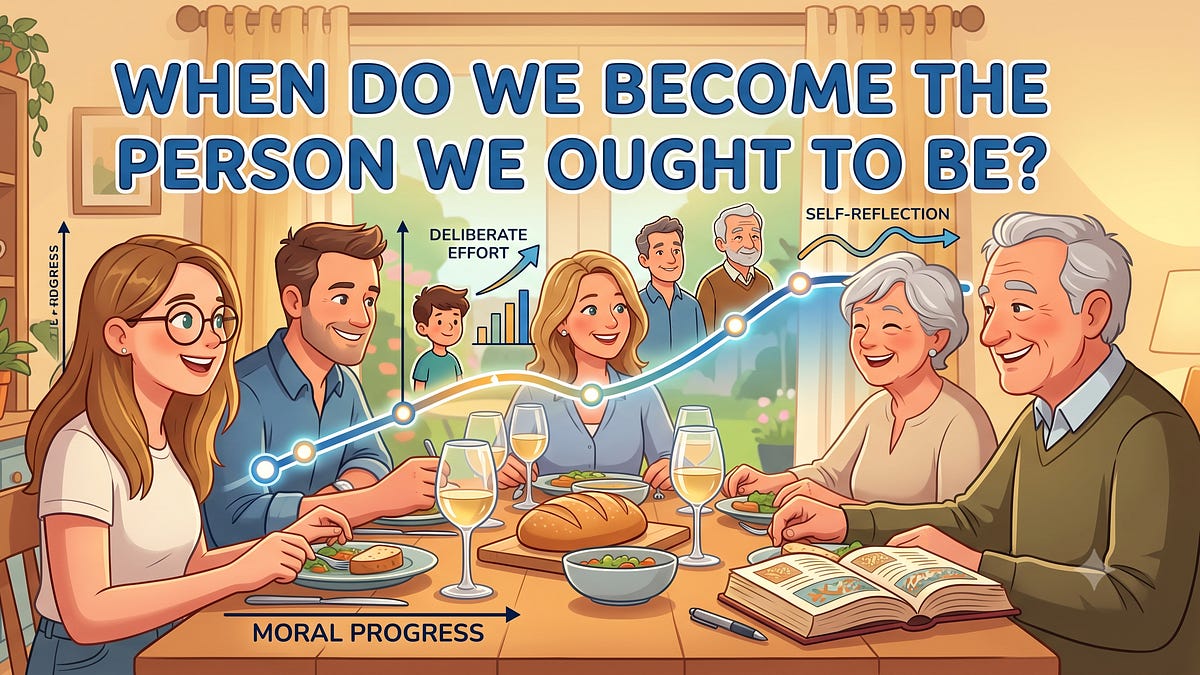
In the modern digital lexicon, self-improvement has been rebranded as “maxxing.” From the viral trends of “jaw-maxxing” to the obsessive optimization of sleep cycles (“sleep-maxxing”), the contemporary American ethos is one of constant, quantifiable personal evolution. But beyond the aesthetics and bio-hacking lies a deeper, more philosophical question: How do we perceive our moral progress as we move through the stages of life?
A new study, conducted in partnership with the University of Notre Dame and supported by the Sorin Fellows Program through the de Nicola Center for Ethics and Culture, seeks to answer that very question. By surveying 557 respondents in August 2025, researchers have uncovered a striking correlation between age, religious engagement, and the internal sense of moral fulfillment.
The Genesis of the Study: A Collaborative Effort
The project originated over a year ago when Anna Bohlen, an undergraduate at the University of Notre Dame, reached out to discuss potential research collaborations. Recognizing the value in mentoring aspiring data analysts, a partnership was formed. The research plan was ambitious but focused: apply for institutional grants to fund a robust survey on the intersection of modern life, religious identity, and personal moral reflection.
Following the successful acquisition of a grant from the Sorin Fellows Program, the team fielded a survey through the Qualtrics platform in August 2025. The resulting dataset of 557 respondents, while modest in size, provides a clear, quantitative snapshot of how Americans view their own moral character.
Chronology of Moral Reflection: The Life Course
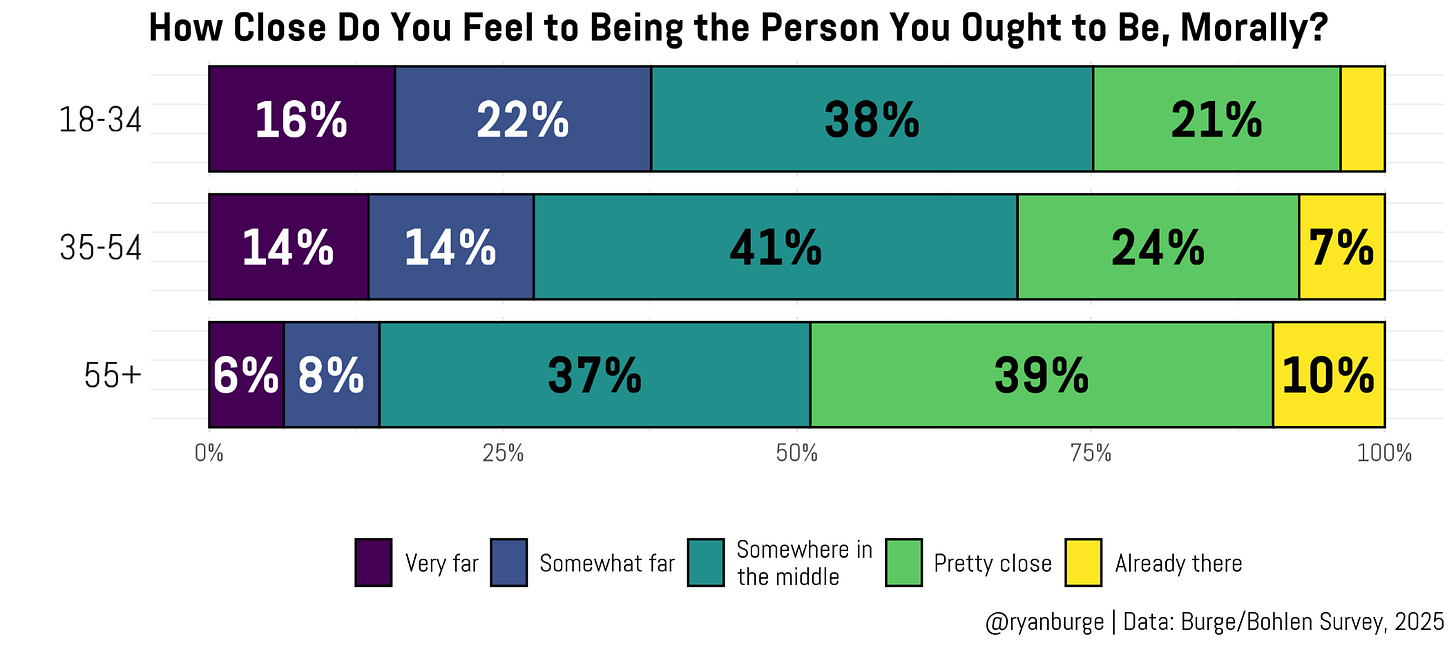
The researchers categorized the respondents into three distinct age brackets to determine how the sense of “being who I ought to be” shifts over time. The findings indicate a profound “age effect” that challenges the popular notion that humans are perpetually dissatisfied with their moral status.
The Youthful Struggle
Among the youngest adult cohort, there is a pervasive sense of moral distance. Nearly 38% of these individuals reported feeling “very far” or “somewhat far” from the person they believe they ought to be. Strikingly, almost none of these younger respondents reported feeling that they had “already arrived” at their moral ideal. This suggests that for young adults, the process of moral development is felt as a steep, ongoing climb.
The Mid-Life Plateau
As respondents enter middle age, the data begins to shift. Only 28% of the middle-aged cohort placed themselves in the bottom two categories of moral distance. The internal pressure to constantly “maxx” or transform one’s character begins to yield, replaced by a growing sense of comfort with one’s current state.
The Contentment of Maturity
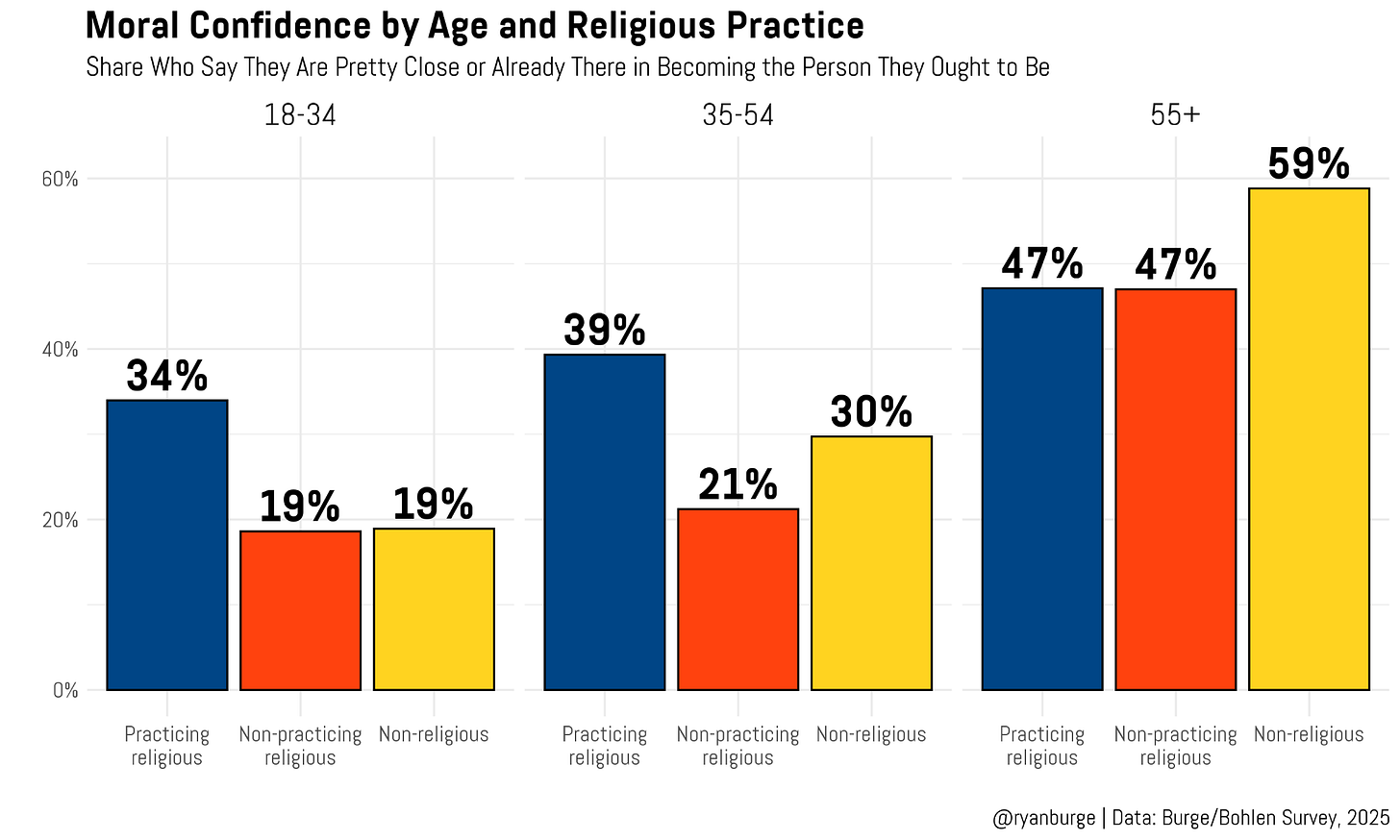
The most dramatic shift occurs among those aged 55 and older. A mere 6% of this group described themselves as “very far” from their ideal self, while 8% labeled themselves “somewhat far.” In sharp contrast, nearly 50% of the older demographic indicated they were “pretty close” or “already there” regarding their moral refinement. Older generations, it seems, have largely achieved a sense of moral equilibrium.
Supporting Data: The Mechanics of Self-Improvement
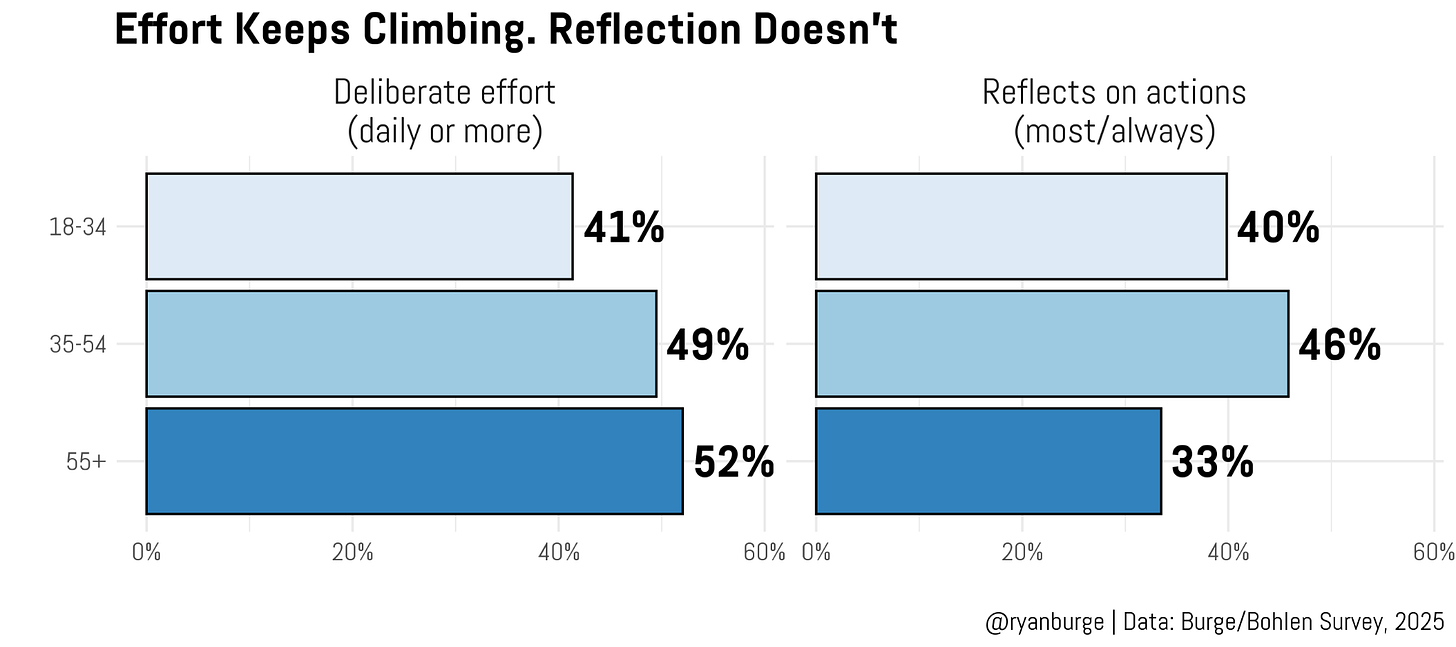
The survey moved beyond general feelings of moral distance to examine the daily habits of self-reflection and character development. The data reveals two competing trends: the frequency of effort versus the frequency of rumination.
The Paradox of Effort
While older individuals feel closer to their moral ideals, they are also more likely to report making a deliberate effort to improve their character on a daily basis. Older respondents are 11 percentage points more likely than younger adults to engage in daily character refinement. This suggests a compelling hypothesis: the sense of having “arrived” is not the result of stagnation, but rather the cumulative fruit of decades of conscious, intentional effort.
The Waning of Rumination
However, a counter-trend emerges regarding mental preoccupation. While older adults work harder on their character, they ruminate significantly less. Younger adults are much more likely to dwell on their daily actions, constantly analyzing whether they did the right or wrong thing. By the time individuals reach the age of 55, this reflexive scrutiny wanes. They remain committed to growth, but they are less likely to be paralyzed by the audit of their past behavior.
The Role of Religious Engagement
A critical component of this study was the influence of faith. Given the traditional emphasis in most religious doctrines on moral introspection and the pursuit of holiness, the researchers hypothesized that active religious participants would demonstrate a higher frequency of self-reflection.
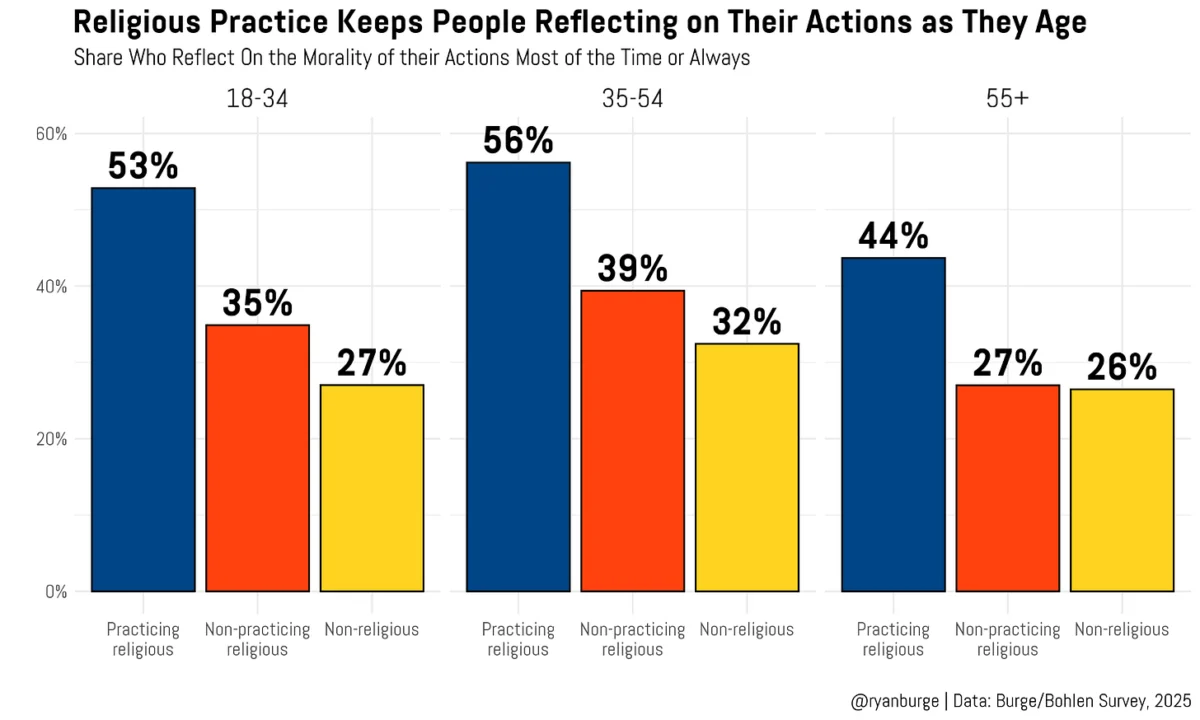
The survey divided participants into three groups: the practicing religious (monthly attendance or more), non-practicing religious (yearly or less), and the non-religious.
The Sanctity of Reflection
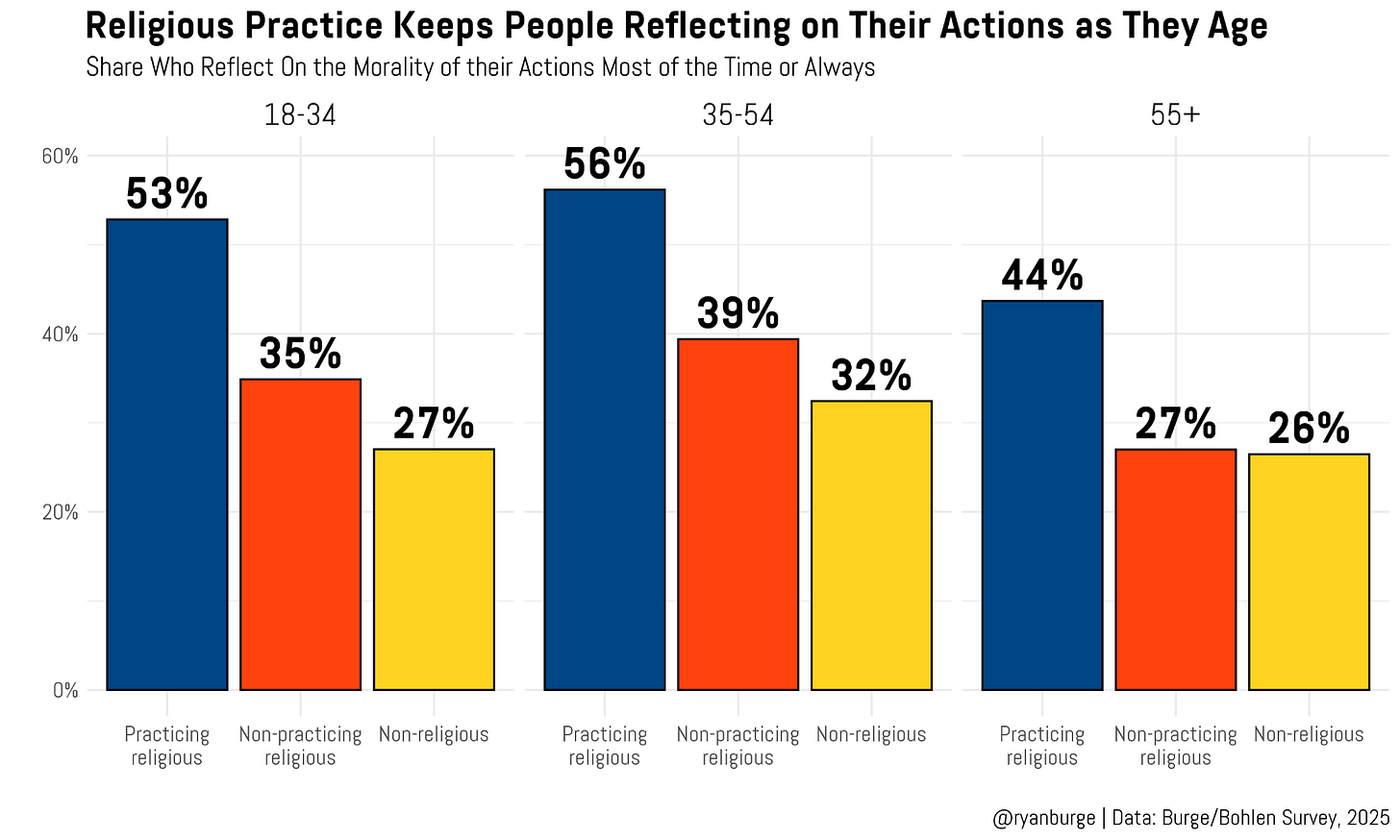
The results confirmed a clear pattern: active religious participants are significantly more likely to contemplate the morality of their actions than their non-religious or non-practicing counterparts. Among the youngest adults, 53% of the religiously engaged reported reflecting on their actions “most of the time” or “always,” compared to just 27% of the non-religious. It is evident that the communal and liturgical structure of religious life serves as a consistent prompt for moral self-assessment.
The Religious Age Gap
Interestingly, even within religious circles, the habit of reflection tends to decline with age. While 53% of religious adults under 35 report constant moral reflection, that number drops to 44% among those 55 and older. This mirrors the general population trend: as we age, we may be more confident in our moral standing, but we become less inclined to agonize over the minute details of our daily conduct.
Implications: The “Arrived” Non-Religious Retiree
Perhaps the most counterintuitive finding of the study involves the “non-religious” group as they enter their later years. While the religiously active under-35s are the most confident in their moral progress, the trend reverses entirely for the elderly.
Among the oldest non-religious respondents, nearly 60% report being “pretty close” or “already there” in terms of their moral development—a higher percentage than any other demographic group in the study. This suggests that the “moral finish line” is perceived differently depending on one’s philosophical framework.
Does Faith Set a Higher Bar?
The researchers posit that religious individuals might be working toward a higher, or perhaps more infinite, standard. If one is raised in a tradition that advocates for becoming “Christ-like” or achieving a specific divine ideal, the goalposts are arguably always moving. This could explain why even the most dedicated religious adherents often feel they have not yet “arrived.”
Conversely, the non-religious older adult may be measuring their moral character against a more secular, humanistic standard—one that is inherently more achievable and less prone to the infinite demands of theological perfection.
Conclusion: The Wisdom of Letting Go
The data offers a poignant portrait of the human life cycle. In our youth, we are obsessed with optimization, constantly measuring ourselves against the world and our own internal standards. We feel the weight of our failures and the distance we have yet to travel. We are the era of “maxxing”—tracking, measuring, and agonizing.
As we age, the urgency of that optimization fades. We continue to try to be good people—perhaps even more so than in our youth—but we do so with a newfound grace toward ourselves. We stop ruminating on every interaction and start accepting the person we have become.
While the religious path continues to spur constant reflection, the secular path in old age appears to offer a unique form of contentment. Whether through faith or the simple passage of time, the overwhelming conclusion is that the frenetic pace of self-improvement is a young person’s game. For the elderly, there is a collective, quiet permission to stop looking in the mirror and start enjoying the life that remains.
Code for the data analysis used in this study is available via GitHub.
Ryan P. Burge is a professor of practice at the Danforth Center on Religion and Politics at Washington University.
 Sagoh
 Pevita Pearce
 Layla Zulfa
