
 By Pevita Pearce
In the rapidly evolving digital landscape of 2026, the distinction between "tools" and "infrastructure" has become a critical point of failure for growing businesses. A common misconception among entrepreneurs and agency leads is the binary choice between productivity platforms and operational engines. Nowhere is this more apparent than in the frequently asked, albeit misguided, comparison between Shopify and Basecamp.
After conducting a comprehensive audit—the equivalent of a full technical sprint—we mapped the feature sets, pricing models, and strategic roles of both platforms. The conclusion is definitive: Shopify runs your store, while Basecamp runs your team. If you are building a resilient online business in 2026, the question is not which one to choose, but how to effectively integrate them into your modern ecommerce stack.
The Strategic Divide: Defining the Roles
To understand why these two platforms are not competitors, we must look at their core functional mandates.
Shopify: The Commerce Engine
Shopify is a hosted ecommerce platform engineered to facilitate the transaction. Its primary objective is to bridge the gap between a product and a consumer. It manages the storefront, inventory, payment processing, and multi-channel distribution. It is the digital "real estate" where revenue is generated.
Basecamp: The Operational Layer
Basecamp is a project management and internal communication suite. Its mandate is to reduce organizational friction, centralize team knowledge, and manage the execution of non-transactional work. It is the "headquarters" where strategy is refined, tasks are delegated, and internal culture is preserved.
| Feature Dimension | Shopify | Basecamp |
|---|---|---|
| Category | Hosted Ecommerce Engine | Team Collaboration Hub |
| Primary User | Retailers, Merchants, D2C Founders | Agencies, Operations Managers, Team Leads |
| Main Objective | Sales conversion and scale | Workflow coordination |
| Pricing | Tiered SaaS + Transaction fees | Flat-fee team pricing |
| Extensibility | 8,000+ App Ecosystem | API-led, opinionated simplicity |
The Economics of Scale: Pricing Philosophies
The financial impact of choosing these tools follows two distinct trajectories.

Shopify: Scaling with Success
Shopify operates on a variable cost model. As your business grows, your revenue increases, and typically, your Shopify costs scale alongside it through higher-tier plans, increased transaction volume, and the necessary integration of specialized apps. For a startup, the "Basic" plan provides a low-barrier entry. However, the true cost of ownership (TCO) includes payment processing fees (starting at 2.9% + $0.30) and the cumulative cost of third-party apps for subscriptions, loyalty, or advanced analytics.
Basecamp: The Predictable Overhead
Basecamp utilizes a flat-fee model, which is an anomaly in the modern SaaS market. While competitors like Asana or ClickUp charge per seat—penalizing teams for growth—Basecamp charges a fixed rate for the entire organization. For a 30-person agency, the monthly cost remains static regardless of the number of active projects or collaborators. This predictability is a significant advantage for operational budgeting, as it decouples team size from software expenditure.
The "Sales" Reality: Why Shopify is Non-Negotiable
If your goal is to accept currency for goods, Shopify is the only logical choice in this comparison.
The Commerce Architecture
Shopify’s feature set is entirely optimized for retail. It includes:
- Unified Inventory: Real-time tracking across web, social, and physical retail locations via Shopify POS.
- AI-Assisted Merchandising: Shopify Magic allows merchants to generate product descriptions and marketing copy at scale.
- B2B Capabilities: Higher-tier plans provide wholesale storefronts, custom price lists, and account management for corporate clients.
In contrast, Basecamp possesses zero native ecommerce functionality. It lacks a product catalogue, a checkout flow, or PCI-compliant payment gateways. Using Basecamp to manage a store would be akin to using a blueprint to construct a house; it is essential for the planning phase, but it cannot house the occupants.
Operational Excellence: The Basecamp Advantage
While Shopify excels at the "what" (selling products), Basecamp excels at the "how" (coordinating the people behind the store).

The Six-Pillar Workspace
Basecamp organizes every project into a single URL featuring:
- Message Boards: For long-form announcements that replace cluttered email threads.
- To-Do Lists: Focused on execution rather than granular tracking.
- Schedules: High-level project milestones.
- Docs & Files: Centralized storage for brand assets and contracts.
- Campfire: Real-time group chat.
- Automatic Check-ins: Periodic status updates that eliminate the need for redundant status meetings.
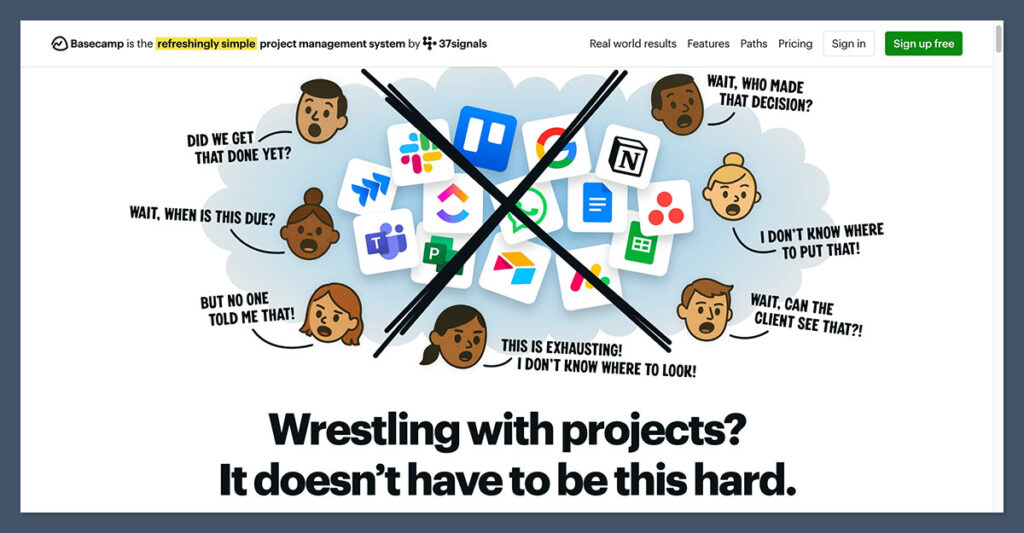
For ecommerce agencies or high-growth brands, this consolidation is the antidote to "tool sprawl"—the condition where teams waste hours toggling between Slack, Google Drive, Trello, and email.
Integration: The "Glue" of the Modern Stack
The true power of these platforms is realized when they are connected. Through middleware such as Zapier, Make, or custom API workflows, you can create a symbiotic relationship between your commerce data and your team’s execution:
- High-Value Order Triggers: An order over $1,000 in Shopify can automatically trigger a "VIP Order" project in Basecamp, alerting the fulfillment team to provide white-glove service.
- Customer Support Escalation: A negative review or a high-frequency return in Shopify can automatically create a task in a "Customer Experience" project in Basecamp, ensuring a human agent addresses the issue immediately.
By utilizing Shopify as the System of Record for data and Basecamp as the System of Execution for humans, companies eliminate the "silo effect."
Chronology of Adoption: A Strategic Roadmap
When should a business invest in these tools?
Phase 1: The Launch (Shopify First)
In the early days, your primary bottleneck is market entry. Focus exclusively on Shopify. You do not need complex project management tools when your team consists of one or two people. Keep communication in email and focus all resources on product-market fit and store optimization.
Phase 2: The Complexity Threshold (Adding Basecamp)
Once your team grows beyond three people, or you begin outsourcing work to freelancers and agencies, communication becomes the primary bottleneck. This is the moment to adopt Basecamp. Use it to document your "Standard Operating Procedures" (SOPs) and manage the creative and marketing workflows that drive traffic to your Shopify store.
Phase 3: The Scale-Up (Integration)
As you hit seven or eight figures, the manual flow of information between your store and your team becomes inefficient. Invest in custom API integrations that bridge Shopify and Basecamp. This ensures that your operational team is always working based on the latest, most accurate data coming directly from your storefront.
Implications for Future Growth
The modern ecommerce brand must be a technology-first entity. The danger in 2026 is not choosing the "wrong" tool, but failing to recognize that different business problems require specialized solutions.
If you attempt to force Shopify to perform project management, you will lack the communication structures necessary to scale. If you attempt to use Basecamp to run an online store, you will fail to capture a single cent of revenue.
The most successful companies are those that build a "composable stack." They recognize that Shopify’s 8,000+ app ecosystem provides the depth for commerce, while Basecamp’s opinionated, calm design provides the structure for culture. By viewing these platforms as complementary components of a unified machine, founders can focus on what truly matters: delivering value to customers and scaling their brand with efficiency and intent.
Summary of Recommendations
- For the Solopreneur: Start with Shopify. Master your product, your theme, and your conversion funnel.
- For the Growing Team: Implement Basecamp as soon as you find yourself repeating instructions or losing track of project briefs in email.
- For the Enterprise/Agency: Integrate the two via API to ensure that every transaction in Shopify informs the next logical step for your operational team in Basecamp.
In this framework, the "versus" debate is rendered obsolete, replaced by a more sophisticated understanding of operational infrastructure.
 Dwi Wanna
  Lina Irawan
  Basiran