
 By Dwi Wanna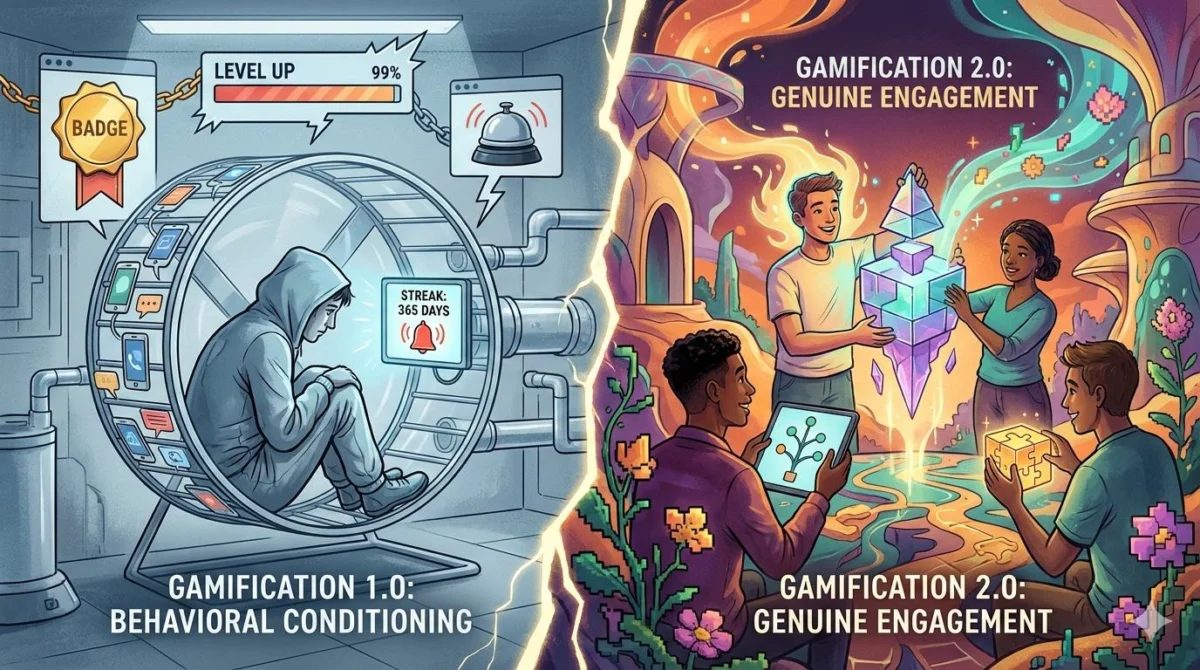
In the digital landscape of the 2020s, a pervasive, hollow phenomenon has taken root. It is a design ethos that promises the engagement of a blockbuster video game but delivers the mechanical soullessness of a Skinner box. We are living through the era of the "Gamification Cargo Cult"—a trend where product managers, growth teams, and UX designers attempt to manufacture user loyalty by stapling points, badges, and leaderboards onto products that lack the fundamental structural integrity of actual play.
For the veteran game developer, this "gamification" is not just ineffective; it is insulting. It is a performative theater of engagement that no genuine gamer would tolerate for more than five minutes.
The Cargo Cult of Engagement
The term "cargo cult" originates from post-WWII observations of indigenous cultures who built replicas of landing strips and air traffic control towers out of bamboo, hoping to summon the return of the supply-laden aircraft they saw during the war. They understood the visuals of the airport, but they lacked the physics of aviation.
Modern software companies are doing exactly this. Consider the "All-Star Profile" badge on LinkedIn—a meaningless digital trinket that exists solely to pressure users into surrendering more personal data to the platform’s algorithm. Consider the guilt-tripping push notifications from language apps, which weaponize shame to keep users clicking rather than actually learning. Or the millions of Fitbit users who, after a brief, breathless period of tracking steps, eventually relegate their hardware to a dusty kitchen drawer.
The pattern is universal: an initial burst of novelty, a period of "gamification theater," and, inevitably, total user abandonment. These features were not designed by game designers; they were drafted in Jira tickets by people who have never shipped a title, let alone understood what makes a game worth playing.
A Veteran’s Perspective: 39 Years in the Trenches
To understand why this approach fails, one must look at the history of the industry. The author of this critique is a 39-year veteran of the gaming world. From programming John Madden Football in 1991 to producing Street Fighter at Capcom and navigating the complexities of the Chinese gaming market, this is a career built on understanding the "why" behind the "play."
In these decades of experience, one truth has remained constant: players do not spend thousands of hours in a game because of the rewards we offer. They stay because the game respects their agency, challenges their intellect, and provides a sense of mastery. Most modern "gamification experts" have never studied the psychological mechanics that drive true, long-term human obsession. They are busy chasing metrics, while the masters of the medium have always chased engagement through intrinsic motivation.
Chronology of the "Engagement Trap"
The trajectory of the current failure can be mapped through the evolution of the software-as-a-service (SaaS) industry:
- The Early Promise (2005–2012): Gamification was heralded as the "silver bullet" for productivity. Early adopters believed that if you simply added progress bars and badges, you could make dull tasks feel like play.
- The Proliferation Phase (2013–2018): "Gamification" became a staple in UX design curriculum. Product teams began treating users like laboratory rats, assuming that a predictable pellet (a notification or a badge) would result in a predictable lever press (user retention).
- The Cynical Feedback Loop (2019–Present): Users have become wise to the game. They now "game the system"—clicking through tutorials they don’t read and checking in just to maintain a streak, while actively avoiding the actual value proposition of the software.
The Extrinsic Trap: Why "Points and Badges" Are Failing
Walk into any product team meeting today, and the conversation is inevitably hijacked by the "Extrinsic Toolkit." This toolkit usually consists of:
- Leaderboards: Designed to spark competition but often resulting in demoralization for the 99% who will never reach the top.
- Streaks: A psychological anchor that transforms a hobby into an obligation, turning "fun" into "labor."
- Leveling Systems: Arbitrary thresholds that signify nothing about actual user proficiency.
The fatal flaw here is the assumption that humans are motivated by binary rewards. This behaviorist model treats the user as a reactive subject rather than an active participant. When you rely on these mechanics, you create compliance, not loyalty. Compliance is fragile. The moment the novelty of the badge fades, or the user decides the "streak" isn’t worth the emotional tax, the app is deleted.
The "Gaming the System" Phenomenon
We are currently seeing a surge in "anti-play" behavior. Users are finding ways to exploit these gamified systems to reap the rewards without engaging with the core product. If your users are clicking through your onboarding just to clear a notification badge, you have failed as a designer. You have optimized for a metric, not for a user experience.
The Science of Intrinsic Motivation
The missing ingredient in the modern tech stack is Intrinsic Motivation. Why do millions of people play Elden Ring for over 100 hours, despite the game being objectively punishing and difficult? Why do people solve Wordle every morning, even though there is no prize, no leaderboard, and no "streak" that impacts their real-world status?
The answer lies in three psychological pillars:
- Autonomy: The player feels they have meaningful choices.
- Competence: The player feels they are growing in skill, not just accumulating "points."
- Relatedness: The player feels connected to a community or a world that matters.
Real games do not bribe players to show up. They create an experience so rich in agency and mastery that the player wants to show up.
Official Responses and Industry Implications
The disconnect between Silicon Valley product teams and the gaming industry has led to a growing rift in the software market. Recent white papers from UX research firms indicate that "gamification fatigue" is at an all-time high. Users are reporting that they feel "monitored" and "manipulated" by apps that demand daily attendance via notifications.
The Implications for Product Teams:
- Churn: Apps that rely on extrinsic rewards see a cliff-like drop in engagement after 30 days.
- Brand Erosion: Users are increasingly viewing aggressive gamification as a sign of a "dark pattern" app.
- The Pivot: There is a slow, necessary shift toward "Gamification 2.0." Companies are beginning to realize that if their gamification could be specced out in a five-dollar Fiverr gig—"Add points and a leaderboard"—they are not building a product; they are building a bamboo tower in the jungle.
The Rescue Mission: Designing for Players
This critique is not a call to abandon gamification entirely. It is a rescue mission. Done correctly—designed by people who understand the rhythm of play, the psychology of flow, and the nuances of feedback loops—gamification could be transformative.
To achieve this, we must stop asking "How can we make them click this?" and start asking "How can we make this experience inherently satisfying?"
The goal of the next phase of design should be to move away from the metrics-obsessed behaviorism of the last decade. It is time to stop treating users like metrics and start treating them like players. The future of software is not in the "points" we award, but in the "meaning" we create.
The cargo cult is falling. It is time to stop building the bamboo towers and start looking for the planes.
Up next in this series: Gamification 2.0. Beyond Points and Badges: Designing for Players, Not Metrics. Chapter 2: The Solution.
 Ammar Sabilarrohman
  Neng Nana
  Sagoh
Sagoh 