
 By Iffa Jayyana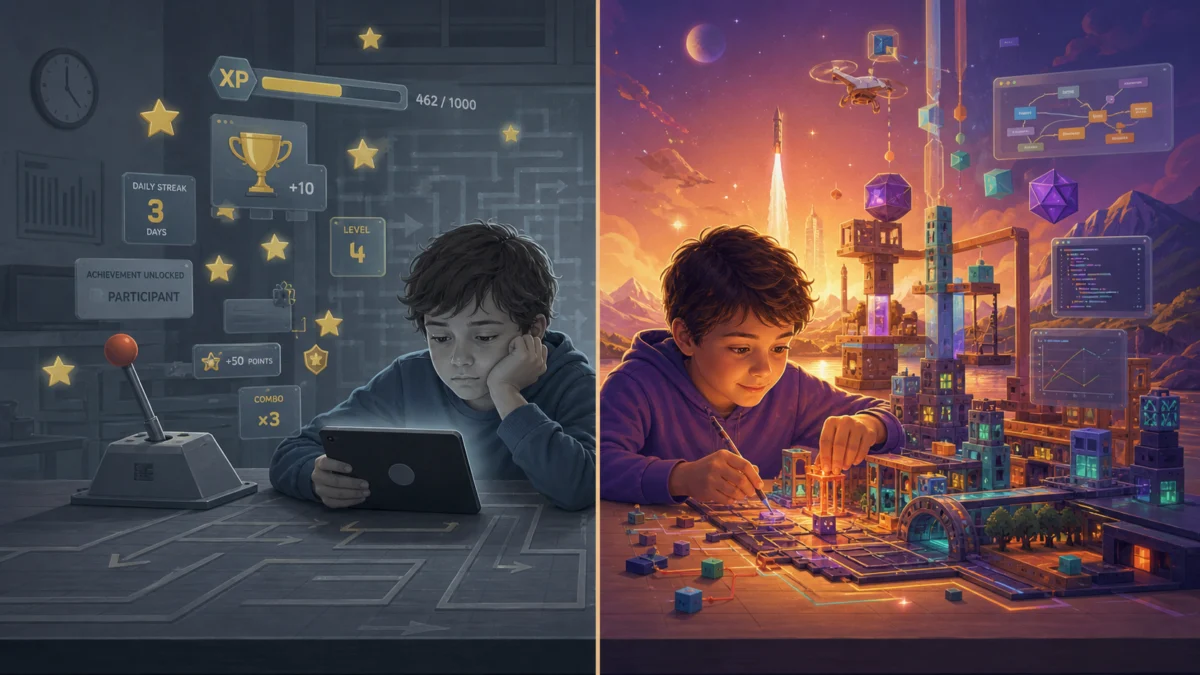
In the modern classroom, a silent crisis of engagement is unfolding. It is a battle between the sophisticated, immersive worlds of modern gaming and the sterile, digitized worksheets that schools and educational software developers often pass off as "gamification."
The divide is best illustrated by a simple conversation between an uncle and his twelve-year-old nephew. The boy spends hours in Minecraft, engineering complex redstone circuitry, coordinating multi-server logistics with friends, and mastering logic through command blocks. Yet, when he returns from school to complete his digital homework, he is met with a platform that awards "experience points" (XP) for solving basic arithmetic. When asked for his opinion, his response was immediate and scathing: "It’s not a game. It’s just homework with points."
This reaction is not a sign of a lazy student; it is the mark of a digital native who has developed a highly calibrated "BS detector." For the education technology (EdTech) industry, this represents a profound disconnect that threatens to undermine the next generation of learning tools.
The Chronology of a Failed Trend
To understand how we arrived at this point, one must look at the timeline of digital education. In the early 2010s, "gamification" emerged as a buzzword in Silicon Valley and pedagogical circles. The theory was simple: if games are addictive, why not borrow their mechanics—points, leaderboards, and badges—to incentivize rote learning?
Phase 1: The "Pointsification" Era (2010–2015)
The initial wave focused on extrinsic motivation. Developers assumed that if they could trigger the brain’s dopamine response through digital rewards, they could force students to repeat boring tasks. This era gave us the "digital worksheet," where the content remained identical to a paper-and-pencil exercise, merely gated behind a progress bar.
Phase 2: The "Cartoon Mascots" Era (2016–2020)
As the novelty of points wore off, developers pivoted to aesthetic gamification. Platforms began incorporating high-fidelity animations, rewards stores, and cartoon mascots that offered hollow praise for minimal effort. This was an attempt to mimic the "fun" of casual mobile gaming, but it failed to account for the actual psychological drivers of engagement.
Phase 3: The Reality Check (2021–Present)
Today, we are in a period of reckoning. Gen Z and Gen Alpha, having been raised on the creative autonomy of Roblox, the social dynamics of Fortnite, and the sandbox depth of Minecraft, have grown intolerant of these low-effort interventions. They are now vocalizing what they have known for years: superficial rewards do not equate to a compelling experience.
Supporting Data: Why Superficiality Fails
The failure of contemporary gamification is rooted in a fundamental misunderstanding of what makes a game "a game." Psychological research into Self-Determination Theory (SDT) suggests that human motivation is fueled by three core pillars: Autonomy, Competence, and Relatedness.
- Autonomy: Players need to feel they are making meaningful choices. A standard math app that forces a linear path offers zero autonomy.
- Competence: Players need to feel they are growing in skill. "Gold stars" for completing basic tasks do not provide a sense of mastery; they provide a sense of patronization.
- Relatedness: Modern gaming is inherently social. Most educational apps are designed as solitary, competitive silos, failing to leverage the collaborative potential of learning.
Data from recent EdTech adoption studies shows that while "gamified" apps see high initial engagement due to novelty, they experience a sharp drop-off in user retention after the first two weeks. Conversely, platforms that allow for "open-ended play"—like Minecraft Education Edition—maintain high engagement levels because they treat the student as a creator rather than a consumer of content.
The Industrial Perspective: Why Developers Miss the Mark
The primary issue within the development community is a lack of "ludological literacy." Many EdTech designers have read the literature on gamification but have never internalized the experience of play.
The "Game = Points" Fallacy
Many developers operate under the mistaken belief that games are simply "reward delivery systems." They view points, streaks, and badges as the product rather than the symptom of a well-designed game. They have never experienced the flow state of a Guitar Hero session, nor the intellectual satisfaction of a Portal puzzle. Consequently, they build systems that feel like an Skinner box—an environment where the subject is conditioned to press a button to receive a pellet, devoid of any genuine challenge or creative satisfaction.
The Problem of Patronization
Perhaps the most egregious sin of modern educational design is the tone. Awarding 50 XP for a task that any child knows is trivial is not motivational; it is insulting. When a platform congratulates a student for "logging in," it signals to the user that the platform expects them to find the content inherently boring. By attempting to mask the "work" with "game" elements, developers inadvertently highlight how uninteresting the work actually is.
Implications for Future Design
If we are to bridge the gap between education and engagement, the industry must pivot away from "gamification" and toward "game-based learning."
The "Genre-First" Framework
Developers should stop asking, "How do we add points to this?" and start asking, "What genre of game does this subject naturally resemble?"
- Language Learning as an RPG: Instead of a series of flashcards, imagine a game where language acquisition is a skill tree, allowing students to "unlock" new abilities and social interactions within a virtual world.
- Math as a Strategy Game: Treat mathematical equations as tools for building or resource management, where the student uses logic to solve a complex, tangible goal rather than checking a box on a list.
- Science as a Simulation: Utilize the "sandbox" model where students can fail, experiment, and observe results in a safe, digital environment, mirroring the actual scientific method.
The Hard Truth: Competing with Roblox
The reality for developers is that they are not competing with other educational apps; they are competing with the entire gaming industry. A student’s attention is a zero-sum game. If an app offers an experience that is demonstrably inferior to the games the student plays in their spare time, the app will be discarded.
The industry must accept that if they are not capable of building a truly immersive, challenging, and creative experience, they should stop pretending to be a "game." There is no shame in building a well-designed, efficient tool. However, the attempt to dress up a standard curriculum in the skin of a video game—without the soul of one—is a strategy that is rapidly approaching obsolescence.
Conclusion: The Path Forward
The next generation of users is the most media-literate cohort in history. They have an innate ability to discern between a system built for their growth and a system built to manipulate their engagement metrics.
To win their attention, developers must move beyond the superficial metrics of XP and leaderboards. They must design for agency, challenge, and discovery. They must trust that students are capable of handling complexity and that they value genuine mastery over artificial rewards.
As we look toward the future of education, the objective is clear: we must stop trying to make "work" feel like a "game" by adding gimmicks, and instead, start making "learning" look more like the challenging, rewarding, and deeply engaging experiences that children already seek out on their own. The age of the gold star is over; the age of the meaningful experience has begun.
Up next in the "Gamification" series: "Gamification 2.0. Beyond Points and Badges: Designing for Players, Not Metrics. Chapter 5: Implementation."
 Ammar Sabilarrohman
  Neng Nana
  Sagoh
Sagoh 