
 By Suro Senen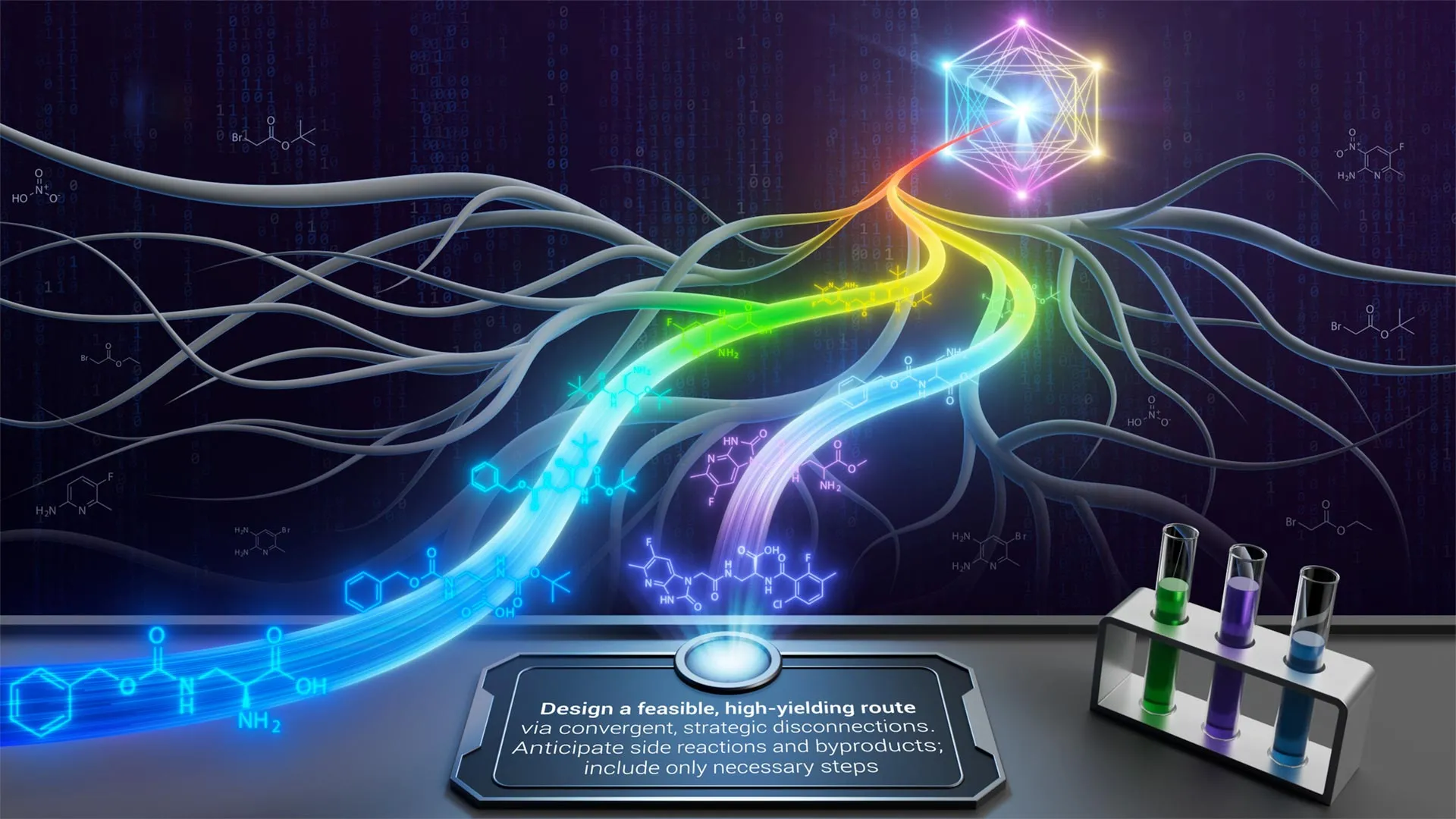
For decades, the art of molecular synthesis has been the "grand challenge" of chemistry. Creating a new molecule—whether it is a life-saving pharmaceutical, a durable polymer, or a high-efficiency battery component—is akin to solving a multidimensional puzzle where the pieces are governed by the volatile, subatomic laws of quantum mechanics. Chemists have traditionally spent years, sometimes decades, mastering the strategic intuition required to plan these synthetic routes. However, a breakthrough from researchers at EPFL (École Polytechnique Fédérale de Lausanne) suggests that the future of this complex craft lies not in more raw computing power, but in the sophisticated application of natural language.
The development of a new framework known as Synthegy marks a pivotal shift in computational chemistry. By utilizing Large Language Models (LLMs) as high-level reasoning engines rather than mere structure generators, scientists are moving closer to a "co-pilot" model of discovery that bridges the gap between human strategic intent and machine-led computational search.
The Architecture of Complexity: Why Synthesis is Hard
To understand the magnitude of this innovation, one must first appreciate the Herculean task of retrosynthesis. Retrosynthesis is the process of deconstructing a target molecule into simpler, commercially available precursors. It is a process of inverse logic: starting at the destination and mapping the route backward.
The difficulty lies in the sheer "chemical space" available. A single molecule could theoretically be synthesized through thousands of different pathways, but only a few are practical, cost-effective, or environmentally sustainable. Chemists must navigate a labyrinth of variables:
- Protecting Group Strategy: Determining whether sensitive functional groups need to be temporarily "masked" to prevent unwanted side reactions.
- Stereochemistry: Ensuring the molecule is formed with the correct three-dimensional orientation, which is often the difference between a therapeutic drug and a toxic compound.
- Ring Closures: Deciding the optimal sequence for constructing the skeletal framework of the molecule.
Historically, computational tools have struggled with this. While computers can brute-force the calculation of millions of potential pathways, they often lack the "strategic judgment" of a seasoned chemist. They might suggest a route that is mathematically sound but chemically nonsensical—ignoring subtle constraints or prioritizing inefficient steps. Furthermore, understanding the reaction mechanisms—the minute-by-minute movement of electrons during a reaction—has remained a specialized, often manual, analytical process.
The Chronology of a Breakthrough: From Search to Reasoning
The journey toward Synthegy began with a recognition that existing AI tools in chemistry were too rigid. They relied on cumbersome, hard-coded rules and filters that failed to capture the nuances of a researcher’s specific goal.
The Shift in Paradigm
The research team, led by Philippe Schwaller, sought to move away from the "black box" approach of generative AI. Instead of asking an AI to "invent" a molecule from scratch—a task that often results in hallucinated structures—they positioned the LLM as a reasoning evaluator.
- Conceptualization: The team hypothesized that LLMs, having been trained on the vast corpus of scientific literature, already possess a latent "understanding" of chemical strategy. The challenge was to harness this without the model losing its grounding in chemical reality.
- Integration: The researchers integrated these reasoning capabilities with traditional, robust search algorithms. This created a dual-layered system: the algorithm generates the potential chemical paths, and the LLM acts as the "judge," reviewing those paths against the chemist’s intent.
- Validation: The final phase involved extensive testing against human experts. Through a rigorous double-blind study involving 36 chemists, the team validated that the AI’s reasoning could align with human expert consensus, providing a statistical baseline for the tool’s reliability.
Supporting Data: Validating the AI Intuition
The efficacy of Synthegy was measured not just by its ability to suggest routes, but by how accurately it echoed the strategic decision-making of professional chemists.
In a double-blind study, 36 chemists were tasked with evaluating the outputs generated by the framework. Out of 368 valid evaluations, the system demonstrated a 71.2% agreement rate with human experts. This is a significant milestone; it suggests that the model is not merely guessing, but is successfully interpreting the logic behind a synthetic route.
Performance Metrics
- Strategy Matching: The system proved capable of identifying pathways that adhered to complex, user-defined instructions, such as minimizing the use of protecting groups or favoring specific ring-forming reactions.
- Model Scaling: Data showed that performance is directly tied to the size of the underlying LLM. Larger models exhibited a superior ability to perform multi-level reasoning, ranging from the analysis of simple functional groups to the evaluation of entire, multi-step synthetic sequences.
- Mechanism Decomposition: Beyond retrosynthesis, the system was able to break down reactions into fundamental electron-movement steps, effectively "debugging" proposed reaction pathways by flagging those that violated basic physical-chemical principles.
Official Responses and Researcher Insights
The publication of the Synthegy paper in the journal Matter has sparked discussion regarding the role of AI in laboratory settings. Andres M. Bran, the lead author of the study, emphasizes that the primary goal of this technology is to democratize and accelerate the research process.
"When making tools for chemists, the user interface matters a lot," Bran stated. "Previous tools relied on cumbersome filters and rules. With Synthegy, we’re giving chemists the power to just talk, allowing them to iterate much faster and navigate more complex synthetic ideas."
Bran highlights a particularly exciting aspect of the research: the unification of synthesis and mechanism. "We usually use mechanisms to discover new reactions that enable us to synthesize new molecules," he notes. "Our work is bridging that gap computationally through a unified natural language interface."
The EPFL team argues that the true power of this system is not that it replaces the chemist, but that it interprets the chemist’s intent. By allowing researchers to input constraints in plain English—such as "avoid toxic reagents" or "keep the process under four steps"—the AI becomes an extension of the researcher’s own strategic mind.
The Broader Implications: A New Era for Chemical Discovery
The implications of the Synthegy framework extend far beyond the laboratory walls. As the pharmaceutical and materials science industries face increasing pressure to shorten development timelines, the ability to automate the strategic planning phase of synthesis could save years of trial-and-error in the lab.
1. Accelerated Drug Discovery
Drug discovery is notoriously slow, with the average candidate taking over a decade to move from the bench to the pharmacy shelf. By using LLM-guided planning, researchers can filter out non-viable routes in seconds rather than weeks of bench work. This "computational pre-screening" allows for a more focused approach to lead optimization.
2. Accessibility and Education
By lowering the barrier to entry for complex synthetic planning, Synthegy could become a vital educational tool. Younger chemists can use the system to explore why certain synthetic strategies are superior to others, effectively using the AI as an expert tutor that explains its reasoning in plain language.
3. Sustainability and Green Chemistry
The ability to quickly compare multiple routes allows chemists to explicitly choose pathways that are more environmentally friendly. By prioritizing routes with fewer, more benign reagents or higher atom economy, AI-guided planning can directly contribute to "Green Chemistry" initiatives, reducing the chemical waste generated in the discovery process.
4. The Future of the "Human-in-the-Loop"
The most profound implication of this research is the definition of the relationship between humans and AI. For years, the industry feared that AI would eventually render the "human expert" obsolete. Synthegy suggests the opposite: that the most powerful systems are those that explicitly rely on human input to function. By centering the chemist’s natural language, the researchers have created a system that respects the expertise of the scientist while providing the computational scale of a supercomputer.
As we look toward the future, the integration of these reasoning models into laboratory information management systems (LIMS) and automated robotic labs seems all but inevitable. We are entering a phase where the "language of molecules" is being translated into the "language of humans," allowing for a more seamless, creative, and efficient era of scientific discovery. The bridge between the theoretical potential of a molecule and its physical realization is no longer just a series of reactions—it is a conversation.
 Sagoh
Sagoh  Asro
Asro  Siti Muinah