The mechanics of search engine optimization (SEO) are undergoing a structural shift. As traditional search engines increasingly prioritize "information gain" and AI-driven engines—such as ChatGPT, Perplexity, and Google’s AI Overviews—reshape how users find answers, the metrics of content value have been rewritten.
For years, the standard SEO playbook dictated that brands produce high-volume content calendars, often relying on outsourced, loosely related public relations surveys to claim authority. Today, that strategy is obsolete. Success in the modern search ecosystem relies on two key pillars: the publication of proprietary, first-party data, and the precise physical layout of that data on the webpage. Recent research indicates that owning the primary data is no longer enough; how that data is structured determines whether a brand wins the organic ranking or loses the resulting AI citation to an aggregator.
Main Facts: The Intersection of Information Gain and AI Citations
Two landmark studies have illuminated the changing dynamics of content originality and LLM (Large Language Model) citation behavior.
First, an information gain study conducted by On-Page.ai evaluated 150 top-ranking Google pages across 50 keywords and 10 distinct verticals. Rather than measuring mere keyword density or word count, the study graded the unique contribution of each page relative to its ranking competitors on a scale of 0 to 100, focusing on semantic meaning rather than phrasing.
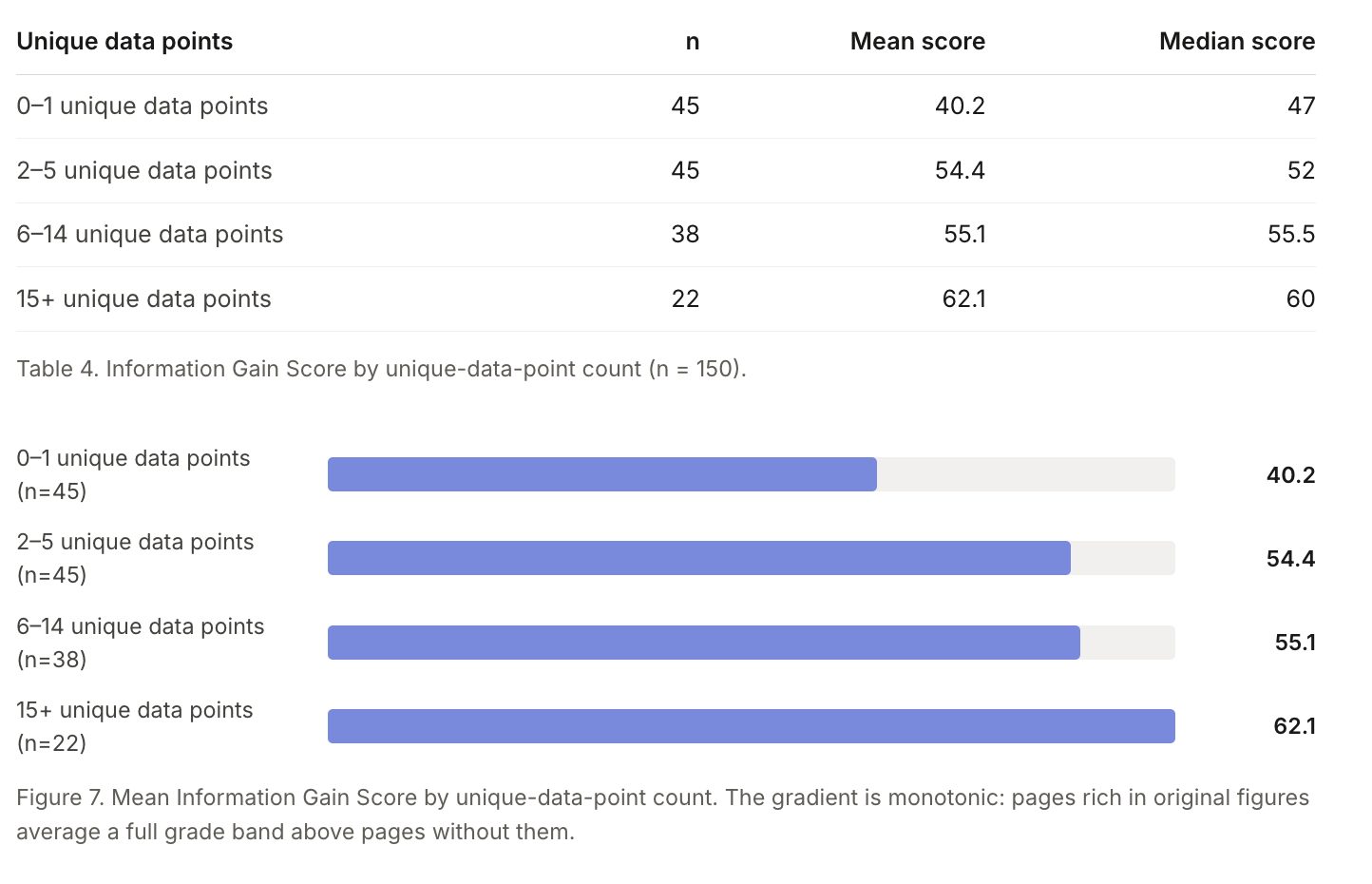
The investigation revealed that original, first-party data is the single most influential variable correlating with high information gain. While the median page scored a modest 52, pages containing 15 or more unique data points scored an average of 62.1. Conversely, pages with one or zero unique figures averaged just 40.2.
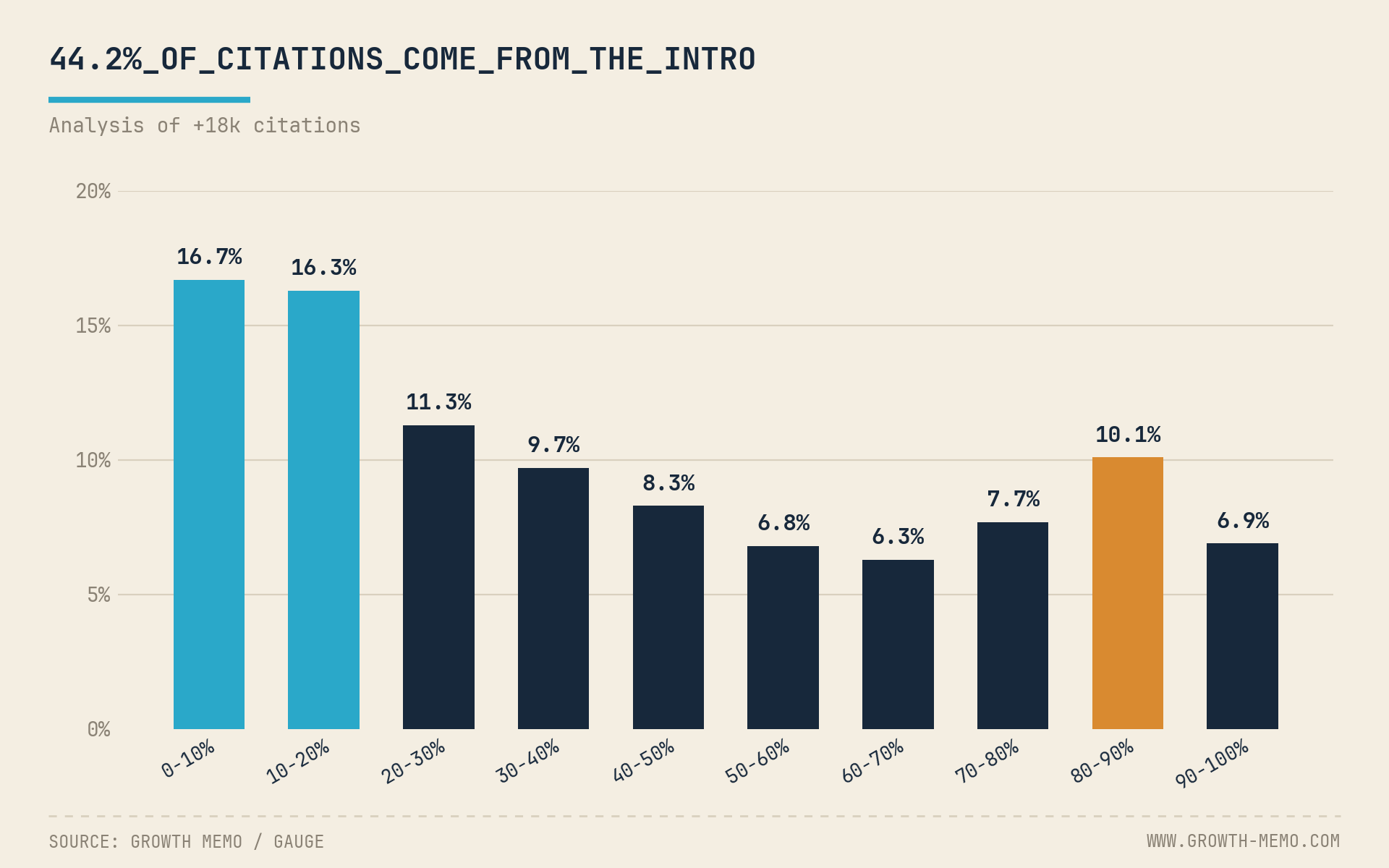
Second, an analysis of 18,012 verified ChatGPT citations conducted by Growth Memo revealed a highly concentrated "ski-ramp" distribution in how LLMs consume and cite web content:
The Hot Zone: AI engines read and cite most heavily within the 10% to 20% vertical band of a webpage.
The Top-Heavy Bias: The first 30% of a page captures 44.2% of all citations.
The Middle Tier: The middle 30% to 70% of a page accounts for 31.1% of citations.
The Depths: Content buried in the bottom 10% of a page receives a mere 2.4% to 4.4% of citations, making deep content roughly 2.5 times less likely to be referenced.
These findings present a dual challenge: content must contain original, hard-to-replicate numbers to rank on traditional search engine results pages (SERPs), but it must also be structured to place these insights directly in the path of LLM crawlers to secure valuable AI citations.
Chronology: The Evolution of Search and Content Valuation
To understand why original data and page layout have become the ultimate levers for visibility, it is necessary to examine how search engine evaluation models have evolved over the past two decades.
[2000s-2010s: Keyword Era] ---> [Mid-2010s: Skyscraper & PR Survey Era] ---> [2020: Google's Information Gain Patent] ---> [2023-Present: LLM & AI Citation Era]
Phase 1: The Keyword and Backlink Era (2000s–Mid-2010s)
In the early days of search, visibility was primarily a function of keyword frequency, metadata optimization, and raw backlink volume. Content originality was secondary to structural optimization. If a page matched the query intent and possessed sufficient domain authority, it ranked.
Phase 2: The Skyscraper and PR Survey Era (Mid-2010s–2020)
As Google’s algorithms grew more sophisticated, content length and comprehensiveness became the dominant ranking factors. This gave rise to the "skyscraper technique," where brands compiled existing web information into longer, more exhaustive guides. To inject pseudo-originality, companies paid external PR or research firms to conduct consumer surveys. These surveys, often loosely tied to the core product (e.g., a car insurance fintech publishing a study on summer road-trip habits), were designed solely to earn backlinks from mainstream media sites.
Phase 3: The Emergence of "Information Gain" (2020–2023)
In 2020, Google was granted a patent titled “Contextual estimation of link information gain.” This marked a fundamental shift in how the search engine evaluated web documents. Google began calculating whether a document provided novel information—new data points, unique perspectives, or original source material—beyond what a user had already encountered in previously viewed documents. Suddenly, regurgitated skyscraper content began losing ground to primary sources.
Phase 4: The AI Citation Era (2023–Present)
The launch of ChatGPT, Gemini, Perplexity, and Google’s own AI Overviews transformed search engines from document indexes into answer engines. Instead of directing users to list of blue links, LLMs synthesize answers using real-time web retrieval. This introduced a new battlefield: securing the citation within the AI-generated response.
Supporting Data: Deep-Diving the Metrics of Modern SEO
The empirical data from On-Page.ai and Growth Memo provides clear, actionable parameters for modern content design.
1. The Low Bar for Organic Originality
The On-Page.ai study showed that despite the theoretical importance of original information, the average organic search result is remarkably deficient in unique data.
Metric
Average / Score
Median Information Gain Score (Overall)
52.0 / 100
Average Unique Data Points (Top Organic Results)
4.0
Average Score (Pages with $le 1$ Unique Figure)
40.2
Average Score (Pages with $ge 15$ Unique Figures)
62.1
This indicates that the barrier to outperforming competitors in classic search remains low. A page containing more than four unique, product-generated data points immediately positions itself ahead of the average ranking page.
Additionally, the On-Page.ai analysis revealed a high volume of adjacent, unanswered consumer questions within every analyzed search query. Using synthetic reader queries—plausible, highly related questions generated for the study—the researchers found that ranking pages consistently ignore long-tail intents. This represents an open opportunity for "query fan-out," where a single, comprehensive page answers multiple related questions, earning broader search footprint.
2. The Mechanics of LLM Attention
The Growth Memo analysis of 18,012 verified ChatGPT citations provides a precise blueprint of how an LLM navigates a webpage.
[Top of Page: 0-10%]    --> Navigation/Intro (AI skips)
[Hot Zone: 10-20%]      --> Peak Citation Density (44.2% of citations in first 30%)
[Middle: 30-70%]        --> Moderate Citation Density (31.1% of citations)
[Bottom: 90-100%]       --> Minimum Citation Density (2.4% - 4.4% of citations)
LLMs do not read web pages linearly as humans do, nor do they treat the entire document with equal weight. The intense concentration of citations in the 10% to 20% vertical band indicates that LLMs prioritize early, highly structured content blocks. The first 10% of a page is frequently bypassed as navigation menus, header images, and introductory fluff.
Once the crawler moves past the introduction, it seeks high-density information. Content placed below the 70% scroll depth is effectively invisible to AI citation algorithms, receiving negligible attribution.
Official Responses and Expert Perspectives: The Aggregator Threat
While publishing proprietary, first-party data is essential for organic visibility, SEO experts warn of a frustrating structural loophole in how LLMs assign credit.
The Problem of "Citation Theft"
Industry analysts have observed that owning the primary data does not guarantee earning the AI citation. If a brand publishes an original benchmark report but presents the data in a dense, poorly formatted PDF or deep within a complex narrative, an agile aggregator can scrape that data, repackage it into a clean, markdown-friendly table, and place it at the top of an optimized page.
When an LLM retrieves information to answer a user’s prompt, it prioritizes extraction efficiency and site authority over historical origin. The aggregator’s highly readable page often wins the citation, leaving the primary creator without traffic or brand attribution.
As the Growth Memo study notes:
"LLM extraction structure (along with the sites that AI search engines trust for the topic) decides who gets the citation, even when your brand owns the data. Unfortunately, an aggregator who repackages your benchmark into a cleaner answer-ready page can collect the citation your research earned."
Vertical-Specific Variation
Experts also emphasize that LLM citation behaviors are not uniform across industries. While the "ski-ramp" distribution remains consistent, the specific signals that trigger citations vary sharply by vertical (e.g., YMYL—Your Money or Your Life—queries in finance and healthcare require higher baseline domain trust than lifestyle queries). However, in every vertical, structured, front-loaded data consistently outperforms dense, narrative-heavy layouts.
Implications: A Strategic Playbook for Content Creators and CMOs
To navigate this shifting landscape, marketing teams must move away from outdated content creation workflows and adopt a structure-first publishing model.
1. Leverage Internal Product Data
Instead of purchasing generic third-party surveys, companies should look inward. Modern software-as-a-service (SaaS) platforms, fintech applications, and e-commerce portals generate vast quantities of anonymized, behavioral data. Extracting these internal benchmarks is cheaper, faster, and far more defensible than external research.
2. Map the "Reasoning Lift" Journey
Brands must transition from targeting isolated search keywords to addressing the complete buyer journey across the five stages of LLM interaction:
Problem: Identifying the core issue.
Exploration: Researching broad solution spaces.
Comparison: Evaluating competing methodologies or tools.
Validation: Verifying performance metrics and case studies.
Selection: Making the final purchasing decision.
By monitoring high-intent prompts across this journey, brands can answer adjacent questions on a single, authoritative page, capturing the "query fan-out" effect. A single comprehensive page addressing 10+ query intents delivers a much higher long-term ROI in AI citation reach than 10 separate, thin pages.
3. Implement the "AI-First" Page Structure
To protect original data from being co-opted by aggregators, websites should design pages using a strict structural template designed for both human readability and LLM extraction:
0% to 10% (The Header): Keep introductions brief. Avoid extensive narrative filler or heavy graphic elements that delay access to the main text.
10% to 20% (The Citation Hot Zone): Place key original data points, core statistics, and primary insights here. Use clear, semantic HTML tags, bulleted summaries, or clean markdown tables.
20% to 70% (The Contextual Analysis): Provide deep-dive analysis, methodology explanations, and secondary supporting data points.
70% to 100% (The Footnotes and Navigation): Place administrative details, author bios, and related links here, as this section is largely ignored by LLM citation engines.
By aligning content creation with the empirical realities of information gain and the physical layout requirements of LLM extractors, brands can protect their intellectual property and secure a dominant position in both classic and AI-driven search ecosystems.

 By Raul Delapena Setiawan

 Jia Lissa
  Nana Muazin
  Layla Zulfa