
 By Reynand Wu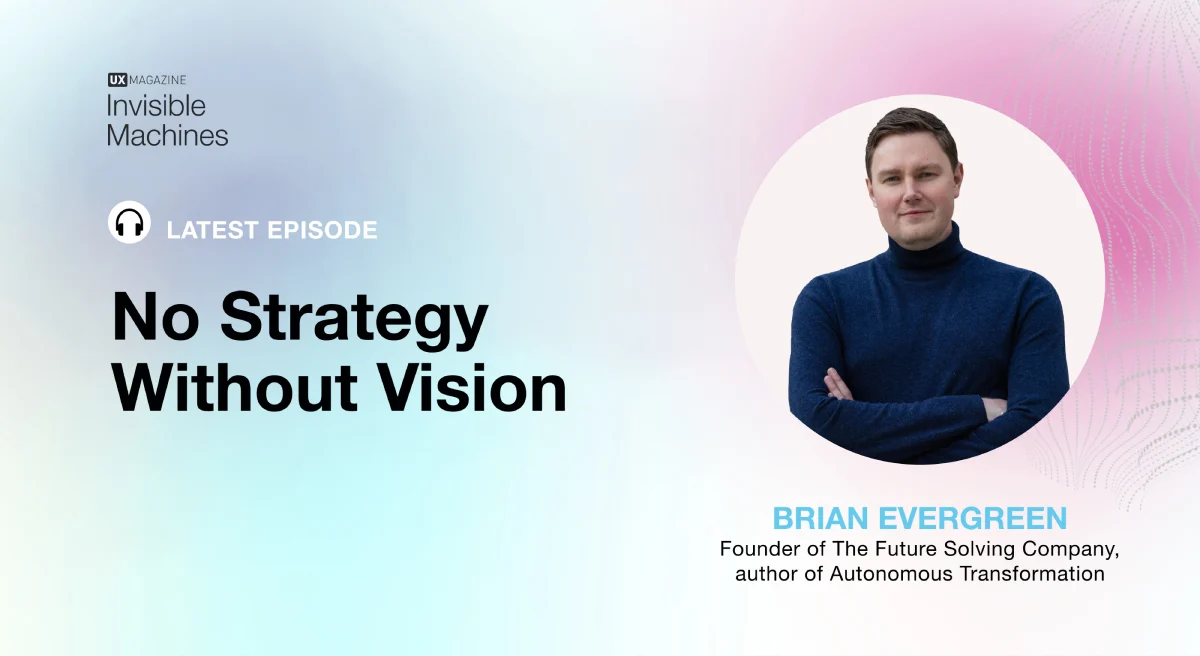
In the executive suites of the Fortune 500, a familiar, frantic ritual is playing out. Boards are demanding an "AI Strategy," and leadership teams are responding with a frantic scramble for literacy—a crash course in Large Language Models (LLMs), neural networks, and agentic workflows. Once the terminology is mastered, the machinery of the modern enterprise kicks into gear: Requests for Proposals (RFPs) are drafted, analyst quadrants are studied, and vendor bake-offs commence.
But according to Brian Evergreen, founder of The Future Solving Company and author of Autonomous Transformation, this entire process is fundamentally broken. In a recent appearance on the Invisible Machines podcast, Evergreen argued that the modern enterprise’s approach to AI is "busy, intelligent, and hollow at the center." By treating agentic AI as a procurement exercise rather than a design challenge, companies are building for a world that no longer exists, effectively trying to solve the problems of tomorrow with the bureaucratic tools of the 20th century.
The Anatomy of a Flawed Strategy
The Literacy-to-Sprint Fallacy
Evergreen posits that executives often approach AI through a "two-step" process: first, gain enough technical fluency to appear credible in a boardroom setting; second, race to curate a list of use cases and potential vendors. While he acknowledges that understanding the mechanics of AI is as essential as a painter knowing their pigments, the danger lies in what happens next.
"The trouble starts when literacy becomes permission to sprint," Evergreen warns. Organizations treat AI implementation like a standard IT upgrade, utilizing RFPs, feature matrices, and oral defenses—tools designed for purchasing commodities or "SKUs." This approach fails spectacularly when the goal is exploration. There is no historical dataset for a market structure that has yet to emerge, and there is no "replicated experiment" for a business category that does not yet exist.
The Myth of the Checklist
Robb Wilson, CEO of OneReach.ai and co-host of Invisible Machines, notes that most large organizations are not suffering from a lack of planning, but rather a "highly evolved plan for buying known solutions." This becomes a liability in the age of agentic AI. Because software capabilities now evolve mid-flight—often shipping as side effects of model updates—a feature checklist that is valid in January may be obsolete by June. By focusing on "vendor parity," companies are often inadvertently selecting tools that are misaligned with their actual long-term needs.
Chronology of a Paradigm Shift: From Problem Solving to Future Solving
The traditional corporate mindset is rooted in "problem solving"—an exercise of elimination, trimming waste, and curating existing value. It is inherently defensive. Evergreen proposes a radical pivot: "Future Solving."
The "Duomo" Analogy
Evergreen uses a striking metaphor to illustrate the limitation of current AI initiatives: "Training everyone in a city to swing hammers might produce sturdier houses, but you will not stumble into the Duomo."
Mass literacy and a focus on incremental "use-case hunting" produces motion without architecture. If an organization begins from its current org chart and asks, "How can we make this 10% more efficient?", it inherits all the constraints of the present as its destiny.
The Future-Solving Framework
Instead, Evergreen suggests a process that is "childlike in its difficulty":
- Define the Destination: Set the system aside and envision the most remarkable, optimized version of your work.
- Backcast the Necessary Conditions: Work backward to identify what would have to be true for that vision to exist. This includes new data contracts, shifted incentives, updated policies, and reimagined partnerships.
- Map the Artifacts: The output is not a mood board or a wish list, but a tangible map of dependencies that leadership can actually align on.
Supporting Data and Historical Precedents
To prove that the technology is rarely the bottleneck, the discussion turned to historical case studies that highlight the role of alignment and institutional inertia.
The Blockbuster Warning
Evergreen revisited the collapse of Blockbuster, which had actually piloted a streaming-shaped service years before the market went mainstream. The project failed not because of technical incompetence, but because the company’s "customer-of-record" was the franchisee, not the renter. The innovation was viewed as a threat to the existing balance sheet. The lesson for today’s AI adopters: If your innovation strategy threatens your primary revenue structure without a transition plan, the organization will naturally reject the "transplant."
The 1952 Bell Labs Reset
In contrast to the siloed failure of Blockbuster, Evergreen pointed to Bell Labs in 1952. Facing a crisis of stagnation, leadership forced an radical exercise: they commanded their engineers to assume the entire telephone network was destroyed and to rebuild it from scratch, using modern science and economic principles. This "unnatural exercise" triggered a decade of breakthroughs, including touch-tone dialing and voicemail. It proved that breakthrough cadence is a function of institutional will, not just calendar availability.
Official Responses: The Governance Layer
Josh Tyson, in the same conversation, highlighted the practical implementation of these ideas at institutions like Morgan Stanley. Their work on a "governed knowledge layer" provides a concrete example of what "what would have to be true" looks like in practice. Instead of dumping PDFs into a large language model, the firm focused on accountability, freshness, and ownership.
Evergreen notes that this shift is linguistic. A vision should be "visceral"—something that can be pictured in a room. If a leader says, "We will be more profitable," that is merely a scoreboard. If they say, "The advisor will answer in real-time, the clinician will stay in the human moment, and the relationship will be so trusted that shadow IT becomes irrelevant," that is a vision that can drive change.
Implications for the Future of Business
The Death of the "Vendor Bake-off"
The ultimate implication of this shift is the death of the traditional vendor bake-off. If an organization does not define its own "story," a platform company will do it for them. When a company relies on a vendor to dictate the "best practice" for their AI integration, they are essentially outsourcing their future strategy.
Friction as a Mirror
Evergreen warns that "friction is infinite without a direction." Organizations often spend millions trying to reduce operational friction without asking if the process itself is worth keeping. Vision acts as a "steamroller"—it provides the momentum required to overcome organizational inertia.
When employees are enrolled in a future they truly desire, they become architects of the path rather than victims of the change. Conversely, if a company focuses purely on adoption metrics for a poorly defined AI project, they may simply be scaling "the wrong future."
The "Invisible" Interface
Perhaps the most profound implication is the move toward "intent-based" computing. As agentic AI matures, the winning experience will likely be the one that handles intent end-to-end, rendering the logistics layer invisible. In this world, the concept of a "login" or a "software interface" will become as antiquated as a floppy disk icon.
Conclusion: Authorship Over Discovery
The future is not discovered by measuring the present with greater intensity. It is authored.
For leaders today, the mandate is clear: Stop treating AI strategy as a procurement exercise. Start by naming the future you wish to create in language that humans can carry. Map the necessary truths—the data, the incentives, and the policies—that must be aligned to make that future a reality. Only once the heading is set, and the organization is aligned on the destination, should you begin to argue about which agents, models, and roadmaps will get you there.
Anything less is simply rearranging the deck chairs on a ship that has no idea where it is sailing.
 Ammar Sabilarrohman
  Neng Nana
  Sagoh
Sagoh 