
 By Siti Muinah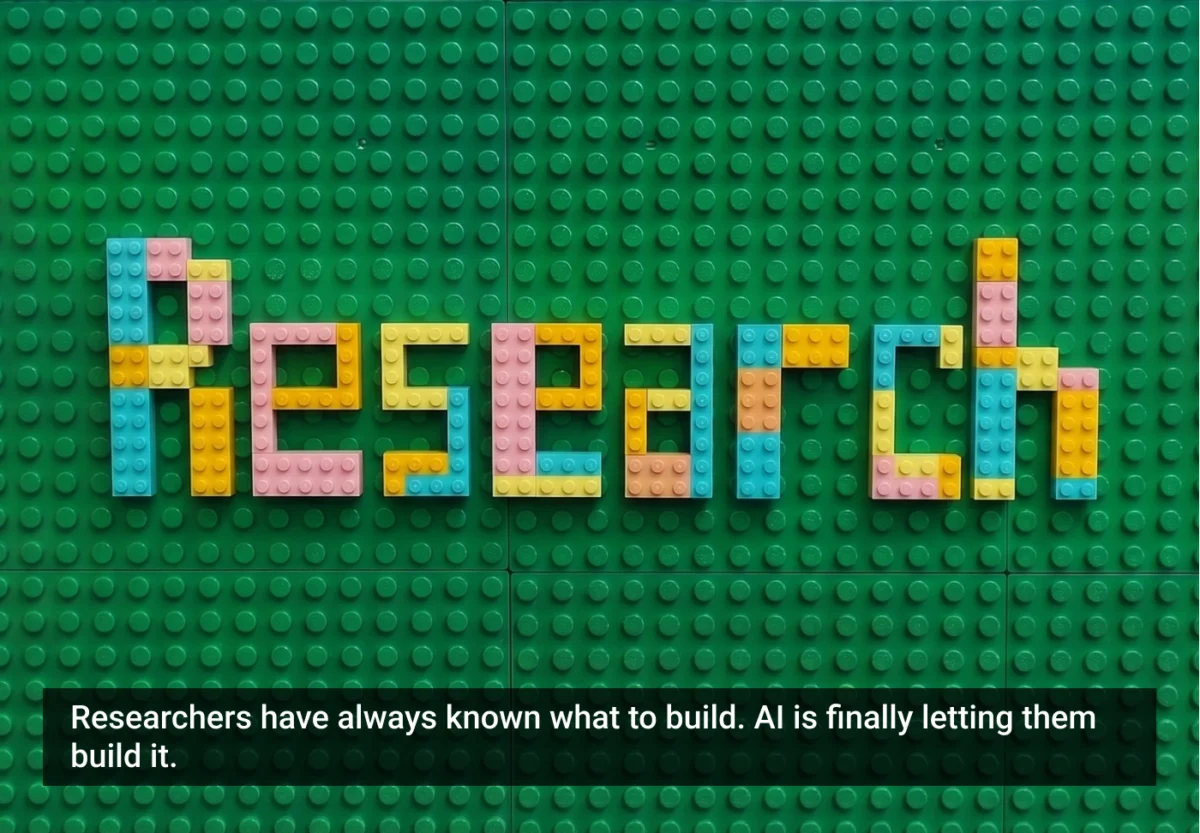
From freeze-dried backpacking food and personal finance applications to innovative photo booth hardware and community-led refugee initiatives, a quiet revolution is taking place. Researchers—traditionally the observers, the chroniclers, and the advisors—are increasingly becoming the creators.
For decades, the role of the researcher was defined by a boundary: we provided the intelligence, and others provided the execution. We influenced through reports, personas, and strategic roadmaps. Today, that wall is crumbling. Driven by the democratization of AI tooling and a shifting professional landscape, researchers are finding that the distance between "I understand the problem" and "I have built the solution" has never been shorter.
Main Facts: The New Researcher Identity
The core shift in the professional landscape is the emergence of the "researcher-maker." This is not a title change, but an identity evolution. Researchers are leveraging their foundational skills—empathy, analytical rigor, and systemic thinking—to build products that address real-world friction.
Crucially, this movement is not solely about software. It is about a "researcher’s way of making," which prioritizes ethical considerations, user-centricity, and iterative development over the "move fast and break things" mantra often associated with traditional startup culture. Whether it is an exhibit at the V&A Museum or a specialized app for children learning AI, the output is secondary to the approach: a deliberate, evidence-based process that refuses to abandon the values of inquiry.
Chronology: From "Could" to "Must"
The transition from passive advisor to active builder has not been linear.
- The Era of "Could": A year ago, the industry buzzed with the potential of AI. Researchers looked at generative tools and saw a vast horizon of possibility. There was a sense of excitement around what could be done.
- The Era of "Should": As the job market tightened and corporate priorities shifted, that sense of possibility hardened into a strategic mandate. Research teams were increasingly tasked with not just identifying gaps, but actively prototyping solutions to fill them.
- The Era of "Must": Today, the pressure to become a maker has, for many, become a survival mechanism. Faced with layoffs and shifting organizational structures, many researchers are finding that their traditional roles are no longer sufficient to provide job security or personal satisfaction.
For many, this was not a choice made in a vacuum, but a reaction to a landscape where the "you can always get a job" mantra no longer holds true.
Supporting Data: The Researcher-Maker Case Studies
The evidence for this shift lies in the stories of those who have already crossed the threshold.
The Neha Model: Balancing Empathy and Speed
Neha, a founder of a personal finance app, realized early on that her researcher instincts—while vital for building a product that resonated with users—were initially a bottleneck for product velocity. She implemented a "time-boxed" decision-making process, ensuring that while her team’s direction remained evidence-based, they maintained the momentum necessary to survive in a competitive market. Her success proved that a startup could be a space for nourishment rather than depletion.
The Jen Approach: The Intersection of Rigor and Business
Jen, who pivoted from a frustrated photo booth user to the founder of a boutique event-tech business, illustrates that entrepreneurial success is often a matter of applying research loops to one’s own product. By treating her business model as an ongoing hypothesis—constantly testing assumptions with real users—she successfully bridged the gap between academic rigor and market viability.
The Brian Perspective: Sales as Discovery
Brian, who runs an AI-focused kids’ club, challenges the stigma surrounding "sales." He argues that in the context of a researcher-maker, sales is simply another form of discovery. It is the act of constructing an argument based on a deep understanding of what the other person truly needs. For Brian, the "aha" moment is not just building a product, but realizing that his research background gave him the exact tools required to scale his impact.
Official Perspectives: The Role of AI and Professional Identity
The consensus among these practitioners is that AI is a tool, not a replacement for the human element of research. Matthieu, who is building a financial planning tool, noted that while AI can populate databases and generate code, it cannot replace the peer-review process, the visual design eye, or the objective, unbiased perspective of a trained researcher.
"Claude is just a tool to expand what you can do," Matthieu explains. "That’s it."
This sentiment is echoed by those who caution against the "romance of the founder." They emphasize that the researcher-maker path is not without significant hazards:
- Isolation: The "productive friction" of a team environment is often lost when one builds in isolation, leading to burnout.
- Financial Precarity: The myth of the "laptop on a beach" is dangerous. True, sustainable building often requires a stable financial runway, which is not evenly distributed across the demographic spectrum.
- Identity Grief: Leaving a corporate role, as Cris (a ceramicist-researcher) discovered, can result in the loss of community and professional identity. The transition requires a period of grieving and the active reconstruction of a new, hyphenated self.
Implications: A New Way of Being
The implications for the research industry are profound. We are seeing a move away from the "service provider" model of research toward a "product owner" model.
1. The Power of the Hyphen
The hyphenated identity—researcher-maker, researcher-founder, researcher-potter—is the key to future-proofing one’s career. It does not diminish the research identity; it expands it. It allows for a more generous definition of "making" that includes community building, educational work, and artistic expression.
2. Redefining Value
As AI commoditizes technical tasks, the differentiator for great products becomes discovery. Researchers are uniquely positioned to define what problems matter. By moving from advising to owning, researchers take full accountability for outcomes, forcing a maturation of the craft.
3. Ethical Stewardship
Perhaps the most significant implication is the infusion of ethical, deliberative, and human-centric values into product creation. If more researchers become makers, the products of tomorrow are more likely to be built with a profound understanding of human needs, rather than just technical feasibility.
Conclusion: Staying True to the Identity
For those considering this path, the advice from those who have gone before is consistent:
- Start Small: Prototyping does not require a venture-backed startup. It can start as a side project, a hobby, or a community tool.
- Seek Community: Combat the isolation of the "maker" by joining specialized networks or finding partners who complement your skill set.
- Be Brutally Honest: Recognize which research sensibilities you are willing to compromise on and which are non-negotiable.
The era of the researcher-maker is here. It is a path that demands resilience, a high tolerance for ambiguity, and the courage to claim an identity that defies traditional labels. It is not an easy road, but it is one that offers the potential for profound professional and personal growth—a way to turn the "coulds" of our industry into the "is" of our future.
 Ammar Sabilarrohman
  Neng Nana
  Sagoh
Sagoh 