
 By Sagoh
While artificial intelligence has successfully colonized our smartphones, tablets, and desktop operating systems, it has faced a stubborn and formidable barrier in the physical world: standalone dedicated devices. From the awkward fumbles of early AI pendants to the widely criticized Humane AI Pin and the niche Friend necklace, the tech industry mantra "hardware is hard" has proven brutally accurate. Consumers have largely rejected standalone gadgets that promise ambient intelligence but deliver clunky interfaces, overheating issues, and dubious utility.
Yet, Silicon Valley’s premier powerhouses are undeterred. Over the next year, tech giants Meta and OpenAI are preparing to mount a concerted campaign to crack the dedicated AI hardware code. Their strategic playbook relies on a fascinating psychological gamble: soft-launching anthropomorphized, cutesy software agents to build consumer affection and familiarity before asking users to buy expensive physical hardware.
By wrapping advanced machine learning in charming, expressive avatars—reminiscent of 90s digital pets—these companies hope to bypass the initial consumer skepticism that torpedoed their predecessors. However, as public fatigue and skepticism toward generative AI mount, the road ahead is fraught with technical, security, and cultural challenges.
Main Facts
The push into physical AI hardware represents the next major frontier for the generative AI boom. Despite previous failures across the industry, Meta and OpenAI are advancing distinct hardware strategies underpinned by software-first engagement models.
- Meta’s Hardware Timeline: Meta is moving aggressively toward a physical release, targeting a timeline ahead of the upcoming holiday shopping season. CEO Mark Zuckerberg recently unveiled the "Muse Charm," a pendant-like keychain device equipped with a small screen that displays the interactive Muse AI agent.
- OpenAI’s Hardware Timeline: OpenAI is taking a more deliberate, long-term approach. According to public regulatory filings, the company is collaborating with legendary former Apple chief designer Jony Ive to build a dedicated device, with a targeted shipping date no earlier than February 2027.
- The Software-First Strategy: Rather than dropping cold hardware onto an unwilling market, both companies are priming consumers by first introducing endearing software agents—Meta’s "Muse" and OpenAI’s "Dots"—as ambient, digital companions.
- The Interface Shift: OpenAI’s newly announced Dots platform features personalizable, colorful graphical blobs equipped with animated eyes. While not explicitly tied to a shipping date, OpenAI leadership has strongly hinted that Dots will eventually serve as the graphical interface for future physical hardware.
Chronology of the Shift Toward Ambient AI
To understand how Meta and OpenAI arrived at their current hardware strategies, it is necessary to examine the evolution of the dedicated AI device market over recent years.
The Era of Premature Hardware (2023–2024)
The initial wave of post-ChatGPT hardware attempted to capitalize on the generative AI hype cycle immediately. Products like the Humane AI Pin and the Friend AI companion wearable rushed to market. However, these devices suffered from severe performance bottlenecks, lack of clear use cases, high price tags, and privacy concerns. They were treated as expensive novelties rather than indispensable tools, resulting in harsh critical reviews and widespread public backlash.
The Pivot to Ambient Software (Late 2024–Mid 2025)
Recognizing that consumers were unwilling to wear poorly functioning pins on their lapels, tech companies re-evaluated their approaches. Instead of forcing hardware adoption, companies began embedding agents deeply into software ecosystems. Meta rolled out its Muse agent across its family of apps, while OpenAI continued to refine ChatGPT into an omni-channel assistant. During this period, developers realized that humans respond more positively to personable, character-driven interfaces than to sterile, text-based chat boxes.
The Convergence of Avatars and Pendants (2025–Present)
Moving into the current phase, both Meta and OpenAI have converged on a hybrid strategy. By introducing visual characters—such as OpenAI’s eyed blobs in Dots and Meta’s tamagotchi-style Muse Charm—they are bridging the gap between cold utility and emotional attachment. Meta is preparing its hardware rollout for late 2025, while OpenAI lays the groundwork for Jony Ive’s hardware design slated for early 2027.
Supporting Data and Ecosystem Analysis
The strategy employed by Meta and OpenAI is fundamentally rooted in behavioral psychology. By making AI agents look "cute" and approachable, the companies are attempting to bypass the uncanny valley and lower consumer resistance.
The Tamagotchi Effect
The physical designs and software behaviors being tested bear a striking resemblance to the nostalgic Tamagotchi craze of the late 1990s. By giving AI agents faces, expressive eyes, and vibrant colors, developers are weaponizing anthropomorphism. When a user perceives an AI not as a cold algorithm, but as a responsive "little guy" living on their keychain or screen, tolerance for minor bugs increases, and daily engagement spikes.
Form Factors and Portability
Meta’s Muse Charm represents a distinct design philosophy: ultra-portability. According to Mark Zuckerberg, the device acts as the fastest alternative to smart glasses. If a user is not wearing AR glasses, the Muse Charm provides an immediate, voice-and-vision portal to the physical world, allowing the AI to "see" surroundings via camera integration and respond instantly.
OpenAI, conversely, is viewing its Dots ecosystem through the lens of ambient ubiquity. As OpenAI’s head of core products, Thibault Sottiaux, noted during a recent press briefing, the point of interaction between humans and AI is destined to blur. Whether accessed via email, phone calls, text messages, or future Jony Ive-designed hardware, the goal is for the assistant to weave itself seamlessly into the fabric of daily life.
Official Responses and Leadership Insights
Executives from both companies have shed light on the strategic thinking driving these hardware ambitions during recent media appearances and keynote events.
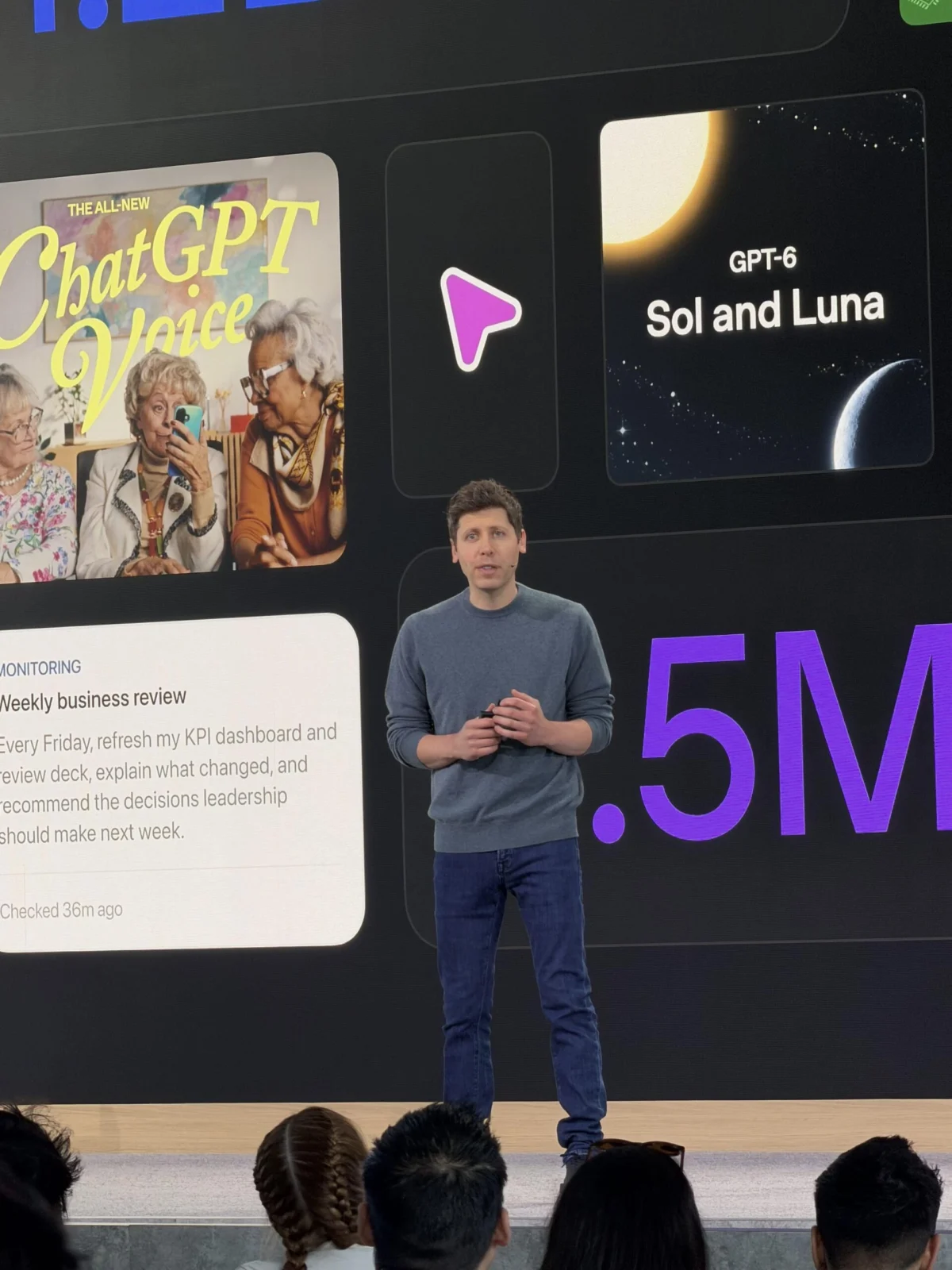
During OpenAI’s recent DevDay press Q&A, CEO Sam Altman addressed reporters regarding the potential physical manifestation of the Dots platform. When asked if the colorful, eyed blobs would power a future physical device, Altman admitted that it "seems like a very reasonable thing to assume we may do someday," while keeping specific hardware blueprints under wraps.
Altman emphasized that Dots is designed to transcend the limitations of previous reactive AI assistants.
"This feels like an always-on helper, collaborator… that you can give very large pieces of work to, and it gets to know you and helps proactively over time," Altman explained.
Thibault Sottiaux echoed this sentiment, detailing how OpenAI plans to evolve ChatGPT in place.
"We’ll be evolving ChatGPT in place to be this incredible personal assistant very soon," Sottiaux said. He added that as users interact with their agents across multiple mediums, the boundaries will dissolve, turning AI into a “natural part of your life.”
On the other side of the aisle, Meta CEO Mark Zuckerberg championed the engineering marvel packed into the Muse Charm during his onstage presentation.
"We’ve packed a lot of technology into this little guy," Zuckerberg remarked. "So, if you’re not wearing glasses, this is going to be by far the fastest way to talk to your Muse and to show it what’s going on around you."
Implications for the Future of Tech
The convergence of Meta and OpenAI on software-primed, character-driven hardware carries profound implications for the consumer electronics landscape, privacy advocates, and the broader tech economy.
1. The Death of the Traditional App Interface
If OpenAI and Meta succeed in making AI agents the primary layer through which users interact with technology, the traditional app grid on smartphones could face obsolescence. Rather than opening individual apps for navigation, shopping, or messaging, users may simply delegate tasks to their persistent "Dots" or "Muse" agents, which will execute actions across third-party platforms via API integrations.
2. Heightened Privacy and Security Risks
Ambient hardware that is "always-on" and capable of viewing the physical world presents terrifying security and privacy implications. Meta’s recent trials have already highlighted vulnerabilities, including concerning security exploits tied to the Muse agent operating within Facebook Marketplace. Furthermore, devices that listen, watch, and learn user habits continuously will serve as massive honeypots for sensitive personal data, inviting intense regulatory scrutiny and potential cyberattacks.
3. Overcoming Public Fatigue
The public is increasingly growing weary of generative AI hype, corporate over-promising, and environmental resource consumption. By relying on playful, non-threatening aesthetics (the cutesy software agent approach), tech companies are attempting a charm offensive. However, if these devices launch with hallucinations, latency issues, or privacy gaffes—as demonstrated by a recent Dots voice demo that malfunctioned live on stage at DevDay—the public backlash could permanently close the door on standalone AI hardware.
Conclusion
Meta and OpenAI are embarking on a high-stakes gamble. By reversing the traditional product launch funnel—building software attachment before committing to multi-million-dollar hardware manufacturing lines—they hope to solve the riddle that defeated the Humane AI Pin and other early pioneers. Whether consumers ultimately embrace a keychain-sized Tamagotchi AI or reject it as another expensive gadget remains to be seen, but one thing is certain: the battle for the physical manifestation of artificial intelligence has officially begun.
 Nana Muazin
 Raul Delapena Setiawan
 Pevita Pearce
