
 By Lina Irawan
As artificial intelligence continues to blur the boundaries between reality and fabrication, distinguishing between authentic media and machine-generated content has become a daily challenge for consumers, journalists, and professionals alike. From hyper-realistic imagery on restaurant menus to sophisticated audio clips circulating across social media platforms, AI-generated assets are now an inescapable facet of modern life.
While traditional visual cues—such as warped hands, unnatural text renderings, or distorted background perspectives—have historically helped flag synthetic media, these "tells" are rapidly disappearing. In response to this escalating digital verification crisis, major technology companies are doubling down on algorithmic watermarking techniques.
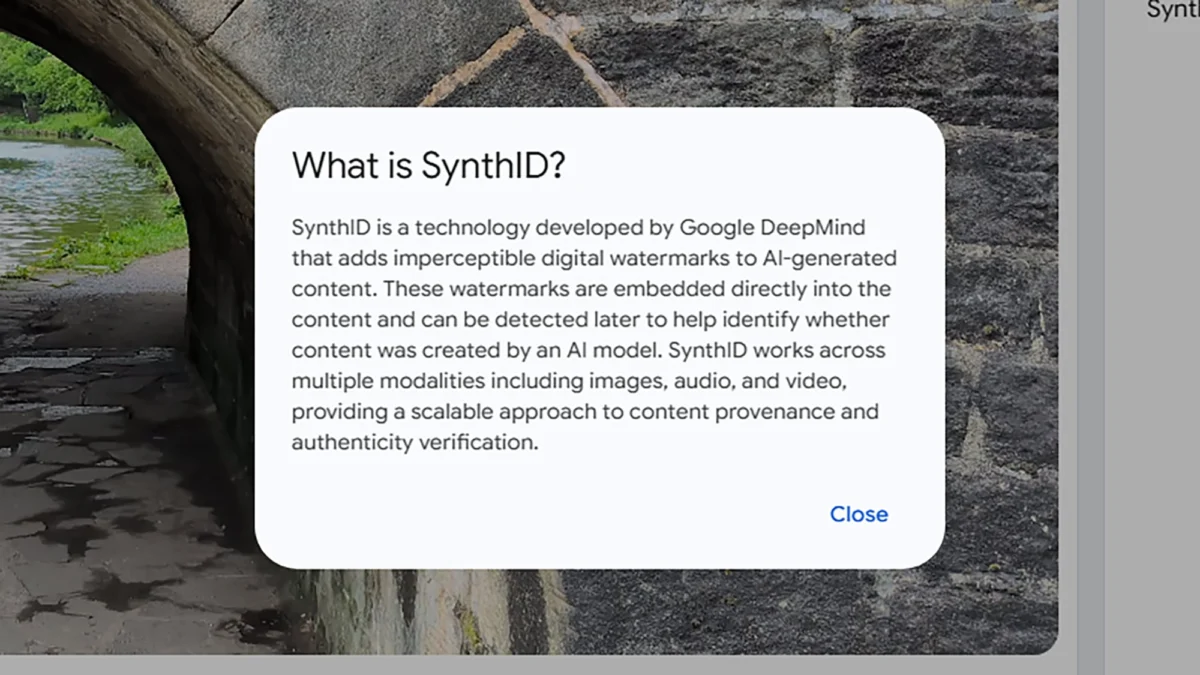
Chief among these efforts is SynthID, an invisible digital watermarking technology developed by Google DeepMind. Previously restricted to backend platforms or limited enterprise integrations, SynthID has now broken into the mainstream. Google has officially launched a standalone, free-to-use SynthID Detector web portal. Accessible to anyone with a Google account, the new tool aims to bring transparency to the digital ecosystem by allowing users to check images, videos, and audio files for hidden AI signatures.
Main Facts: What is Google’s SynthID Detector and How Does It Function?
At its core, Google’s SynthID Detector is a web-based utility designed to verify whether media files—spanning multiple formats of images, audio, and video—contain an embedded, invisible SynthID watermark.
The tool supports a vast array of file types:

- Images: JPG, JPEG, PNG, BMP, WEBP, AVIF, HEIC, HEIF, TIFF, TIF, and GIF.
- Videos: MP4, MOV, and WEBM.
- Audio: WAV, MP3, OGG, FLAC, AAC, and M4A.
Unlike traditional watermarks that appear as visible logos or translucent stamps in the corner of a frame, SynthID is mathematically woven directly into the foundational data of the file. For images and videos, this means the watermark is embedded within the pixel structure itself; for audio, it is integrated into the frequency components. Crucially, Google notes that these watermarks are imperceptible to human eyes and ears, meaning they alter neither the aesthetic quality nor the fidelity of the original asset.
Furthermore, SynthID is not merely a proprietary Google standard. It is supported by an expanding consortium of tech giants, including Nvidia, OpenAI, and Kakao, though individual companies may also field their own verification ecosystems—such as OpenAI’s distinct tracking and verification research tools.
To prevent abuse and manage computational loads, the public web portal currently imposes a daily usage quota, reportedly capping users at roughly 10 files per day across each media category (images, video, and audio) before requiring a 24-hour cool-down period.
Chronology: The Evolution of SynthID and Its Path to Public Release
The journey toward universal AI watermarking has been iterative, marked by a series of strategic rollouts across the tech industry:
- Early 2023–Late 2023 (The Wild West of Generative AI): As text-to-image generators like Midjourney, OpenAI’s DALL-E, and Google’s Imagen gained public prominence, the proliferation of deepfakes and unverified synthetic imagery triggered widespread concern regarding election interference, fraud, and misinformation.
- August 2023 (Google DeepMind Introduces SynthID): Google officially unveils SynthID, initially deploying it as a watermarking tool for images generated by its Imagen model via Vertex AI. The technology proves capable of remaining intact even after cropping, filtering, or saving lossy files.
- May 2024 (Expansion to Audio and Text): Recognizing that generative AI extends far beyond static images, Google expands SynthID capabilities to cover AI-generated audio and text outputs, cementing its status as a multi-modal safety framework.
- Late 2024–2025 (Cross-Industry Adoption): Major industry players begin aligning with watermarking protocols. Nvidia and other hardware and software vendors incorporate structural support for watermarking standards, laying the groundwork for broader interoperability.
- October 2026 (The Public Web Portal Launch): Google bridges the gap between enterprise safety tools and end-users by deploying the standalone, public SynthID Detector web interface. For the first time, everyday internet users can independently drag and drop media files into a browser window to interrogate their origins.
Supporting Data: Putting the Detector Through Real-World Tests
To understand how the SynthID Detector performs outside of controlled laboratory environments, independent tech journalists and early testers have put the web portal through a series of rigorous, real-world trials. The results paint a nuanced picture: while the detector is remarkably resilient against common digital manipulations, it is far from infallible.

1. Direct Downloads and Standard Formats
When fed pristine images downloaded directly from leading generative engines—such as Google’s Gemini and OpenAI’s ChatGPT—the detector excelled. It successfully flagged the media as synthetic within seconds, often accurately identifying the specific corporate family of the AI tool used to craft the asset.
2. Resistance to Image Manipulation
Bad actors rarely upload pristine, unedited AI files; instead, they crop, color-correct, and filter images to mask their origins. Testers subjected SynthID-watermarked images to several standard editing procedures in software like Adobe Photoshop:
- Applying artistic filters: Adding an oil painting filter or subtle blur did not break the watermark; the detector still identified the underlying pixel-level signature.
- Color and contrast adjustments: Tweaking exposure, saturation, and tone vectors left the hidden cryptographic signal intact.
- Cropping and compositing: Combining elements from two different AI images (e.g., merging a Gemini-generated background with a ChatGPT-generated foreground) yielded mixed results, but the detector frequently managed to isolate at least one watermarked component.
3. Where the Detector Fails
Despite its sophisticated architecture, the SynthID Detector hits a wall under extreme modification or boundary-case scenarios:
- Heavy Pixelation: Intentionally degrading an image through massive pixelation or extreme compression successfully stripped the readability of the watermark—though images degraded to this degree lose their utility for disinformation campaigns anyway.
- Composite Edge Cases: In tests involving mixed-media collages—such as inserting a single AI-generated human figure into an otherwise fully authentic, real-world group photograph—the detector occasionally faltered. In some instances, the presence of a small amount of AI data triggered a positive flag, while in others, the dilution of the synthetic signal caused the tool to report the image as clean.
- Authentic Media Verification: When testing verified, 100% human-shot photographs, the tool correctly reported that no SynthID watermark was found. However, it tended to hedge its output, returning statements indicating that it was "unlikely" the media was AI-generated. This highlights a crucial caveat: the detector only checks for the presence of a specific watermark, rather than performing a holistic scan for generalized digital anomalies or visual artifacts.
Official Responses and Industry Perspectives
Google has been transparent regarding the limitations of its new tool. In accompanying documentation and technical disclosures, company representatives emphasize that SynthID is not designed to be a silver bullet for the global disinformation crisis.
Google’s engineering teams openly acknowledge that heavy modifications, iterative saves, and complex multi-step transformations can degrade the watermark signal. Consequently, the company strongly advises users to upload files in the highest possible resolution and uncompressed formats to maximize detection accuracy.

Industry analysts and security experts have largely welcomed the release of the public portal as a step in the right direction, though they offer tempered enthusiasm. Cybersecurity researchers point out that watermarking systems rely entirely on voluntary adoption by AI developers. If bad actors deploy open-source models—such as unaligned variants of Stable Diffusion—that do not incorporate SynthID watermarks, Google’s detector will inevitably return a negative result, even if the image is entirely synthetic.
Furthermore, privacy advocates have raised questions regarding the requirement to sign in with a Google account to access the web portal. While necessary for rate-limiting and managing server quotas, mandatory authentication links search queries and uploaded media files directly to individual user profiles, a factor that privacy-conscious consumers may weigh carefully before testing sensitive files.
Implications: What the SynthID Detector Means for the Future of Media
The widespread availability of the SynthID Detector carries profound implications for journalism, law, legal proceedings, and the general public’s trust in digital media.
1. The Arms Race Between Generation and Detection
The introduction of a free, accessible web tool marks another phase in the ongoing technological arms race between generative AI creators and malicious actors. As watermarking standards mature, bad actors will inevitably invest in adversarial techniques—such as adversarial noise injection or specialized stripping algorithms—designed to scrub or scramble hidden pixel-level signatures without degrading visual quality. Tech companies, in turn, will be forced to make their watermarks increasingly robust.
2. Shifting Burdens of Proof
In legal, journalistic, and corporate environments, verifying the authenticity of digital evidence has historically relied on metadata analysis and expert testimony. Tools like the SynthID Detector shift the paradigm toward automated, platform-agnostic verification standards. However, this creates a dangerous inverse assumption: the public may soon begin to believe that any image lacking a positive SynthID flag is automatically authentic, ignoring the reality that many legitimate AI models still do not apply the standard, and that malicious actors can intentionally evade detection.

3. Toward an Interoperable Ecosystem
Ultimately, the long-term success of SynthID and competing protocols depends on universal industry adoption. For a watermarking standard to truly protect the integrity of the global information space, it must be universally implemented across every major commercial and open-source generative model on the market.
Google’s decision to launch a public-facing detector provides a vital testing ground for how consumers interact with verification technology. While the tool is not infallible and cannot replace critical thinking or thorough investigative journalism, it equips the public with a powerful new lens through which to examine the digital world—proving once again that in the age of generative AI, seeing is no longer necessarily believing.
 Layla Zulfa
 rifanmuazin
 Nila Kartika Wati
