
 By Pevita Pearce
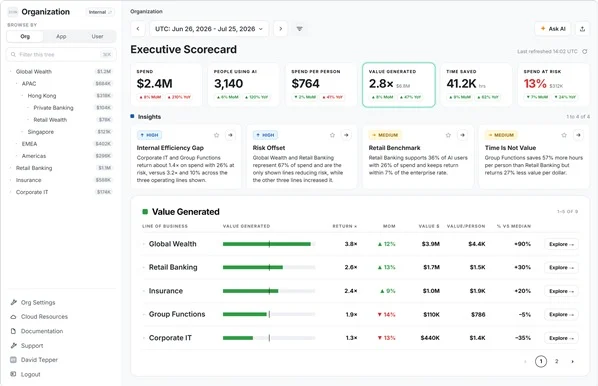
In the early days of the generative AI gold rush, corporate strategy was defined by a frantic race to "do AI." CIOs and CFOs greenlit countless pilot programs, authorized blanket subscriptions for copilots, and provisioned massive GPU clusters with little more than a hope that these investments would eventually pay off. Today, that era of unchecked experimentation is colliding with the cold reality of the corporate balance sheet.
Ascerta, the enterprise management platform formerly known as Pay-i, is stepping into this breach. This week, the company announced a significant pivot and rebrand, accompanied by an $18 million Series A funding round led by Dell Technologies Capital. With this injection of capital—bringing the company’s total funding to $22.9 million—Ascerta is moving beyond mere cost-tracking to define a new mission-critical category: Enterprise AI Management.
The Evolution of the AI Ledger: From Pay-i to Ascerta
The transition from Pay-i to Ascerta is more than a superficial marketing exercise; it represents a fundamental shift in the company’s philosophy. When the company emerged from stealth in May 2025 with a $4.9 million seed round, its primary focus was the "FinOps" of artificial intelligence—helping enterprises track token consumption and license fees to prevent budget overruns.
However, as co-founders David Tepper, Doron Holan, and Erik Winters observed their clients’ internal operations, they realized that knowing the cost of AI was only half the battle. Enterprises were drowning in "vanity metrics"—counting lines of generated code, agent runs, and active users—without any clear line of sight into whether these activities were moving the needle on revenue or operational efficiency.
"The market is full of meaningless vanity metrics," says David Tepper, CEO and co-founder of Ascerta. "Companies are counting tokens and agent runs while struggling to derive the impact AI has on their business. We built Ascerta to cut through the noise and provide the means to win in the AI era. That means insights specific to their business, people, and use cases. That means purpose-built tools to prevent waste and aggressively optimize for value."
A Foundation Built on Microsoft Hyperscale Expertise
The authority behind Ascerta’s vision is rooted in the deep technical background of its leadership team. All three co-founders are veterans of Microsoft, where they witnessed the challenges of scaling AI infrastructure within a massive, complex organization.

David Tepper, who spent 19 years at Microsoft, was a key architect of the company’s internal GenAI strategy for Azure. Doron Holan, with a 27-year tenure at the tech giant, brings critical expertise in hyperscale infrastructure, having managed systems that process hundreds of billions of requests daily. Together with COO Erik Winters, they recognized that the economics of AI were fundamentally different from traditional cloud computing—the variables were more volatile, and the potential for "shadow AI" and "zombie projects" was significantly higher.
How Ascerta Orchestrates AI Value
Ascerta’s platform acts as an intelligence layer that sits atop an enterprise’s existing AI ecosystem. Whether a company is using Microsoft’s Copilot suite, Amazon Bedrock, Salesforce Agentforce, or sophisticated coding agents like GitHub Copilot and Claude Code, Ascerta integrates into the workflow to provide a holistic view of the "AI estate."
The platform’s functionality is divided into three specialized modules:
- Atlas: The analytical engine of the platform. Atlas maps AI usage to specific business KPIs. It provides the "truth" about ROI by tracking adoption metrics across teams, departments, and specific use cases. It allows leadership to distinguish between high-performing initiatives and those that are essentially burning capital.
- Forge: Targeted at engineering organizations, Forge analyzes the efficacy of coding agents. It measures not just how much code is generated, but how that adoption translates into developer productivity, faster release cycles, and higher-quality outputs.
- Convoy: Designed for companies that manage their own AI capacity and infrastructure. Convoy helps organizations consolidate workloads and optimize GPU/model utilization, ensuring that scaling new use cases does not destabilize the production environment or lead to unnecessary cloud expenditure.
Chronology of a Shift: From Experimentation to Accountability
- 2024: Ascerta is founded by Microsoft veterans Tepper, Holan, and Winters, identifying a gap in how enterprises monitor and justify AI expenditure.
- May 2025: The company emerges from stealth under the name "Pay-i," securing $4.9 million in seed funding with a focus on AI cost management and financial visibility.
- Late 2025 – Early 2026: Market demand shifts from simple cost-cutting to value-justification. The founders realize that enterprise clients need to understand business outcomes, not just spend.
- September 2026: The company rebrands as "Ascerta" and announces its $18 million Series A, led by Dell Technologies Capital, with participation from Hitachi Ventures, BGV, and Wipro Ventures.
- Present: Ascerta transitions to a full-lifecycle Enterprise AI Management platform, partnering with global firms like Atos and IBM to bring rigor to the AI-first enterprise.
Supporting Data: Proving the ROI of Management
The value proposition of Ascerta is supported by tangible performance data. In an environment where companies are scrutinizing every dollar spent on AI, Ascerta’s impact on the bottom line is substantial. According to the company’s internal reporting, customers utilizing the platform have achieved:
- 47% improvement in ROI on AI initiatives by identifying and scaling the most effective models.
- 86% reduction in wasted AI spend by eliminating redundant licenses and failed agent runs.
- 24% faster launch times for new AI agents, allowing teams to move from pilot to production with higher confidence.
Florin Rotar, Group CTO and Chief AI Officer at Atos, highlights the necessity of this visibility: "At Atos, our Sovereign Agentic Studios operating model is built on moving agentic AI from pilot to production at global scale. That requires measurable business value, not just technical capability. Ascerta has been instrumental in delivering on that promise."
The Strategic Implication: Why This Matters Now
The rise of the "Enterprise AI Management" category is a direct response to the "AI sprawl" currently plaguing the C-suite. As organizations integrate hundreds of models, agents, and custom applications, the traditional FinOps approach—which focuses on cloud storage and compute costs—is no longer sufficient.
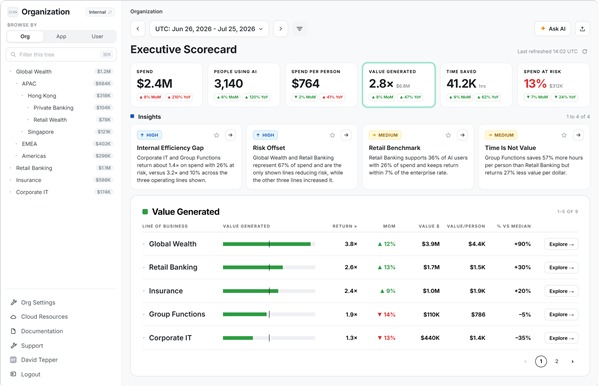
The gap between "what AI costs" and "what AI does" has become a liability. Without a system like Ascerta, companies risk continuing to fund projects that offer little value, while simultaneously missing out on opportunities to double down on the initiatives that are actually driving transformation.
Raman Khanna, Managing Director at Dell Technologies Capital, summarizes the significance of the shift: "Most enterprises are moving beyond broad AI experimentation and focusing their investments on what delivers measurable business value. David and the Ascerta team are giving leaders the visibility and rigor they need to understand what’s working, optimize spending, and scale their most successful AI initiatives."
Future Outlook: Beyond Measurement to Optimization
With the Series A funding secured, Ascerta is poised for aggressive growth. The company plans to scale its go-to-market operations and deepen its integration with the rapidly expanding universe of enterprise AI tools.
However, the long-term vision for the founders extends beyond simply "measuring" value. The research the company is currently conducting into AI value optimization suggests a future where Ascerta’s platform could become an active participant in AI orchestration. By not only reporting on what is worth scaling but potentially suggesting configuration changes, model swaps, or resource reallocation in real-time, Ascerta is positioning itself to become the central nervous system of the modern, AI-first enterprise.
As the industry matures, the survivors will not necessarily be the companies that spend the most on AI, but those that have the most clarity on where that spend is delivering results. In this new, disciplined chapter of the AI revolution, Ascerta is positioning itself to be the definitive guide.
 Basiran
 Sagoh
 Nana Wu
