
 By rifanmuazin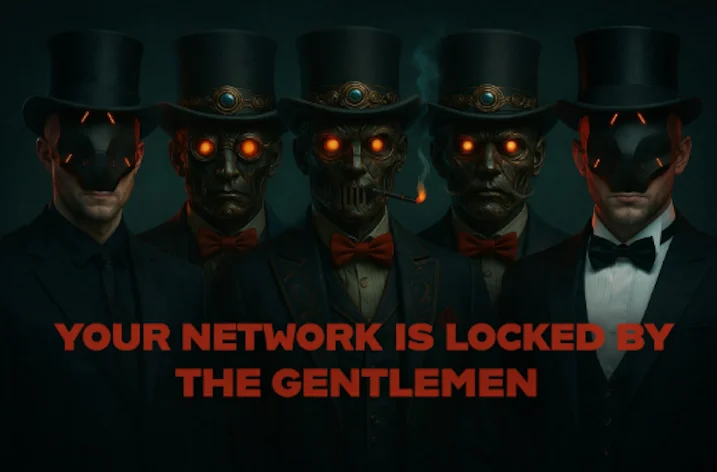
In the shadowy ecosystem of global cybercrime, few entities have ascended as rapidly or as aggressively as the ransomware collective known as "The Gentlemen." Operating under a “Ransomware-as-a-Service” (RaaS) model, the group has cemented its status as the second most active threat actor by victim count in 2026. While their technical prowess is significant, it is their radical business model—and a series of catastrophic operational security failures by their leadership—that has allowed researchers to peel back the curtain on the man behind the mask.
The Anatomy of a RaaS Disruptor
The Gentlemen have effectively weaponized corporate economics to dismantle the status quo of the cyber-underground. While the industry standard for RaaS operations typically dictates an 80/20 revenue split—with 80 percent going to the affiliate who performs the intrusion and 20 percent to the group administrator—The Gentlemen have pivoted to a 90/10 split.
This aggressive incentive structure has triggered a mass migration of seasoned cybercriminals from legacy programs to The Gentlemen’s ranks. According to security researchers at Check Point Software, this disruption has been the primary catalyst for the group’s growth. Since its inception in mid-2025, the collective has claimed at least 332 published victims, with over 240 incidents recorded in 2026 alone.
Their methodology is characterized by speed and precision. The group primarily targets internet-facing infrastructure—specifically VPNs and firewalls—to establish a foothold. Once inside, they move with remarkable velocity, often encrypting entire corporate networks within mere hours of initial access.
Chronology of a Cybercriminal Evolution
The investigation into the group’s leadership centers on a single, prolific persona: Zeta88, who is also known by the earlier moniker Hastalamuerte. By cross-referencing data from intelligence firms like Intel 471, Flashpoint, and Constella Intelligence, researchers have constructed a timeline of an individual who evolved from a novice forum participant into a sophisticated ransomware administrator.
- 2019–2020: The Formative Years. The user “Hastalamuerte” began appearing on Russian-language cybercrime forums, including Exploit, Ramp_V2, and BHF. During this period, the user was far from an elite operator. Records from a Telegram-based penetration testing training group (@pntst) show an individual struggling to master basic security tools, seeking guidance on the very exploits they would later automate to scale their ransomware operations.
- 2020: The Digital Footprint. Registration records from Raidforums link the user to the email address
[email protected]. The use of “1488”—a numeric code associated with white supremacist ideology—became a recurring theme in the actor’s branding. - 2022: The Birth of Zeta88. The user registered on the English-language forum Breached under the name Zeta88. Geolocation data from Intel 471 confirms that both the Hastalamuerte and Zeta88 accounts originated from the same Russian city: Izhevsk, the capital of the Udmurt Republic.
- 2025: Operational Maturity. With the launch of The Gentlemen, the administrator began centralizing their power. Backend infrastructure leaks analyzed by Kela Cyber confirm that the administrator behind this moniker is responsible for assembling the locker, managing the RaaS panel, and distributing payments.
The Paper Trail: Connecting the Dots to Izhevsk
The collapse of the actor’s anonymity is a classic case study in "breadcrumbing"—the accumulation of disparate data points that, when aggregated, point to a single physical existence.
The investigation utilized the email address [email protected], which linked to an Apple account and a phone number ending in 04. This same number was associated with a Telegram ID (30907522) that belonged to an account using the handle “bu4vs.”
Crucially, this phone number, 79127650004, appears in multiple leaked Russian government databases. The data identifies the owner as Alexander Andreevich Yapaev, a 36-year-old resident of Izhevsk. Further digital forensics by Constella Intelligence revealed that Yapaev utilized the username “4apai18” on the social media platform Pikabu—a phonetic play on the name “Chapaev.”
The most damning evidence, however, comes from the corporate sector. The email address [email protected]—used by the cybercriminal for years—is directly linked to a LinkedIn profile for an Alexander Yapaev, who lists himself as the Head of B2B Marketing for Uralenergo Udmurtia, a major supplier of electrical and lighting equipment in Russia.
Intelligence Perspectives and Advanced Capabilities
The threat research group PRODAFT recently published a comprehensive analysis of The Gentlemen, confirming with “high confidence” that the Zeta88/Hastalamuerte persona is the architect of the operation. PRODAFT’s report highlights a chilling development: the group is no longer relying solely on human skill. The administrator is reportedly integrating Artificial Intelligence to develop, maintain, and update the ransomware’s codebase.
Furthermore, the AI is being utilized to streamline post-exploitation activities, allowing the group to identify high-value data within a compromised network more rapidly than ever before. This automation ensures that even as the group grows, their technical quality remains consistent, minimizing the risk of decryption failures that could damage their reputation among affiliates.
The "Unwritten Rules" of Russian Cybercrime
The persistent question remains: why would an individual with a high-profile corporate job take such blatant risks with their digital identity?
The answer lies in the unique geopolitical landscape of the Russian Federation. Intelligence experts have long noted that the Russian government often adopts a policy of "controlled impunity." So long as cybercriminals focus their efforts on foreign targets and refrain from attacking domestic Russian infrastructure, they are largely shielded from international law enforcement.
This environment fosters a false sense of security. Many, like Yapaev, begin their careers as hobbyists and are drawn into the criminal economy by the promise of easy wealth. In the early days, their operational security (OPSEC) is poor, but by the time they reach a level of criminal sophistication where they should be hiding their tracks, they are often already "burned." They remain in their home country, shielded by borders and, in some cases, the complicity of local authorities.
Implications for Global Cybersecurity
The rise of The Gentlemen and the potential identification of their leader highlight the shifting nature of the ransomware threat. We are no longer dealing with monolithic, faceless cartels, but rather hybrid actors—individuals who occupy traditional corporate roles by day and orchestrate international cyber-terror by night.
- The AI Threat Multiplier: As seen with The Gentlemen, the barrier to entry for high-level cybercrime is dropping. AI-assisted development allows smaller groups to produce high-quality, professional-grade ransomware, effectively democratizing the ability to cause mass destruction.
- The Failure of Anonymity: Despite the use of encrypted email providers and VPNs, the human element remains the weakest link. Reusing handles, phone numbers, and email addresses across both criminal and professional platforms remains the primary way intelligence agencies identify threat actors.
- Targeted Infrastructure: The focus on VPNs and firewalls suggests that companies must move toward a "Zero Trust" architecture. If the perimeter can be breached in minutes, the only defense is a robust, offline-backed recovery strategy and segmented network access.
As of this writing, Alexander Yapaev has not responded to multiple requests for comment regarding his alleged dual life. Whether he continues his operations under the banner of The Gentlemen or is forced into hiding as his identity becomes common knowledge remains to be seen. What is clear, however, is that the era of the "untraceable" ransomware administrator is coming to an end, as the digital breadcrumbs they leave behind are becoming impossible to ignore.
 Sagoh
Sagoh  Evan Lee Salim
  Ammar Sabilarrohman