
 By Lina Hope
In the rapidly evolving landscape of global e-commerce, the convergence of social media and direct-purchasing power has birthed a new titan: TikTok Shop. While Western markets are still navigating the nuances of social commerce, Asian markets have already integrated creator-led discovery and in-app purchasing into the very fabric of daily consumer life. A groundbreaking case study released by PropellerAds has shed new light on this phenomenon, revealing how savvy affiliate marketers and media buyers are leveraging high-intent traffic sources to drive staggering conversion numbers.
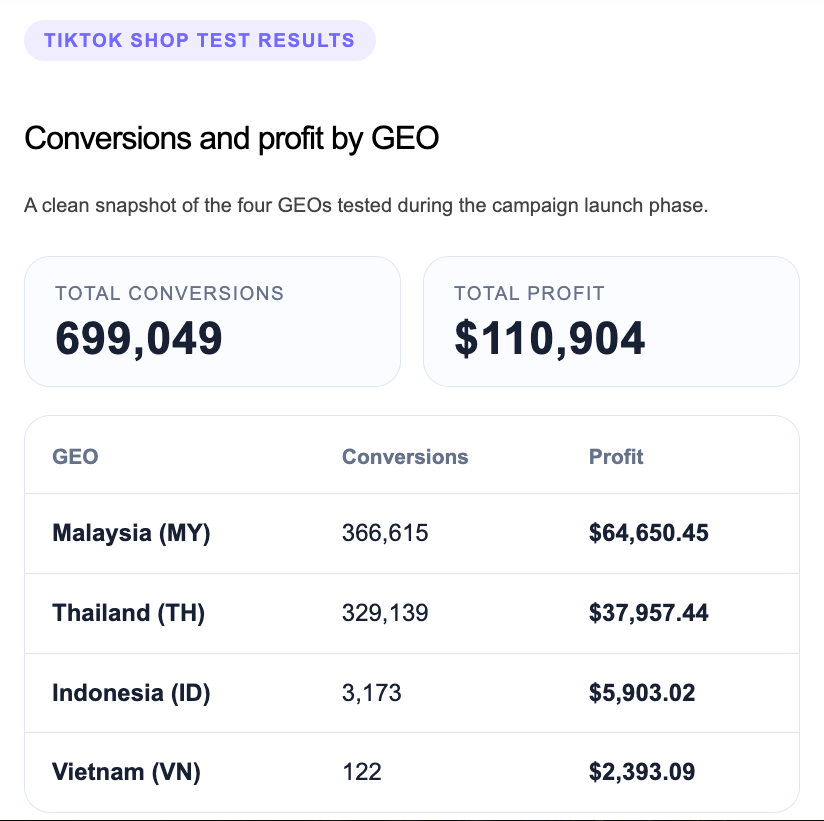
The data from the first quarter of 2026 suggests that TikTok Shop is no longer just a platform for viral entertainment; it has matured into a sophisticated conversion engine. One advertiser, utilizing PropellerAds’ vast network, managed to generate over 699,000 conversions and secure more than $110,000 in pure profit, proving that the synergy between alternative traffic sources and social commerce is a goldmine waiting to be tapped.
The Mechanics of the Campaign: A Strategy of Scale
The success of this campaign was not the result of blind luck, but rather a meticulously structured approach to digital media buying. The advertiser focused on a diverse array of Asian Geographies (GEOs), including Malaysia, Thailand, Indonesia, and Vietnam—markets where mobile-first consumption is the dominant behavior.
Strategic Bidding and Traffic Allocation
The campaign architecture was built upon a hybrid model of traffic and bidding methods. By utilizing Popunder traffic—a high-visibility, full-page advertising format—the advertiser was able to capture user attention at the precise moment of browsing. To ensure profitability, the campaign employed three distinct bidding strategies:
- CPA Goal: Focused on achieving a specific Cost Per Acquisition to maintain margins.
- SmartCPM: An automated bidding system that optimizes for the best possible reach at the most efficient price.
- High Intent CPM: A surgical approach targeting users who demonstrated clear indicators of purchase readiness.
Chronology of the Success: From Broad Testing to Precision
The path to $110,000 in profit did not begin with high-budget precision. Instead, it followed a disciplined, data-driven chronology.
Phase 1: The "Run-On-Network" (RON) Foundation
In the initial stages, the advertiser eschewed the temptation to micro-optimize. Instead, they deployed broad "Run-On-Network" campaigns across all targeted Asian GEOs. The objective here was not immediate profit, but the acquisition of raw data. By casting a wide net, the advertiser could identify which devices, traffic sources, and specific user segments were generating the strongest "conversion signals."
Phase 2: Data-Driven Optimization
Once the initial data pool reached statistical significance, the strategy shifted. The advertiser transitioned from a broad-spectrum approach to a refined, high-performance funnel. This involved:

- Device Filtering: Eliminating underperforming mobile operating systems and hardware configurations.
- Source Whitelisting: Identifying high-converting publishers within the PropellerAds network and allocating more budget toward those specific sources.
- Creative Refreshing: Iterating on ad copy and visual assets based on the performance of specific product categories (e.g., fashion vs. gadgets).
Phase 3: Scaling and Market Dominance
By the mid-point of Q1 2026, the campaign hit its stride. Malaysia and Thailand emerged as the "star" regions, demonstrating an uncanny ability to turn impressions into completed transactions. This allowed the advertiser to double down on these markets, effectively locking in a profitable ROI while continuing to test secondary markets like Vietnam and Indonesia for long-term growth.
Supporting Data: The Numbers Behind the Success
The metrics provided by the PropellerAds study provide a roadmap for other affiliates looking to enter the space. The cost-efficiency of the campaign was striking, with Cost Per Acquisition (CPA) rates consistently landing between $0.04 and $0.20.
Perhaps most impressive was the conversion rate, which peaked at 10% in top-performing regions. In the world of affiliate marketing, where conversion rates often hover in the low single digits, a 10% conversion rate is indicative of a "perfect storm": a high-demand product (TikTok Shop), a frictionless checkout process, and a perfectly matched audience.
The Frictionless Revolution: Why TikTok Shop Works
To understand the success of this campaign, one must look at the user experience. Traditional e-commerce often suffers from "friction"—the moment a user clicks an ad, is redirected to a browser, struggles with a slow-loading site, and ultimately abandons the cart.
TikTok Shop eliminates this. Because the entire journey—from discovery through a creator’s video to the final checkout—occurs within the app, the psychological resistance to buying is significantly lowered. For impulse-led categories such as beauty, lifestyle gadgets, and fast fashion, this "click-to-buy" ecosystem is a game-changer.
Furthermore, the integration of social proof is inherent. When a user sees a product being used by a trusted creator and can access the purchase link with a single tap, the barrier to entry is virtually non-existent.
Implications for the Affiliate Marketing Industry
The success of this TikTok Shop campaign carries several profound implications for the future of digital marketing:
1. The Death of "Platform Silos"
Historically, affiliate marketers have kept their social media traffic and their programmatic display traffic in separate buckets. This case study proves that these channels should be treated as complementary. By using PropellerAds to drive traffic to TikTok Shop offers, the advertiser essentially used "outside" traffic to feed an "inside" ecosystem, proving that social commerce platforms are now effectively "open" for external affiliate traffic.
2. The Rise of Alternative Traffic Sources
Many marketers are overly reliant on Meta or Google Ads. This study serves as a potent reminder that alternative traffic sources—such as Popunder and Push notifications—remain highly viable, particularly in emerging markets where the digital advertising landscape is less saturated and costs per thousand impressions (CPM) are more favorable.
3. Localization is Non-Negotiable
The success of the Malaysia and Thailand campaigns highlights that successful affiliate marketing in Asia requires a deep understanding of local nuances. Language, payment preferences, and cultural shopping trends are not "one size fits all." Affiliates who take the time to tailor their landing pages and creative assets to the local market will almost always outperform those who use a blanket global strategy.
Expert Insight: Practical Takeaways for Affiliates
For those looking to replicate these results, the consensus is clear: Test, Measure, Refine.
- Prioritize Fast-Moving Goods: TikTok Shop is currently optimized for impulse buys. Focus your campaigns on products that have a strong visual appeal and a price point that doesn’t require excessive deliberation.
- Leverage Automated Bidding: As seen with the SmartCPM usage, letting the algorithm handle the heavy lifting of bid adjustments allows the affiliate to focus on the broader creative strategy.
- Don’t Ignore the "Bottom of the Funnel": Even with an in-app checkout, retargeting and high-intent traffic sources (like the ones used in this study) are crucial for converting users who are "on the fence."
Looking Ahead
The digital commerce landscape is shifting away from static web-based storefronts toward dynamic, content-first experiences. As platforms like TikTok continue to integrate commerce deeper into the user journey, the role of the affiliate marketer will evolve from that of a simple "traffic sender" to a "conversion facilitator."
The PropellerAds case study is more than just a report on a successful Q1; it is a signal of where the industry is heading. With the right combination of data-backed testing, the use of diverse traffic formats, and a willingness to embrace the frictionless nature of social commerce, the potential for affiliate marketers to capture a significant share of the Asian e-commerce boom is higher than it has ever been.
As we move further into 2026, the question for affiliates is no longer whether to integrate social commerce into their portfolios, but how quickly they can scale these high-intent campaigns before the landscape becomes as crowded as the traditional search and social channels of yesterday.
 Dwi Wanna
  Lina Irawan
  Basiran