
 By Evan Lee Salim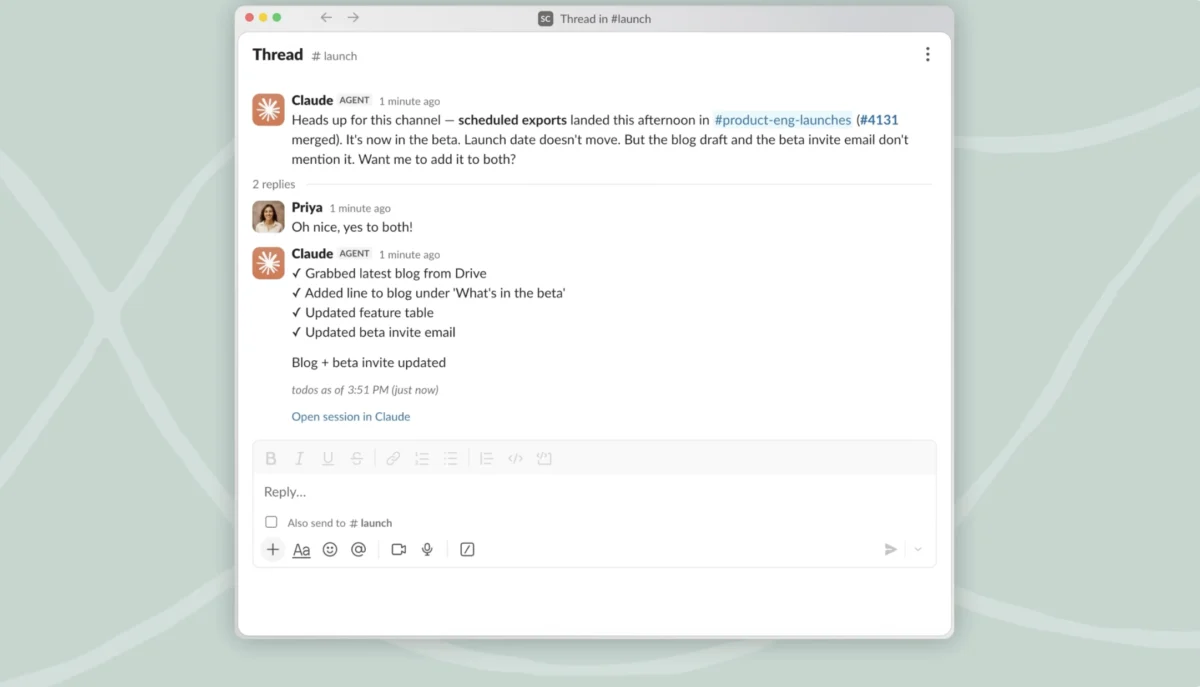
In the rapidly shifting landscape of enterprise artificial intelligence, the divide between "chatbot" and "colleague" is narrowing. Anthropic, the high-profile AI research company behind the Claude model family, has announced a significant evolution in its product suite: Claude Tag. Designed as an "always-on" AI teammate that lives directly within Slack, this new service promises to move beyond reactive prompting, offering instead a persistent, context-aware collaborator that functions as a functional member of any business team.
Available in beta for Claude Enterprise and Claude Team customers, Claude Tag represents a strategic pivot toward "ambient intelligence." By allowing users to tag @Claude within channels to assign tasks, provide real-time insights, and maintain project memory, Anthropic is positioning itself to capture the growing demand for AI that doesn’t just answer questions, but actively participates in the workflows of human organizations.
The Core Innovation: From Reactive Chatbot to Persistent Teammate
For years, the standard interaction with AI has been transactional: a user asks a question, the model generates an answer, and the context often vanishes when the session closes. Claude Tag disrupts this model by introducing persistent memory and state.
Unlike previous iterations where @Claude functioned as a standalone DM or an on-demand tool, Claude Tag resides within specific Slack channels, absorbing the nuances of ongoing projects. As the AI follows the thread of conversation, it builds a repository of institutional knowledge. If a team is working on a complex product launch, Claude Tag remembers the decisions made three weeks ago, the constraints discussed by the engineering department, and the feedback provided by legal counsel.
Key Functional Capabilities:
- Shared Identity: Everyone in a channel interacts with the same Claude instance. If one team member tasks the AI with summarizing a thread, the results are visible to the entire group, allowing others to pick up where the last person left off.
- Task Orchestration: When assigned a complex objective, Claude Tag doesn’t just provide a textual response; it breaks the task into actionable stages, leverages integrated tools to execute the steps, and posts progress updates directly into the Slack thread.
- Ambient Proactivity: Perhaps the most radical departure from traditional AI is the "ambient mode." Claude Tag can now proactively jump into a conversation to flag potential issues, suggest follow-ups on forgotten tasks, or surface relevant data from other authorized channels.
Chronology: The Evolution of Claude in the Workplace
The introduction of Claude Tag is not an isolated event, but rather the culmination of a deliberate strategy by Anthropic to integrate its models deeply into the enterprise software stack.
Early 2025: Establishing the Beachhead
Anthropic began its push into the workplace with basic interactive apps. These initial integrations allowed for direct messaging with Claude to facilitate brainstorming and content creation. While effective for individual productivity, these tools lacked the "group intelligence" required for enterprise-scale operations.
Late 2025: The Arrival of Claude Code
The release of Claude Code in Slack marked a significant inflection point. By allowing the AI to route coding tasks from channel mentions to dedicated web-based coding sessions—and then report back to the thread—Anthropic proved that its models could handle complex, multi-step engineering workflows. This established the infrastructure for the more sophisticated task-routing seen in today’s Claude Tag launch.
Early 2026: The "Always-On" Era
With the launch of Claude Tag, Anthropic has moved beyond simple task-routing to stateful interaction. By providing a persistent identity that follows along with team discussions, the company is attempting to solve the "context gap"—the tendency for AI models to lose the plot in long-running professional projects.
Supporting Data: Why Context is the New Currency of AI
Anthropic’s push into persistent context is a direct response to the primary pain point identified by enterprise users: fragmentation. In a typical large organization, knowledge is siloed across thousands of documents, email chains, and Slack messages.
According to recent industry analysis, the average employee spends nearly 20% of their week searching for internal information. By granting Claude Tag permission to read specific, admin-defined channels, Anthropic is effectively creating a "Knowledge Bridge." If an engineering team is working on a deployment, Claude can reach into a legal or compliance channel (if authorized) to ensure the documentation meets regulatory standards.
Data Security and Governance
Anthropic has emphasized that this increased access does not come at the expense of security. System administrators maintain granular control over:
- Tool Access: Which APIs and software suites the AI can interface with.
- Channel Scoping: Ensuring that an AI agent trained on marketing data cannot access or "leak" information into a secure HR or engineering channel.
- Memory Management: Administrators define the boundaries of the AI’s "memory," ensuring that sensitive data is siloed according to the principle of least privilege.
Official Responses and Strategic Positioning
Anthropic describes the value proposition of Claude Tag as a psychological shift: "It makes it feel like you’re working with a real colleague—one that can produce work in public view, with far greater context and understanding than before."
By forcing the AI to work "in public," Anthropic is addressing the "black box" problem that often prevents businesses from trusting AI with critical workflows. When the AI makes a mistake or produces an output, the entire team can see the process, verify the sources, and correct the trajectory in real-time. This transparency is vital for corporate adoption, where accountability and traceability are non-negotiable.
Implications: The Enterprise AI Land Grab
The launch of Claude Tag places Anthropic squarely in the crosshairs of the world’s largest software conglomerates. The race for "Enterprise Context" has become the primary battleground for the next generation of AI.
The Competitive Landscape
- Microsoft: Through Graph and Copilot, Microsoft is leveraging its deep integration into the Office 365 ecosystem to provide a similar, if more rigid, experience. Microsoft’s advantage lies in the ubiquity of its data silos (Outlook, Teams, SharePoint).
- Snowflake & Databricks: These data giants are repositioning their platforms not just as warehouses, but as the "brains" of the enterprise. By storing the raw data that agents need to reason, they are becoming the foundational layer upon which AI agents like Claude Tag must operate.
- Glean: As a specialist in the "intelligence layer," Glean is building the connective tissue between disparate enterprise applications. Its focus on indexing internal company data creates a direct challenge to Anthropic’s more model-centric approach.
The Long-Term Outlook for the Workforce
The broader implication of tools like Claude Tag is the potential transformation of the "middle manager" and "administrative" roles. If an AI can track tasks, flag forgotten follow-ups, and synthesize cross-departmental data, the nature of human work will necessarily shift toward high-level strategy, creative oversight, and interpersonal management.
However, the technology is not without its risks. The reliance on an "always-on" agent requires organizations to maintain strict data hygiene. If the input data is poor, the AI’s "memory" will simply scale the chaos of an unorganized team. Furthermore, the reliance on a single AI identity raises questions about "AI bias"—if Claude develops a certain "personality" or approach based on the loudest voices in a Slack channel, it could inadvertently amplify existing team dysfunctions.
Conclusion
Claude Tag is a bold step forward for Anthropic, marking the transition from "AI as a tool" to "AI as a team member." By anchoring the model in the daily, chaotic, and high-context flow of Slack, Anthropic is banking on the idea that the future of work isn’t just about better models—it’s about better integration.
As enterprises move from experimental AI deployments to deep, operational integration, the winners will be those who can provide the most reliable, context-aware, and secure agents. Whether Claude Tag becomes the indispensable office assistant or simply another noisy bot in the channel remains to be seen, but the intent is clear: Anthropic wants a seat at the table, and they want it to be permanent.
 Sagoh
Sagoh  Iffa Jayyana
  Lina Hope