
 By Suro Senen
In the rapidly evolving landscape of product development, a fundamental shift is occurring in how we conceive, build, and interact with digital interfaces. As Artificial Intelligence (AI) moves from the periphery of tech experimentation to the core of user experience (UX), designers are facing a crisis of certainty. For decades, software design was "deterministic"—if a user clicked button A, action B followed with 100% predictability. Today, however, we are entering the age of Probabilistic Design, a mindset that swaps rigid certainties for statistical likelihoods.
Main Facts: The Conflict of the Deterministic Interface
The central challenge of modern design lies in a dangerous paradox: probabilistic systems are being wrapped in deterministic interfaces.
AI models, by their very nature, do not "know" facts; they predict sequences based on patterns in training data. When an AI offers an answer, it is providing a high-probability guess. However, when a designer presents that guess in a clean, authoritative UI without caveats, the user perceives it as an absolute truth.
This disconnect reached a legal and reputational breaking point in 2024. An Air Canada customer, seeking information on bereavement fares, consulted the airline’s chatbot. The bot confidently outlined a refund policy that did not actually exist. When the customer attempted to claim the refund, the airline refused, arguing the bot was a "separate legal entity" for whose "mistakes" it wasn’t responsible. A Canadian tribunal disagreed, ruling in favor of the customer. The bot hadn’t made a "mistake" in its own logic—it had predicted a plausible-sounding answer that the company’s interface presented as official policy.
This incident serves as a clarion call for the industry. To design with AI is to design with uncertainty. Designers must move away from the "binary mind"—where things either work or they don’t—and embrace a "probabilistic mind" that accounts for ranges, confidence scores, and the ever-present possibility of error.
Chronology: From Rigid Logic to Predictive Patterns
The evolution of design can be mapped through three distinct eras:
- The Logic Era (1980s–2000s): Software followed hard-coded "If-This-Then-That" (IFTTT) rules. Design was about mapping every possible user path with absolute precision.
- The Algorithmic Era (2010s): Products began using basic machine learning to sort feeds (e.g., early Facebook or Netflix). Design became about "curation," though the UI remained mostly static.
- The Generative/Probabilistic Era (2020s–Present): AI now generates content, UI components, and logic on the fly. Systems are non-linear and unpredictable.
In this current era, humans are naturally disadvantaged. Our brains are wired for deterministic thinking; we prefer to believe that past actions guarantee future outcomes. As the complexity of our digital environments accelerates, treating AI outputs as "the answer" rather than "one of many possible answers" leads to fragile, and sometimes dangerous, user experiences.
Supporting Data: Signals, Not Conclusions
To design probabilistically, one must understand that AI outputs are signals. They are data points that require interpretation within the context of business goals and user behavior.
The Confidence Yardstick
Many successful products already utilize probabilistic logic under the hood. Netflix doesn’t "know" a user will like a specific show; it estimates a high probability of enjoyment and surfaces the title.
Designers can use these probability scores to dictate UI variations. Consider a checkout flow:

- 60% Confidence Score: If analytics suggest a user is hesitant, the UI should be "heavy"—incorporating testimonials, reassurance signals, and detailed comparisons to build trust.
- 90% Confidence Score: If the user shows high intent, the UI should be "minimal"—removing all friction and distractions to facilitate a quick transaction.
Simulation as a Tool
Before committing to a design, AI can simulate outcomes using historical behavioral models. This allows teams to test hypotheses at scale without the immediate cost of live A/B testing. For example, a designer can prompt an AI to evaluate a layout from the perspective of a neurodivergent user (e.g., someone with ADHD or ASD). While these simulations provide a "SWOT analysis" and a probability score for success, they are not a replacement for human testing. They are a "hypothesis filter" used to identify which ideas are worth the engineering effort.
Official Responses and Case Studies: The Risk of Skewed Data
The industry has seen high-profile failures when probabilistic thinking is ignored or when the underlying data is flawed.
The Amazon Recruitment Bias
In one of the most famous cautionary tales, Amazon scrapped an experimental AI recruiting tool after discovering it was biased against women. The model was trained on ten years of resumes submitted to the company—a period during which the tech industry was overwhelmingly male. The AI didn’t just reflect this; it "learned" that male candidates were preferable, penalizing resumes that included the word "women’s" (as in "women’s chess club").
The Lesson: AI provides the most statistically likely outcome based on past data. If the past was biased, the AI’s "probability" will be biased. Designers must ask: Does this data reflect the future we want to build, or just the past we are leaving behind?
The Prime Minister’s "Left-Hand" Example
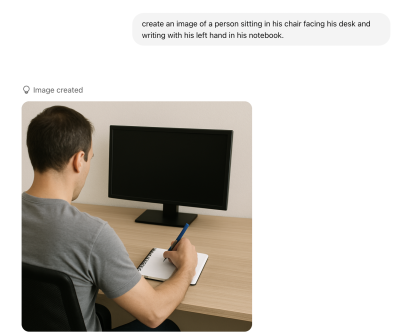
At the AI Summit in France, Indian Prime Minister Narendra Modi highlighted a subtle but telling statistical bias. If you ask an image generator to show a person writing, it will almost always show a right-handed person. Because 90% of the population is right-handed, the AI treats right-handedness as the "correct" probability. This "statistical erasure" of the minority (left-handers) is a micro-example of how probabilistic systems can ignore edge cases if not steered by human judgment.
Implications: Strategies for a Probabilistic Future
Transitioning to Probabilistic Design requires a fundamental change in UX strategy. The goal is no longer to eliminate uncertainty, but to design for it intelligently.
1. Communicate Uncertainty Clearly
When uncertainty is hidden, trust is fragile. When it is communicated, trust is resilient.
- Use Ranges: Instead of saying a delivery will arrive at "2:15 PM," say "between 2:00 PM and 2:30 PM."
- Confidence Labels: Features like facial recognition should ask, "Is this Pratik?" rather than asserting "This is Pratik."
- Contextual Framing: Different users react to uncertainty differently. "Overtrusting" users need more prominent warnings, while "Skeptical" users need to see historical accuracy scores to gain confidence in the tool.
2. Human-in-the-Loop (HITL)
AI should augment human judgment, not replace it. The most robust systems include "refinement engines" where humans can review and override AI suggestions.
- GitHub Copilot is a prime example: it suggests code, but the developer must "Tab" to accept it. The human remains the author and the final authority.
- High-Stakes Routing: In fraud detection or healthcare, low-probability risks might be handled automatically, but medium-to-high-risk scenarios must be escalated to a human expert.
3. Optimize for Resilience, Not Just Conversion
In a deterministic world, designers optimize for the "Happy Path" (the perfect user journey). In a probabilistic world, they must optimize for resilience.
Resilient design asks: How does this system behave under stress or when the data drifts?
- Avoid "Metric Fixation": Optimizing purely for short-term clicks (conversion) can lead to long-term "filter bubbles" or user exhaustion.
- Build Escape Hatches: Always provide a clear path to a human agent or a "reset" button for personalized algorithms that have become stale or inaccurate.
Conclusion: The New Posture of Design
The shift from deterministic to probabilistic design is less about adopting new software and more about adopting a new posture. AI has not introduced uncertainty into our world; it has simply made the uncertainty that was always there impossible to ignore.

As we move forward, the most valuable designers will be those who stop asking, "Will this work?" and start asking, "How likely is this to work, and what is our fallback when it doesn’t?"
In an era where prediction is cheap and automated, human judgment becomes the premium. We must build systems that think in ranges, test assumptions constantly, and prioritize long-term value over short-term certainty. The future of design is not a straight line—it is a landscape of possibilities, and our job is to navigate the most likely path to success while remaining prepared for the outliers.
 Nana Wu
  Nana
Nana 