
 By Muslim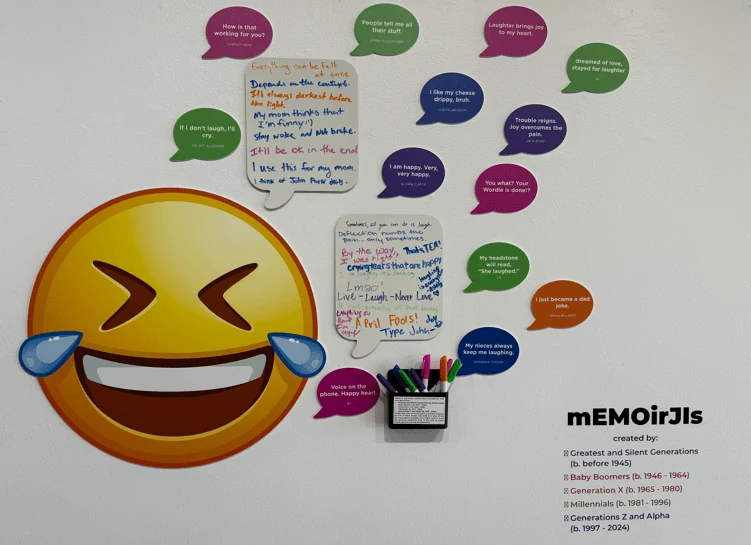
In the digital age, our conversations are punctuated not just by periods and commas, but by a vibrant, evolving lexicon of yellow faces, hand gestures, and symbolic objects. Emojis have transcended their origins as simple keyboard shortcuts to become a sophisticated form of data visualization—a visual shorthand that compresses complex emotional states into a single, pixelated icon. Yet, as this digital language permeates every level of global communication, a fundamental question emerges: Is this a universal dialect, or are we speaking past one another?
Recent sociological and linguistic research suggests the latter. As digital natives continue to iterate on the "meaning" of these icons, a palpable generational friction has emerged. This disconnect prompted a unique experiment in 2024: "mEMOirJIs," a data-art project that sought to bridge the gap between abstract iconography and human experience through the lens of literature.
The Ambiguity of the Digital Icon
The premise of universal emoji understanding is increasingly being challenged by empirical data. A 2024 survey by Preply identified the "most confusing emojis" across the United States, with the "Nail Polish" emoji ranking as the most frequently misunderstood. Further research from the University of Ottawa has highlighted that older adults, while eager to adopt digital communication, often struggle to interpret the nuances—and the evolving irony—of modern emoji use.
This is compounded by a CNN poll from the same year, which solidified the existence of a "generation gap" in digital expression. The study underscored that Generation Z utilizes emojis with a level of irony and detachment that is often foreign to Boomers and Generation X. For a Gen Z user, a "Loudly Crying Face" may signal overwhelming excitement or hilarity, whereas an older user is more likely to interpret the icon literally—as an expression of profound sorrow or distress. When the medium of communication is inherently ambiguous, the risk of misinterpretation in professional, social, and romantic settings grows exponentially.
Chronology of the "mEMOirJIs" Project
The "mEMOirJIs" project was born out of a desire to move beyond quantitative data and explore these nuances through a qualitative, art-driven approach.

Phase I: Selection and Framework
In the fall of 2024, the project began with the identification of six specific emojis known for their high potential for miscommunication. The goal was to select icons that carried heavy emotional or situational weight. The project utilized the framework of the "six-word memoir"—a literary genre famously attributed to Ernest Hemingway—to anchor the abstract icons in concrete, human-centric narratives.
Phase II: The Workshop Series
Partnering with diverse community and school groups in Shreveport, Louisiana, the project facilitated a series of writing workshops. By challenging participants to summarize an experience or emotion in exactly six words, the project bypassed the barrier of "literary expertise." It turned out that the constraints of the six-word limit actually fostered a deeper level of creativity, allowing participants to distill their lives into sharp, relatable, and often contradictory vignettes.
Phase III: The Installation
The culmination of this research was an exhibition at the Artspace Gallery in Shreveport, titled "Data is Poetry." The installation aimed to visualize the data collected during the workshops. Giant, 3D-printed PVC versions of the selected emojis were mounted on the walls, serving as the "speakers" for the memoirs collected from the community. Each memoir was printed on a speech bubble and color-coded to denote the generation of the author, creating a visual map of how different age cohorts perceive the same symbol.
Supporting Data: When Words Fail
The data collected during the workshops offered a stark look at the generational divide. For instance, when presented with the "Loudly Crying Face" emoji, the interpretations varied wildly:
- Gen Z: "I have never been so excited."
- Millennial: "Daycare dropoff: two sets of tears."
- Gen X: "Coping with cataracts? See a doctor."
These snippets demonstrate that emojis do not function as static symbols; they are projections of the user’s current life stage and cultural context. While quantitative data might tell us how often an emoji is used, these six-word memoirs reveal why it is used, providing a qualitative depth that traditional surveys lack. The "Melting Face" emoji, often associated with feeling overwhelmed by heat or social anxiety, garnered responses ranging from descriptions of mid-life burnout to the literal discomfort of a Louisiana summer, highlighting how personal experience shapes digital vocabulary.

Official Perspectives and Academic Implications
The academic community has taken note of these shifts. Researchers studying computer-mediated communication (CMC) have long argued that as we strip away the non-verbal cues of face-to-face interaction—tone of voice, body language, eye contact—we replace them with a digital architecture of emojis.
However, as the "mEMOirJIs" project suggests, this replacement is not a perfect 1:1 translation. The implications are significant for both sociology and technology. If we cannot agree on the "definition" of an icon, we risk a decline in the quality of digital empathy. The project underscores that technology often promotes a paradox: it creates the infrastructure for global connection while simultaneously deepening the cracks caused by generational, regional, and cultural differences in language usage.
A Living Installation: Community Engagement
One of the most striking aspects of the "Data is Poetry" exhibition was its evolution. By including dry-erase speech bubbles and color-coded markers for visitors to add their own contributions, the artist transformed a static installation into a living, breathing document.
Over the two-month duration of the exhibition, visitors did not merely observe; they participated. Interestingly, they frequently ignored the "six-word" constraint, opting instead to crowd the boards with long-form reflections. They also proved reluctant to use the erasers provided, preferring to overlap their words in a chaotic, layered mosaic of sentiment. This behavior itself became a data point: it suggested that in the digital age, users value the persistence of their expression over the neatness of the format.
Conclusion: The Future of Digital Expression
The "mEMOirJIs" project serves as a poignant reminder that data is not merely a collection of numbers in a spreadsheet. Data is the sum of our experiences, our frustrations, and our joys—even when those experiences are summarized by a "Melting Face" or a "Loudly Crying Face."

As we look toward the future of communication, it is clear that the emoji will remain a permanent, albeit fluid, fixture of our language. We must acknowledge that our digital tools are not neutral. They are interpreted through the unique, often idiosyncratic lenses of our own generations. By fostering projects that encourage us to interrogate these symbols, we can bridge the gaps in our understanding and perhaps learn to communicate more effectively—even when we are using little more than a string of yellow icons to do so.
Data, as it turns out, is everywhere: in the literature we write, the text messages we send, and the smiles and tears we broadcast to the world. Through the "mEMOirJIs" project, we are reminded that even in the most pixelated of languages, there is profound, human poetry to be found.
About the Author:
Callie Dean is the director of applied research at the Institute for Nonprofit Administration and Research at LSU Shreveport. She is the author of the poetry chapbook "Metadata" (Bottlecap Press, 2025) and two forthcoming picture books: "Marvelous Mistakes" (Beaming Books, 2026) and "Unstoppable Song" (Lerner/Carolrhoda, 2027).
 Lina Irawan
  Nana
Nana  Nila Kartika Wati