
 By Asro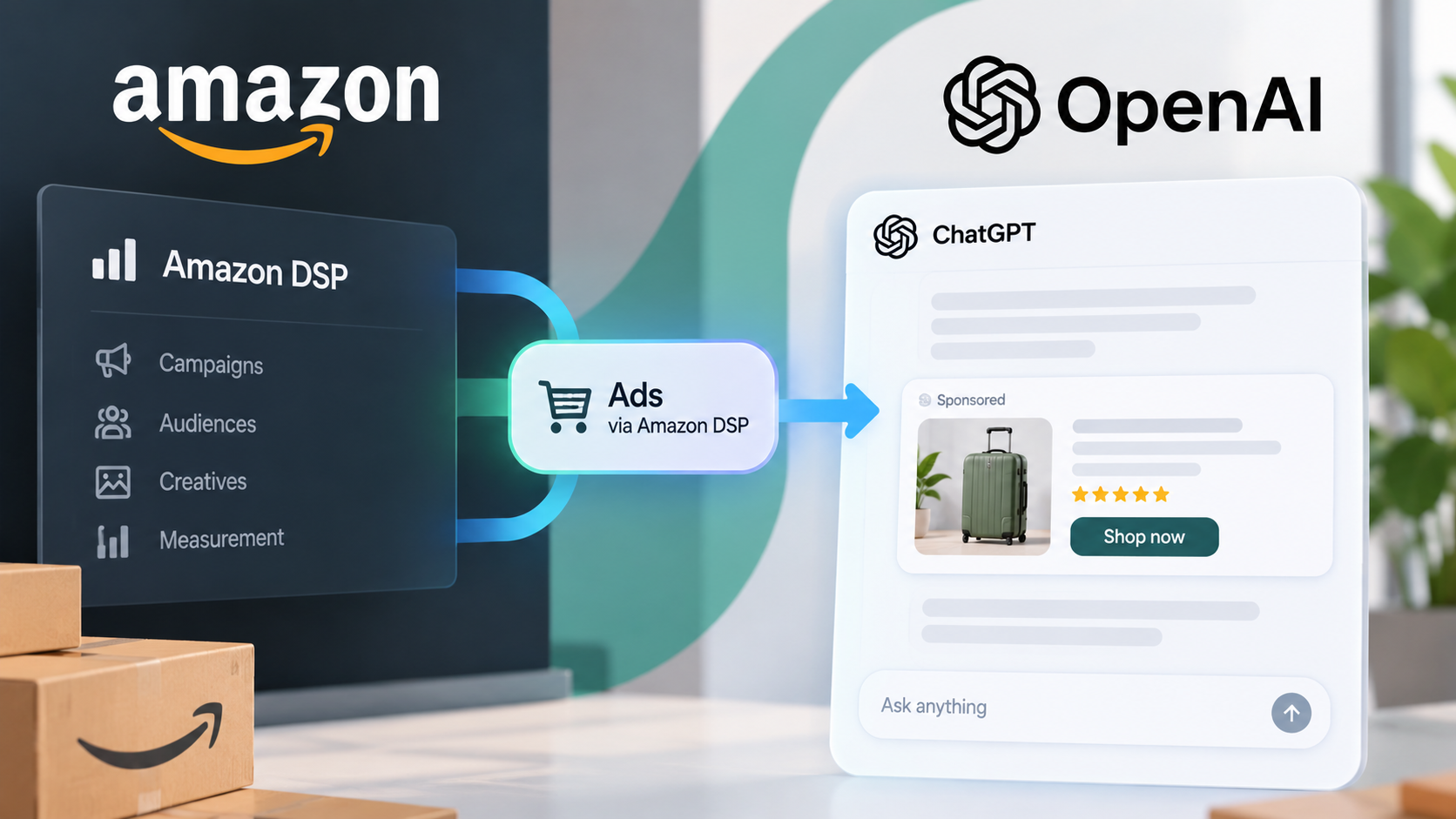
By: Global Technology & Digital Media Desk
Enriched Industry Analysis & Reporting
Main Facts: The Intersection of Retail Media and Generative AI
In a landmark development reshaping the digital advertising landscape, e-commerce titan Amazon has announced a strategic partnership with artificial intelligence pioneer OpenAI. The collaboration allows brands utilizing the Amazon Demand-Side Platform (DSP) to seamlessly extend their advertising campaigns directly into ChatGPT, unlocking a powerful new channel within the chatbot’s rapidly expanding ad inventory.
At launch, the integration is being rolled out exclusively in the United States as a managed service pilot program. Major brands, including Delta Vacations, have already signed on as part of a select cohort of initial U.S. advertisers testing the capability.
The mechanism bridges two digital behemoths: Amazon provides the buying, campaign management, and optimization layer through its robust DSP, while OpenAI retains strict control over the actual ad delivery, placement algorithms, and user-experience integration within ChatGPT.
Key structural highlights of the partnership include:
- Flexible Purchasing Models: Advertisers can procure ChatGPT ad inventory on both a cost-per-click (CPC) and cost-per-mille (CPM) basis.
- Automated Product Feed Ads: Amazon is introducing automated ad creation tools that dynamically build ad assets using an advertiser’s existing product catalog.
- Non-Endemic Appeal: The integration opens ChatGPT inventory not just to native e-commerce brands, but also to non-endemic advertisers—companies that do not sell products on Amazon yet leverage Amazon DSP to capture target audiences elsewhere on the web and connected TV (CTV).
- Distinct Operational Boundaries: While Amazon manages the financial and strategic setup, OpenAI exercises absolute autonomy over where and how ads appear within the conversational UI. Ads manifest primarily as text and image units positioned cleanly beneath organic ChatGPT responses, complete with clear "sponsored" disclosures.
Chronology: How the Amazon-OpenAI Ad Partnership Unfolded
The convergence of conversational artificial intelligence and programmatic retail media did not happen overnight. The timeline leading up to this monumental partnership highlights the rapid commercialization of generative AI platforms.
Late 2022 – 2023: The Generative AI Explosion
Following the public launch of ChatGPT by OpenAI, user adoption skyrocketed to historic highs. As millions of global users began relying on conversational AI for daily research, coding, travel planning, and consumer discovery, industry analysts immediately recognized the platform’s potential as a premier digital real estate asset for brands.
Throughout 2024: Monetization Pressures Mount
As OpenAI’s infrastructure costs mounted alongside its soaring user base, leadership began exploring sustainable monetization models. Unlike traditional search engines that rely on instant ad injections, integrating commercial messages into conversational threads required a delicate balancing act to preserve user trust. Testing early ad formats became a priority for OpenAI as it looked to transition from a research-heavy entity into a self-sustaining commercial powerhouse.
Late 2024 – Early 2025: Amazon Expands DSP Boundaries
Meanwhile, Amazon aggressively pushed its Demand-Side Platform beyond its traditional walled-garden boundaries, enabling brands to utilize Amazon’s rich consumer purchase and streaming intent data across third-party publishers, connected TV, and audio platforms.
Q1/Q2 2025: Conceptualizing the Integration
Recognizing mutual incentives—OpenAI needed scaled advertiser demand and sophisticated campaign management infrastructure, while Amazon sought fresh, high-engagement inventory for its DSP clients—executives from both companies initiated talks for a formal partnership.
Current Status: The U.S. Pilot Launch
The formal announcement materialized as a managed-service pilot program in the United States. Brands like Delta Vacations stepped up as early adopters, evaluating how programmatic retail media data performs inside a generative AI chatbot environment. Industry watchers are now tracking the rollout closely to gauge performance metrics, pricing stability, and expansion roadmaps.
Supporting Data, Measurement, and Technical Architecture
For digital marketers, the success of any ad channel hinges on data transparency, targeting precision, and measurable return on ad spend (ROAS). The Amazon-OpenAI integration addresses these needs through structured performance reporting and advanced catalog integration.
Performance Reporting and Metrics
Advertisers participating in the pilot are granted access to granular, aggregated performance data sets. These include standard digital metrics such as:
- Impressions: Total views generated by the ad units within ChatGPT interfaces.
- Clicks & Click-Through Rates (CTR): Engagement levels showing how often users interact with sponsored text or image cards.
- Cost Metrics: Transparent data regarding Cost-Per-Result, CPM, and CPC.
The Power of Combined Data Insights
What sets this partnership apart from traditional programmatic networks is the fusion of data layers. Amazon possesses unparalleled, deterministic consumer shopping and streaming data (via Prime Video and Freevee). When coupled with ChatGPT’s contextual, intent-rich conversational data—where users explicitly state their desires, preferences, and long-term plans in natural language—advertisers gain a hyper-refined targeting mechanism.

For instance, a user chatting with ChatGPT about planning an upcoming family trip to the Caribbean could be served a relevant Delta Vacations ad powered by Amazon DSP, based not just on their current prompt, but informed by historical retail and entertainment signals.
Ad Format Specifications
- Placement: Ads are rendered as clean text and image units positioned directly beneath organic conversational responses.
- Transparency: Every unit carries explicit "sponsored" labels to maintain regulatory compliance and consumer trust.
- Automation: Product feed ads automate creative production, pulling imagery, pricing, and descriptions directly from the brand’s centralized product catalogs managed within Amazon’s ecosystem.
Official Responses and Industry Perspectives
While official statements from executive leadership at both Amazon and OpenAI have emphasized the mutually beneficial nature of the alliance, industry analysts have been quick to dissect the underlying strategic motivations.
The OpenAI Perspective: Scaling Demand Safely
For OpenAI, opening up inventory via Amazon DSP solves a classic chicken-and-egg problem for digital publishers: building a proprietary ad sales force from scratch is capital-intensive and slow. By plugging directly into Amazon’s sprawling, pre-existing roster of millions of active advertisers, OpenAI can instantly monetize its inventory at scale without sinking massive resources into enterprise sales infrastructure.
Simultaneously, by retaining strict control over ad delivery and placement algorithms, OpenAI ensures that commercial placements do not degrade the core user experience or compromise the neutrality and accuracy of its generative AI responses.
The Amazon Perspective: Expanding the DSP Footprint
For Amazon, the partnership cements the Amazon DSP as an indispensable tool for modern media planners. By securing exclusive or early access to premier conversational AI inventory, Amazon enhances its value proposition to brands. Advertisers no longer need to manage a fragmented array of siloed AI ad networks; they can leverage Amazon’s unified platform to run campaigns across shopping sites, streaming TV, and now, cutting-edge generative AI chatbots.
Industry Analyst Commentary
Prominent media and advertising analysts have noted that this integration represents a watershed moment for Retail Media Networks (RMNs). Historically confined to onsite search bars and owned-and-operated properties, RMNs are rapidly evolving into external advertising superpowers.
“This isn’t just about putting a banner inside a chat window,” noted a leading digital marketing strategist. “It represents the marriage of deterministic purchase data with generative intent. For brands, it provides a bridge to reach consumers at the exact moment of consideration, backed by the robust measurement they’ve come to expect from Amazon.”
Implications for Marketers and the Future of Digital Advertising
As the pilot phase progresses, the broader implications for the digital advertising ecosystem are profound, opening up new strategic considerations for brands, agencies, and competing tech platforms.
1. The Rise of Conversational Commerce
Generative AI interfaces are rapidly shifting from novelty chat tools to primary discovery engines. Consumers increasingly bypass traditional search engines in favor of conversational recommendations. By securing a foothold in ChatGPT through Amazon DSP, early-adopting brands can establish prime digital shelf space in this emerging channel before it becomes saturated and expensive.
2. Empowering Non-Endemic Brands
Historically, retail media networks were primarily favored by brands selling physical goods directly on those marketplaces (e.g., consumer packaged goods brands on Amazon). However, this partnership acts as a Trojan horse for non-endemic brands—such as financial institutions, insurance providers, travel companies (exemplified by Delta Vacations), and B2B software providers—to harness Amazon’s audience intelligence within an entirely non-retail context.
3. The Power Struggle Over Ad Governance
The division of labor in this partnership—Amazon handles the money and campaign setup; OpenAI controls the user experience and delivery—highlights a new paradigm in platform cooperation. It proves that tech giants are willing to decouple inventory ownership from sales mechanics. However, it also raises future questions regarding optimization transparency: if an ad underperforms, will brands blame Amazon’s targeting algorithm or OpenAI’s placement engine?
What to Watch Next
As the U.S. pilot gathers momentum, industry stakeholders should monitor several critical developments:
- Geographic Expansion: Will OpenAI and Amazon expand DSP access to international markets (such as Europe and Asia-Pacific) in the near future?
- Ad Format Evolution: Will OpenAI introduce richer, more interactive ad units (such as embedded checkout buttons or multi-turn conversational ads) beyond basic text and image cards?
- Competitor Reactions: How will rival AI players (such as Google Gemini, Microsoft Copilot, and Anthropic Claude) structure their own monetization models in response to this powerful alliance?
Bottom Line
The partnership between Amazon and OpenAI marks a pivotal chapter in the evolution of digital advertising. Amazon is successfully cementing its position as a primary gateway into conversational AI advertising, while OpenAI maintains absolute sovereignty over its user experience. For marketers, the message is clear: the era of conversational advertising has arrived, and the tools to navigate it are becoming more consolidated, sophisticated, and data-driven than ever before.
 Jia Lissa
  Nana Muazin
  Layla Zulfa