
 By Layla Zulfa
Main Facts: The Inevitable Decay of Digital Real Estate
Every website reaches its absolute zenith on the day it launches. The final code branch merges cleanly, the staging server goes live, and the digital asset is, for a brief, shining moment, entirely complete. It is pristine, modern, and aligned with current market conditions.
Yet, as any digital strategist or web developer knows, it will never be this good again.
This degradation is rarely catastrophic; servers rarely explode, and domains rarely vanish overnight. Instead, the decay is insidious. Markets shift, competitors launch flashier tools, internal messaging evolves, and design systems mature. Within a year, a state-of-the-art web application morphs into a digital period piece. It is not fundamentally broken, but it is behind.
For decades, the web development industry has treated this entropy as an immutable law of nature. Maintenance cycles are expensive, time-consuming, and prone to human error, resulting in delayed updates, rotted hyperlinks, uncompressed media assets, and neglected accessibility (a11y) standards.
Enter the era of autonomous websites. Powered by continuous optimization agents, these platforms promise a radical paradigm shift: websites that actively improve after launch, quietly self-optimizing while human teams focus on core product engineering and creative strategy.
However, as developers and platform creators are discovering, solving the technological hurdle of autonomy is only half the battle. The deeper, more complex friction point has little to do with code and everything to do with human psychology: Almost nobody actually wants a website that changes entirely on its own.
Chronology: From Static Deployed Assets to Continuous Autonomous Agents
Phase 1: The Static Era and Manual Upkeep
Historically, websites were treated as static documents or monolithic applications. Once deployed via FTP or early continuous integration pipelines, they remained frozen until a developer manually pushed an update. The workflow was linear: design, develop, launch, and wait three to five years for a painful, expensive redesign.
Phase 2: The CMS and Agile Content Operations
The proliferation of Content Management Systems (CMS) like WordPress, Contentful, and headless alternatives democratized publishing, allowing non-technical teams to alter text and images without touching code. While this accelerated content velocity, it introduced a new fragmentation problem. Content drifted away from design systems, accessibility standards degraded with every rushed blog post or landing page, and technical debt accumulated silently in the background.
Phase 3: The Birth of Fimo and the Autonomy Hypothesis
Recognizing this perpetual administrative drag, platforms like Fimo set out to build fully autonomous website infrastructures. Operating on the assumption that total hands-off automation was the ultimate industry goal, developers deployed agents designed to write, edit, optimize, and publish web updates without human intervention.
The initial real-world response, however, was unexpected hesitation. Users did not reject the technology out of distrust; rather, they balked because websites are inherently cross-functional assets. Different stakeholders owned different layers of the user experience, and each stakeholder demanded a vastly different degree of agentic autonomy.
Supporting Data & Conceptual Frameworks: Categorizing the Work of a Website
To understand why "full autonomy" failed as a blanket product goal, platform architects analyzed the operational lifecycle of a modern web property. They found that website maintenance workload splits cleanly into three distinct categories:
1. The Chores: The Rule-Bound 80%
The vast majority of website upkeep is entirely repetitive, rule-bound, and devoid of creative expression. This includes:
- Enforcing WCAG accessibility compliance as new pages are appended.
- Propagating global design-system token updates (e.g., changing border radii or primary color hex codes across thousands of pages).
- Catching broken meta tags, unoptimized raster images, and broken inbound/outbound links.
According to platform usage metrics, this administrative maintenance accounts for roughly 80% of total web operations. Because these tasks are defined by strict technical rules rather than subjective taste, agents excel at executing them silently in the background, relieving human engineers of tedious, low-value labor.
2. The Untouchables: The Core of Human Taste
At the opposite end of the spectrum lies the creative core—the strategic judgment calls that define a brand’s identity. An AI agent can verify whether a color contrast ratio passes legal accessibility thresholds, but it cannot decide what a page is supposed to feel like, nor can it evaluate whether a piece of copywriting captures the nuanced emotional resonance of a brand’s voice.
This human-exclusive domain represents a tiny fraction of total web operations, but it holds disproportionate value. It is precisely what human designers and copywriters are hired to do, making it fiercely protected territory.
3. The Gray Area: Per-User and Per-Role Boundaries
Between the mindless chores and the untouchable creative core lies a vast, ambiguous middle ground. Crucially, the boundary line in this category is not dictated by the task itself, but by who is performing it.
Consider a concrete example: changing the default landing page theme to dark mode.
- To a front-end developer, this is a straightforward one-line configuration change with a clear technical rationale—an ideal candidate for agentic automation.
- To a brand designer, the default theme is a foundational statement of identity regarding how the company wishes to be perceived first—a deliberate artistic choice requiring strict human sign-off.
The exact same technical change carries entirely different weights of judgment depending on the stakeholder. Consequently, rigid, one-size-fits-all autonomy settings are inherently flawed.
Official Responses and Industry Perspectives
Pierre Burgy, co-founder of Fimo, has spoken candidly about the architectural pivot required when building for website autonomy. Reflecting on user behavior, Burgy noted that the primary engineering challenge shifted away from raw machine learning capabilities and toward granular, role-based governance.
"The point of autonomy was never to remove you from your website. It was to remove the decay," Burgy explains.
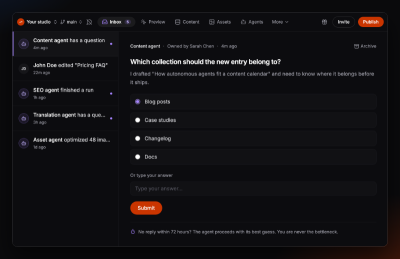
Rather than presenting users with a binary toggle—choosing blindly between "fully manual" and "fully autonomous"—modern agentic platforms have been forced to evolve. Users now compose modular teams of specialized agents (such as content agents, accessibility agents, translation agents, and asset optimizers) and explicitly define the permission boundaries for each.
Furthermore, trust in these systems is earned iteratively through transparent auditing. Platforms provide comprehensive execution histories, system logs, and side-by-side visual diffs of every modification made by an agent. When an agent quietly corrects an overlooked error—such as fixing a broken mobile viewport scaling rule—and the developer can review the exact change log, psychological friction dissolves, paving the way for broader, trusted delegation.
Implications: The Future of Digital Operations and the Risk of the Frozen Site
As autonomous website infrastructure matures, the broader implications for digital agencies, enterprise engineering teams, and solo creators are profound.
1. Redefining the Role of the Developer and Designer
Rather than acting as manual executors of repetitive CSS patches or asset compression tasks, digital professionals are transitioning into agent orchestrators. By setting explicit operational parameters, establishing style guidelines, and auditing agent outputs, teams can scale their web operations exponentially without expanding headcount.
2. The Evolution of Trust-Based Delegation
The industry is moving away from static permission configurations toward dynamic, trust-based systems. As agents demonstrate reliability over time—learning from corrections and adapting to institutional preferences—the boundary of autonomy naturally expands, reducing human bottlenecks organically.
3. The Ultimate Danger: Embracing the "Frozen Site" Risk
While anxiety over unintended automated edits often paralyzes organizations from adopting AI-driven web tools, industry analysts emphasize that the true existential threat is the stagnant, unmaintained website. A site that remains frozen in time does not stay safe; it slowly drifts into irrelevance.
By bridging the gap between human creative oversight and autonomous rule execution, the next generation of web infrastructure ensures that websites no longer peak on launch day. Instead, they continuously adapt, mirroring the dynamic, living nature of the modern enterprises they represent.
 Nana Wu
  Nana
Nana 