
 By Nana
By the Industry Insights Desk
Published: October 2023
Main Facts: The Crisis of Meaningless Metrics
For over a decade, the digital product landscape has suffered from a collective delusion. Businesses, app developers, and corporate training architects have sought to capture user engagement by applying a thin veneer of video game mechanics onto otherwise mundane software. This approach—widely known as gamification—has relied on a predictable formula: award points for completing tasks, hand out digital badges for logging in consecutively, and display an ascending progress bar to encourage retention.
However, after decades of watching millions of players interact with deeply immersive systems, industry veterans are sounding the alarm. Traditional gamification is failing. Users see right through arbitrary reward structures. They are fatigued by unearned praise, hollow level-ups, and participation trophies masquerading as achievements.
Enter Gamification 2.0: a paradigm shift that abandons surface-level psychological tricks in favor of the foundational, time-tested principles of actual game design. Drawing from decades of experience building worlds that capture voluntary human attention for thousands of hours, experts argue that true engagement cannot be slapped onto a product like a coat of paint. It must be architected from the ground up, honoring human psychology through mastery, agency, flow, curiosity, identity, and genuine social interdependence.
Chronology: The Evolution from Play to Pointification
To understand how the industry arrived at Gamification 2.0, it is necessary to examine the historical trajectory of how games and software intersected over the last forty years.
-
1980s–1990s: The Golden Age of Intrinsic Engagement
Video games evolved from simple pixelated pastimes into complex, narrative-driven experiences. Designers learned what hooked players organically: compelling challenges, spatial exploration, and skill acquisition. Players spent countless hours mastering titles like Super Mario, The Legend of Zelda, and Civilization purely for the intrinsic joy of overcoming obstacles. -
Late 2000s–Early 2010s: The Birth of "Gamification"
As smartphones and social media exploded, product managers looked at the addictive nature of games and attempted to reverse-engineer it. The term "gamification" was coined, reducing rich interactive systems down to an actionable checklist: points, badges, and leaderboards (PBL). Foursquare popularized checking in for mayor badges; corporate intranets introduced points for reading HR manuals. -
Mid-2010s: The First Wave of User Fatigue
Consumers quickly grew numb to artificial incentives. A digital badge for opening an email lost its dopamine-inducing power once users realized the badge carried no real-world utility or representation of actual skill. Engagement metrics dipped despite heavy investments in reward programs, revealing that transactional loops could not substitute for genuine utility. -
The Present Day: The Rise of Gamification 2.0
Recognizing that traditional gamification produces high short-term churn and long-term annoyance, designers are looking back to core game design theory. Moving away from behavioral conditioning, Gamification 2.0 seeks to construct environments where users develop real competencies, make consequential choices, and experience authentic human connection.
Supporting Data and Comparative Analysis
The fundamental flaw of traditional gamification lies in its reliance on extrinsic rewards rather than intrinsic motivation. Psychological studies repeatedly demonstrate that while points and badges can spike initial participation, they degrade long-term intrinsic interest.
To illustrate the stark contrast between fake gamification and Gamification 2.0, consider the following structural comparisons across key product categories:
| Feature Dimension | Traditional Gamification (1.0) | Gamification 2.0 (Real Game Design) |
|---|---|---|
| Progression | "You completed 5 tasks! You are now Level 3!" | Measurable skill acquisition (e.g., Guitar Hero skill progression). |
| Choice | "Pick your app theme color or notification sound." | Consequential decisions that alter outcomes (e.g., Civilization strategy). |
| Challenge | Friction disguised as difficulty (clicking through multiple menus). | Dynamic flow states matching skill to challenge (e.g., Dark Souls). |
| Onboarding | A tedious 10-minute tutorial front-loading all features. | Gradual discovery and spatial exploration (e.g., Breath of the Wild). |
| Identity | A generic "Level 12" badge given to every active user. | Tools for self-expression and personal systems (e.g., Notion, Obsidian). |
| Social Structure | Global leaderboards competing against anonymous strangers. | Interdependent cooperation and shared goals (e.g., World of Warcraft raids). |
Core Principles of Real Game Engagement
If developers wish to transition to Gamification 2.0, they must embrace six foundational pillars drawn from decades of commercial game development.
1. Mastery and Progression (Real, Not Fake)
In Guitar Hero, players are not rewarded for simply pressing buttons. The game provides undeniable, visible proof of growing competence. In week one, a novice fails on Easy mode; by week four, they are executing complex solos on Hard. This is measurable skill development.
Contrast this with a software app that announces, "You completed 5 tasks! You’re now Level 3!" Users are left asking: What skill did I develop? What can I do now that I couldn’t do before? If progression is merely a number ticking upward, it is not progression—it is a progress bar.
Language-learning platform Duolingo exemplifies this duality. It succeeds brilliantly when a user suddenly realizes they can read a foreign restaurant menu (real progression), but falters when it bombards the user with celebrations of a "7-day streak" while the individual still cannot hold a basic conversation.
2. Agency and Meaningful Choice
In strategy games like Civilization, decisions carry immense weight. Choosing whether to research sailing or mathematics first, or whether to construct a warrior unit versus a granary, dictates the trajectory of the entire campaign. Players agonize over these choices because they matter.
Conversely, most gamified apps offer the illusion of agency: choosing an avatar color or a notification tone. These are decorative additions, not meaningful decisions. Real agency means choices create genuinely divergent outcomes. When Spotify lets users pick between "Discover Weekly" and "Release Radar," it offers true agency because the choice alters the user’s auditory journey.
3. Challenge and Flow
Mihaly Csikszentmihalyi’s concept of flow—complete absorption in an optimally challenging activity—is the holy grail of game design. If a task is too easy, users experience boredom; if too hard, frustration. The sweet spot lives precisely where challenge scales alongside growing competence.
Dark Souls achieved legendary status by mastering this balance. It is brutally difficult, yet impeccably fair. Every death is a direct result of user error, offering a lesson that fuels self-correction. By contrast, traditional gamification rarely fosters flow because it fails to introduce genuine challenge, relying instead on artificial friction like forcing users to click through five redundant screens to finish a workflow.
4. Curiosity and Discovery
The Legend of Zelda: Breath of the Wild drops players into an expansive sandbox with a simple mandate: "Go explore." Almost every visible landmark can be reached, and almost every experimental idea is supported by the game’s physics engine. The joy of stumbling upon hidden shrines or secret side quests makes the exploration its own reward.
Compare this to software onboarding processes that subject users to a ten-minute tutorial explaining every single feature upfront. By front-loading information, designers murder curiosity. Great gamification reveals its depth gradually, rewarding exploration and prompting moments of sudden realization: "Oh wow, I didn’t know it could do that."
5. Identity and Self-Expression
In role-playing epics like Mass Effect, players do not merely control a protagonist named Commander Shepard; they define who Shepard is through moral choices, alliances, and interpersonal relationships. This yields deep emotional ownership.
Generic gamification hands out uniform digital badges. Telling a user, "You’re Level 12!" when every other user who has interacted with the app for three weeks holds the exact same status produces no genuine identity. True identity design enables self-expression. Note-taking applications like Notion and Obsidian thrive because users construct unique, highly personalized knowledge systems that mirror their internal thought processes.
6. Social Dynamics That Actually Work
World of Warcraft guilds achieved legendary retention rates through interdependence. A 40-person raid requires specialized tanks, healers, and damage dealers to coordinate seamlessly. People logged in not for daily bribes, but because 39 other human beings were counting on them.
Most app-based "social features" are shallow leaderboards pitting strangers against one another for meaningless stakes. That is not community; it is a comparative metric. Real social design fosters genuine human accountability—workout buddies who check in, study groups tackling hard problems, or teams coordinating toward a shared professional outcome. If a social feature functions identically when populated by bots, it is not truly social.
Official Industry Responses and Expert Perspectives
As the limitations of early gamification become glaringly apparent, industry leaders and user experience (UX) researchers are speaking out about the imperative for structural change.
Dr. Aris Thorne, a cognitive psychologist specializing in human-computer interaction, notes:
"We spent fifteen years treating human motivation like a Skinner box. We assumed that if we dropped enough digital pellets—points, stars, badges—users would continue pulling the lever. Gamification 2.0 acknowledges that humans possess intrinsic drives for competence, autonomy, and relatedness. If your software does not satisfy those psychological needs, no amount of UI confetti will save it."
Lead product designers at major enterprise software firms report a marked pivot away from superficial engagement loops. Corporate clients are reportedly rejecting off-the-shelf gamification plugins, demanding instead that internal tools focus on reducing cognitive load, enhancing user agency, and fostering genuine collaboration.
Sarah Lin, a veteran UX director for educational technology platforms, stated during a recent industry panel:
"Players are cynical. Gen Z and millennial users grew up with advanced gaming ecosystems; they understand how game loops work. When an enterprise app tries to trick them into finishing expense reports by giving them a ‘Receipt Master’ badge, it feels insulting. We have to design for dignity and mastery, not metrics."
Implications for the Future of Product Design
The transition to Gamification 2.0 carries profound implications for software developers, UI/UX designers, and enterprise organizations alike.
- Higher Development Standards: Designing for genuine mastery and flow requires a deeper understanding of human psychology, pacing, and interaction design. Product teams can no longer rely on simple gamification software kits; they must invest in thoughtful UX research.
- Shift in Key Performance Indicators (KPIs): Companies must move away from vanity metrics such as "daily streak counts" or "badges collected," which often correlate poorly with actual business value or user satisfaction. Instead, metrics should track genuine skill acquisition, task completion efficiency, and self-directed user exploration.
- Redefining Enterprise Software: B2B software—traditionally notorious for its dry, punitive interfaces—stands to benefit the most. By integrating principles of autonomy, curiosity, and meaningful progression, enterprise tools can transform from dreaded corporate obligations into empowering environments.
Ultimately, the core thesis of Gamification 2.0 is unapologetically straightforward: People do not play games because they want progress bars; they play games because games make them feel capable, curious, and connected.
App designers facing the next decade of digital product development must confront a defining question: Are you willing to design your software like an actual game, or will you continue handing out digital stickers while users quietly look for the exit?
Up next in the "Gamification" series: Gamification 2.0. Beyond Points and Badges: Designing for Players, Not Metrics. Chapter 3: The Framework.
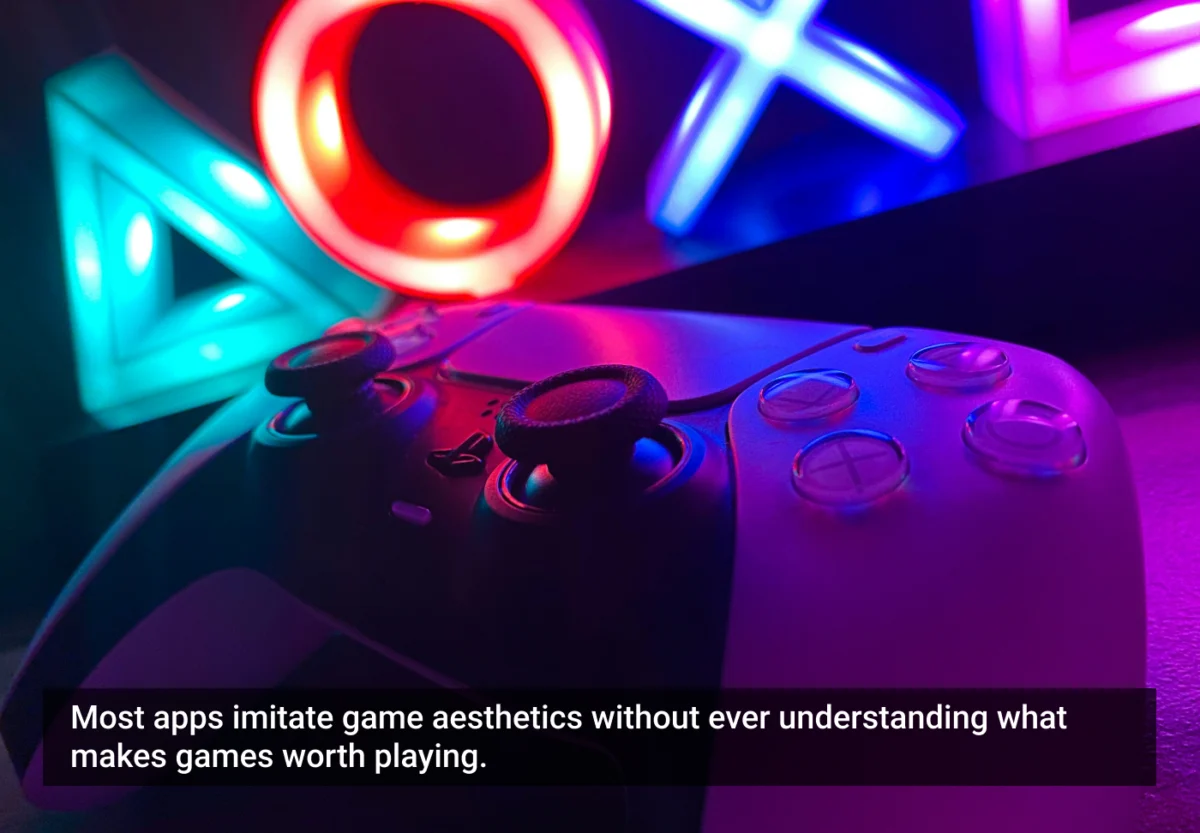
Featured image courtesy of Cash Macanaya.
 Nana Muazin
 Raul Delapena Setiawan
 Suro Senen
