
 By Suro Senen
By Global Tech & Labor Desk
Published: October 24, 2025
Main Facts: The Modern Employment Paradox
The contemporary white-collar job search has devolved into a high-stakes guessing game. As corporations rapidly automated their recruitment pipelines, millions of qualified applicants found themselves locked out, forced to explain their professional lives to invisible, unyielding machines. The burden of this technological shift has fallen almost entirely on the shoulders of the worker: job seekers are now expected to reverse-engineer proprietary algorithms, rewrite resumes to satisfy opaque digital parsers, and pay out-of-pocket subscriptions for third-party platforms just to secure basic visibility.
At the center of this crisis is a staggering revelation from a 2025 academic paper titled "AI Self-preferencing in Algorithmic Hiring." The research uncovered a profound systemic flaw: large language models (LLMs) heavily favor resumes that mimic their own stylistic output. The study documented a self-preference bias ranging between 68% and 88%. In simulated recruitment pipelines spanning 24 distinct occupations, candidates utilizing the exact same LLM as the evaluator were found to be 23% to 60% more likely to secure a shortlist interview than equally qualified candidates who submitted human-authored resumes.
This feedback loop of machine narcissism has created an existential crisis for human resources. Job seekers are no longer judged solely on their skills, achievements, or cultural fit; they are graded on how closely their career history mirrors the synthetic cadence of an artificial intelligence.
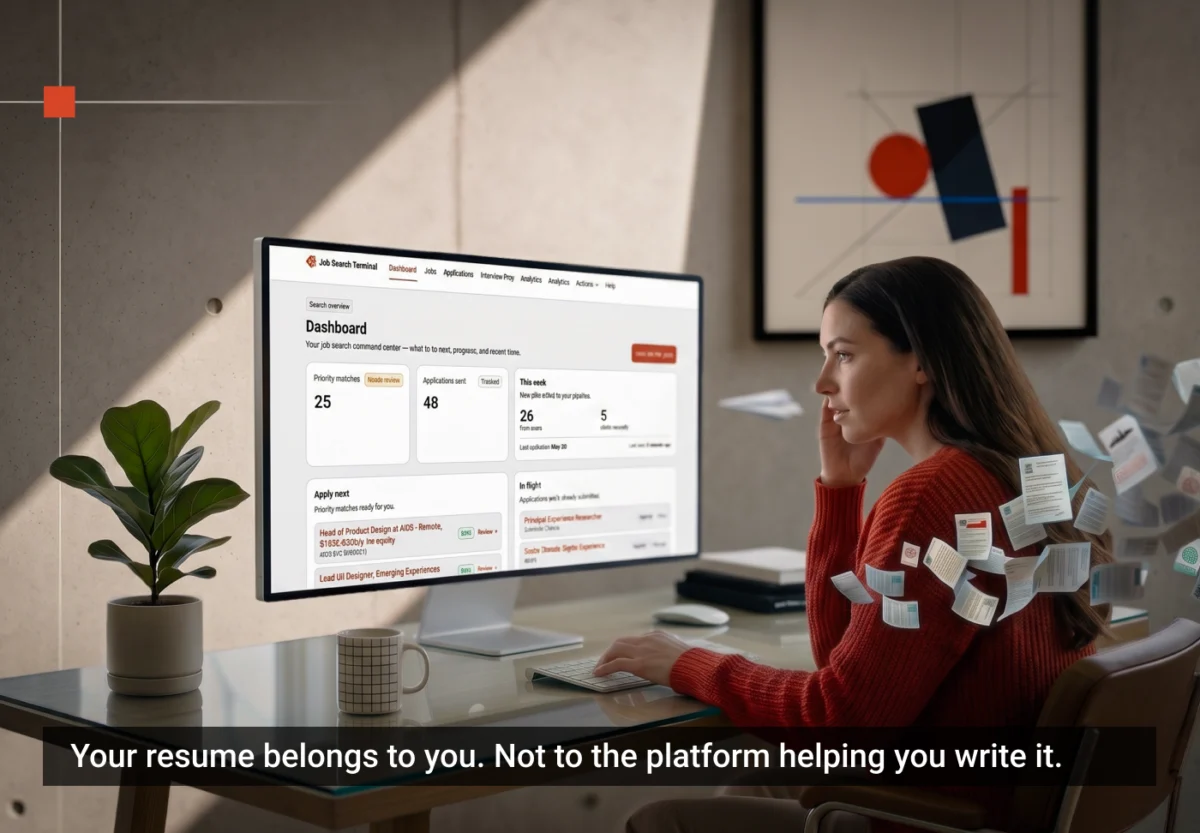
In response to this opaque digital barrier, developer and designer Pavel Bukengolts has introduced the Job Search Terminal—a free, open-source, local-first dashboard designed to help applicants reclaim control over their professional narratives without adding yet another subscription fee to an unemployed worker’s monthly ledger.
Chronology: How We Arrived at the Black-Box Hiring Crisis
To understand how the employment market became a labyrinth of machine gatekeepers, it is necessary to trace the rapid evolution of recruitment technology over the past decade.
Phase 1: The Rise of Keyword Scrapers (Early 2010s – 2020)
Long before generative AI entered the mainstream, Applicant Tracking Systems (ATS) dominated human resources departments. Companies relied on rudimentary keyword-matching software to filter out resumes before a human recruiter ever laid eyes on them. Job seekers responded by "stuffing" white text with invisible keywords, sparking an ongoing arms race between candidates and corporate gatekeepers.
Phase 2: The Generative AI Gold Rush (2023 – 2024)
Following the public explosion of consumer-facing generative AI tools in late 2022, corporate recruiters and enterprise software vendors rushed to integrate LLMs into hiring stacks. Platforms promised automated sourcing, instant resume screening, and conversational AI pre-screeners. Simultaneously, job seekers adopted AI to blast out hundreds of customized applications with a single click, flooding HR inboxes with synthetic noise.
Phase 3: The Algorithmic Collapse and Self-Preference Bias (2025)
By 2025, the recruitment ecosystem buckled under the weight of automation. The publication of the "AI Self-preferencing in Algorithmic Hiring" paper proved what many candidates suspected: the algorithms were no longer objective arbiters of talent. Instead, they had become echo chambers. AI models were systematically rewarding candidates who used the same AI tools to write their applications, marginalizing authentic human voices and locking traditional writers out of the corporate funnel.
Phase 4: The Pushback and Local-First Alternatives (Late 2025)
Realizing that centralized subscription apps were profiting off job seeker anxiety, independent developers began building decentralized alternatives. Tools like the Job Search Terminal emerged as a direct pushback against cloud-based gatekeeping, shifting the power dynamic back to the individual.
Supporting Data: The Numbers Behind the Bias
The empirical evidence condemning modern algorithmic hiring is difficult to ignore. The 2025 study on AI self-preferencing exposed vulnerabilities that strike at the heart of fair labor practices.
- 68% to 88% Bias Rate: Across multiple testing environments, LLM-driven evaluators exhibited an overwhelming tendency to select resumes generated by models identical to their own underlying architecture.
- Up to 60% Shortlist Advantage: Candidates employing the correct model match experienced a massive statistical advantage over human-written counterparts, even when their underlying professional qualifications were identical or inferior.
- 24 Occupations Impacted: The bias was not restricted to tech or writing roles; it spanned a diverse array of industries, confirming that the issue is structural rather than sector-specific.
These figures underscore a chilling reality: the modern hiring funnel does not necessarily select the best worker; it selects the best algorithm mimic. Consequently, applicants are forced to abandon their authentic voices, learning how to code-switch into robotic prose just to pass the first digital inspection.
Official Responses and Industry Perspectives
The rapid deployment of AI in recruitment has ignited fierce debates among ethicists, labor economists, and software engineers.
The Corporate and Vendor Perspective
Enterprise HR software providers defend their integration of AI by citing efficiency. With hundreds of thousands of applications flooding major corporations for single positions, human recruiters argue that automated filters are a logistical necessity. Proponents claim that AI reduces unconscious human bias, speeds up time-to-hire, and surfaces top-tier talent faster than manual sorting.
The Critic and Developer Perspective
Critics, however, argue that replacing human bias with machine bias simply scales discrimination while making it harder to audit. Pavel Bukengolts, creator of the Job Search Terminal, argues that the problem goes beyond simple text generation—it is a matter of autonomy and data dignity.
"The real problem is that people start changing how they describe their work just to sound acceptable to a system they do not understand," Bukengolts explains. "That is why I built Job Search Terminal: not another AI job search app, but a practical system people can own without adding another subscription between them and a paycheck."
Bukengolts emphasizes that the goal is not to eliminate AI entirely—which would be an exercise in futility—but to shift the locus of control. By leveraging Bring-Your-Own-Key (BYOK) architecture, users can harness AI for analytical tasks (like summarizing job descriptions or brainstorming cover letter angles) while retaining absolute veto power over every word sent to an employer.
Implications: Reclaiming Agency in an Automated Market
The rise of tools like the Job Search Terminal points toward a broader ideological shift in how individuals interact with software. For years, tech platforms have centralized user data in the cloud, monetized personal information, and locked essential utilities behind monthly paywalls. In the context of a job search—where an individual is often at their most vulnerable—this monetization of desperation is particularly predatory.
1. The Death of the Centralized Subscription Model
Job seekers should not have to pay rent to look for work. Charging unemployed or underemployed individuals subscription fees for basic organizational tools (like Kanban boards, resume version control, and application trackers) is an exploitative business model. Open-source, local-first alternatives demonstrate that utility software can exist without extracting recurring revenue from people who are trying to earn a living.
2. Data Sovereignty for Professionals
A resume, a portfolio of past projects, and career notes represent an individual’s professional identity. Storing this hyper-sensitive data on third-party cloud databases exposes users to privacy breaches and algorithmic profiling. Local-first architecture—where data resides exclusively on the user’s personal machine—ensures that a job seeker’s career trajectory remains private property, not fodder for corporate data-harvesting operations.
3. Redefining the Role of AI: Assistant vs. Autopilot
The industry is currently divided between two philosophies:
- The Autopilot Approach: Letting AI write, apply, and negotiate on behalf of the candidate. This leads to automated noise on both sides of the hiring desk.
- The Assistant Approach: Using AI as an analytical sparring partner to organize chaos while keeping human judgment firmly at the wheel.
The Job Search Terminal deliberately champions the latter. It does not auto-apply to jobs. It does not claim to understand a career better than its owner. Instead, it handles the tedious administrative overhead—parsing job descriptions, comparing requirements, and drafting comparative text—leaving the human free to focus on critical thinking: deciding what is true, what is worth pursuing, and what ethical compromises are worth making.
Conclusion: A Step Toward a Human-Centric Future
We cannot fix the structural rot of the global labor market with a single open-source application. Corporate recruiters will continue updating their filters, and AI models will continue evolving.
However, by refusing to surrender our professional identities to opaque cloud black boxes, we can alter the terms of engagement. Tools like the Job Search Terminal prove that software can be built with empathy, transparency, and respect for the user.
For those navigating the brutal terrain of the modern job market, the path forward requires a blend of skepticism, technical pragmatism, and mutual aid.
Project Resources & Further Reading
- Project Overview: Job Search Terminal Project Page
- Source Code & Setup Guides: GitHub Repository
- Academic Reference: "AI Self-preferencing in Algorithmic Hiring" (arXiv:2509.00462)
 Nana Muazin
 Raul Delapena Setiawan
