
 By Raul Delapena Setiawan
By Global Tech & Innovation Desk
Published: March 2025
Main Facts
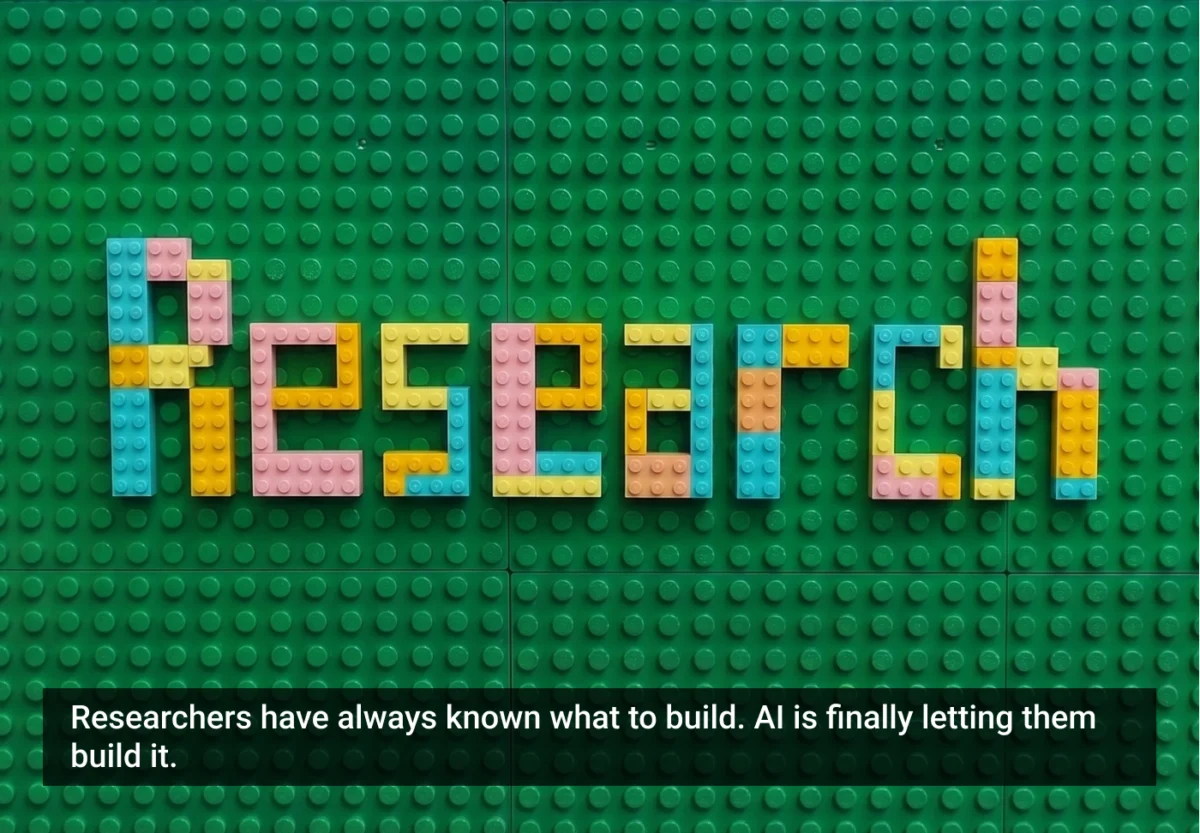
The traditional boundaries of academic and corporate research are dissolving. Driven by the rapid commoditization of artificial intelligence tools, a shifting economic landscape, and intensifying mandates from employers, researchers are stepping out of the advisory backseat and into the driver’s seat of product creation.
From freeze-dried backpacking food and personal finance applications to physical photo booths and community dinner initiatives for refugees, modern researchers are no longer content with merely generating insights for others to execute. They are becoming founders, creators, and makers.
However, this transition is far from a frictionless golden age. While the democratization of software development and AI-assisted workflows—such as "vibe coding" and automated prototyping—has lowered technical barriers to entry, it has exposed deep psychological, financial, and cultural friction. Researchers are finding themselves wrestling with their own professional identities, the realities of cash-flow management, the isolation of solo-founding, and the ethical tension between corporate growth metrics and human-centric values.
Interviews with over twenty pioneering researcher-makers reveal a complex portrait of an industry at a crossroads, where the ultimate challenge is not learning how to use new tools, but learning how to reconcile a deeply analytical worldview with the chaotic, pragmatic demands of shipping commercial products.
Chronology: From Advisory Insights to Direct Action
To understand the current surge of researcher-makers, one must trace the evolution of the role over the past several years, marked by a steady progression from passive recommendation to mandatory creation.
- The Pre-2023 Era (The Advisory Paradigm): For decades, user experience (UX), market, and scientific researchers operated strictly one step removed from product delivery. Their core function was to conduct studies, synthesize data, and influence decision-makers in the C-suite or product management. Researchers built reports, frameworks, and personas; product managers and engineers built the actual software or hardware.
- Late 2023 to Early 2024 (The Rise of "Could"): As generative AI tools gained mainstream traction, initial enthusiasm rippled through the research community. Articles and thought leadership pieces, such as Hopeful Futures for UX Research, began mapping out a theoretical future where researchers could leverage AI to prototype rapidly, test ideas independently, and expand their creative footprint.
- Mid to Late 2024 (From "Could" to "Should"): Macroeconomic pressures began reshaping the tech and corporate landscape. Consecutive waves of layoffs and shrinking innovation budgets dismantled the safety net of traditional employment. At the same time, organizations began reorganizing product teams around leaner, AI-augmented squads. The theoretical potential of AI prototyping hardened into an organizational expectation.
- The 2025 Reality (The Mandate of "Must"): Today, the trajectory has shifted from optional exploration to structural necessity. Employers increasingly demand that researchers generate not just insights, but functional prototypes, codebases, and viable business models. Consequently, a growing cohort of professionals has bypassed the corporate ladder entirely, founding bootstrapped startups, building community-led initiatives, and redefining what it means to be a modern knowledge worker.
Supporting Data & Case Studies: The Lived Experience of the Researcher-Maker
Transitioning from a researcher to a maker involves navigating a treacherous psychological and operational landscape. Case studies from early adopters illuminate the specific trade-offs and structural hurdles inherent in this journey.
Neha and Incluya: The Price of Momentum
Working in a corporate innovation lab, Neha watched critical product decisions get approved or rejected by executives who had never spoken to an actual customer. Facing a collapsing job market where traditional employment security had evaporated, she asked herself a fundamental question: "I’m a researcher. Why am I not a CEO?"
She founded Incluya, a personal finance application built firmly on anthropological principles. Within a year, she led a team of ten and secured a closed beta. However, her core research instincts—analyzing every angle, weighing every option—began bottlenecking the startup’s momentum. To survive, Neha had to learn to time-box her decisions, accepting imperfect outcomes in exchange for speed. While a powerful user testimonial praising the app’s profound personal impact validated her mission, it also created an emotional burden that made it difficult to step away, highlighting the constant threat of founder burnout.
Jen and the Photo Booth Pivot
Jen’s journey began with a frustrating consumer experience: renting a portable photo booth for an industry conference, only to find the unboxing chaotic and the hardware flimsy. Recognizing an unaddressed market need, she purchased fifteen iPads, invested in R&D, and hired developers.
By applying the same iterative feedback loops she used in corporate UX research—asking strangers at her own events how to improve the product—she discovered a major flaw in her initial business model. While she assumed users wanted a self-service setup, the market demanded a hosted experience. By pivoting quickly, Jen transformed a casual observation into a thriving enterprise, though she notes that inventing something from scratch requires a vastly different psychological gear than evaluating someone else’s product.
Matthieu and AI-Assisted Finance
Faced with the challenge of personal financial literacy for under-served demographics—such as artists, teachers, and service workers—Matthieu utilized AI tools like Claude to build custom financial planning dashboards and operating models.
However, his experience offers a cautionary tale regarding over-reliance on AI generation. When he presented his AI-built designs to a veteran design manager, the feedback was blunt: the system required a complete architectural rebuild. Matthieu realized that AI could automate technical execution, but it could not replace human peer review, visual identity design, or unbiased user research. "Claude is just a tool to expand what you can do," he reflects. "That’s it."
Official Responses and Industry Perspectives
The institutional reaction to the researcher-maker trend is characterized by a stark disconnect between corporate directives and individual practitioner readiness.
Corporate leadership and agile evangelists, such as those at the Silicon Valley Product Group (SVPG), argue that discovery is the ultimate differentiator in an AI-saturated market. From an enterprise perspective, combining the roles of researcher and builder promises higher efficiency, faster time-to-market, and tighter alignment between user needs and technical execution.
Conversely, professional associations and community leaders express significant concern over the systemic pressures being placed on knowledge workers. Many organizations are pushing researchers into maker roles not as an empowering career evolution, but as a cost-cutting measure to downsize specialized research teams.
Furthermore, veterans of the space emphasize that the industry lacks relatable role models. Social media platforms like LinkedIn often present a hyper-polished, toxic-positive narrative of overnight startup success that alienates practitioners struggling with cash flow, technical debt, and impostor syndrome. True institutional support—such as mentorship programs, financial runways, and psychological safety frameworks—remains scarce within traditional corporate structures.
Implications: The Hazards and Future of the Hyphenated Identity
As the industry moves deeper into this era, the implications for professionals are profound, touching upon financial stability, psychological well-being, and the fundamental definition of career success.
1. The Material Reality and Inequality of Risk
The romanticized narrative of "following your passion" and bootstrapping a startup hides a dangerous economic truth: the risks of becoming a maker are not evenly distributed. Practitioners with dependents, those carrying heavy debt, or those located outside thriving venture capital hubs cannot easily absorb months of zero income. Sustainable maker journeys almost universally require a financial safety net—such as a partner with a stable income, prior savings, or small angel funding rounds. Without these cushions, the push toward entrepreneurship can feel less like an empowering choice and more like a forced march driven by corporate layoffs and economic precarity.
2. The Danger of Isolation
Traditional research is a deeply collaborative, team-oriented discipline. Moving to solo-founding or AI-augmented development strips away the "productive friction" of working alongside human colleagues. Many researcher-makers report acute loneliness and isolation, realizing that delegating administrative and technical tasks to AI agents cannot replace the emotional and intellectual richness of human discourse.
3. Embracing the Hyphenated Identity
Ultimately, the future of the profession lies in claiming a hyphenated identity—whether that is researcher-maker, researcher-founder, or researcher-developer. Adopting this identity does not mean abandoning the analytical rigor, empathy, and ethical frameworks that define traditional research. Rather, it requires expanding the definition of creativity to include the messy, pragmatic realities of shipping products, managing cash flow, and taking accountability for real-world outcomes.
As practitioners like Cris, Jen, Sarah, and Brian demonstrate, the researcher’s way of making is fundamentally values-driven rather than purely growth-driven. By applying their deep understanding of human behavior to the creation of tools, communities, and businesses, these pioneers are proving that the transition from advisor to maker is not just an occupational pivot—it is the ultimate evolution of the modern knowledge worker.
 Nana Muazin
 Suro Senen
