
 By rifanmuazin
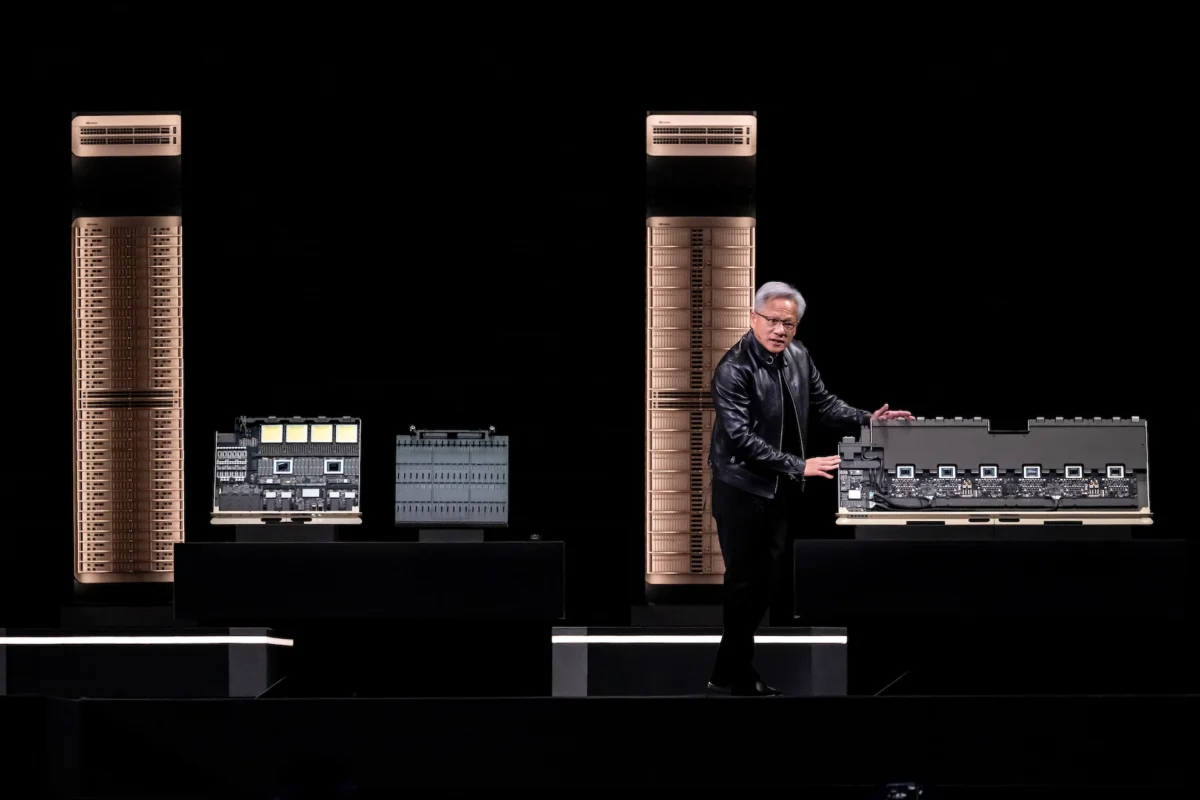
In a move that underscores the insatiable global demand for artificial intelligence compute power, Amazon Web Services (AWS) and Nvidia have announced a massive expansion of their strategic partnership. The agreement, unveiled during Nvidia’s quarterly earnings call this Wednesday, solidifies a multi-billion-dollar commitment that will see an additional 2 million high-performance Nvidia GPU chips integrated into Amazon’s global data centers by 2027 and 2028.
This deal represents one of the most significant infrastructure investments in the history of cloud computing, signaling that despite the rapid rise of internal, proprietary silicon development, the industry remains tethered to the unparalleled processing power of Nvidia’s architecture.
The Core of the Deal: Expanding the Compute Frontier
The expanded partnership is centered on the deployment of Nvidia’s most advanced hardware, including the Blackwell Ultra, Rubin, and Rubin Ultra GPU architectures. These processors are the current gold standard for training and running large-scale generative AI models, which require massive parallel processing capabilities to handle billions of parameters.
The scale of this deployment is unprecedented. Just five months ago, Amazon committed to deploying over 1 million Nvidia GPUs across its AWS infrastructure. According to Nvidia, the demand for this capacity has not only met but significantly exceeded initial expectations. This rapid escalation in requirements from startups, global enterprises, AI laboratories, and sovereign governments has forced a strategic pivot, leading to this latest agreement to double down on hardware procurement.
While neither company disclosed the precise financial terms of the deal, industry analysts estimate the value to be in the tens of billions of dollars. Given the current market price of advanced AI-focused GPUs, this procurement represents a massive capital expenditure aimed at maintaining AWS’s position as the primary engine for the AI revolution.
A Chronology of Collaboration and Expansion
The relationship between the world’s largest cloud provider and the world’s leading chip designer has evolved from a transactional supplier-customer model into a deep, multi-layered technological marriage.
- Initial Strategic Alignment: Historically, AWS and Nvidia collaborated to offer GPU-optimized instances for research and enterprise use.
- The 2026 Shift: Earlier this year, the partnership accelerated significantly, with Amazon agreeing to a massive deployment of Nvidia GPUs to combat the compute shortages plaguing the industry.
- Mid-2026 Hardware Surge: Amazon announced the successful integration of its own custom chips—specifically the Trainium and Graviton series—to diversify its supply chain.
- The Current Accord (Q3 2026): The announcement this week marks the largest expansion to date, formalizing the integration of next-generation hardware like the Rubin GPU and Vera CPU into the AWS backbone.
- The 2027-2028 Roadmap: Looking ahead, the two companies have locked in a multi-year roadmap that ensures AWS will have priority access to Nvidia’s upcoming product cycles, shielding them from potential market volatility in the semiconductor sector.
The Dual-Track Strategy: Amazon’s Balancing Act
Perhaps the most fascinating aspect of this deal is its timing. Amazon is currently in the midst of a massive, well-funded push to develop its own artificial intelligence chips. By investing in its own silicon, Amazon is attempting to reduce its long-term reliance on Nvidia and provide its customers with more cost-effective alternatives for specific AI workloads.
Amazon’s AI chief, Peter DeSantis, has been vocal about the company’s plans to sell its Trainium chips to external companies, positioning them as direct competitors to Nvidia’s H100 and Blackwell platforms. Furthermore, the Arm-based Graviton CPU has gained significant traction as a powerful alternative to traditional server chips from legacy giants like Intel and AMD.
During its recent earnings call, Amazon reported that its custom chip division had crossed a $25 billion annualized revenue run rate. This growth is bolstered by a staggering $225 billion in total commitments from major AI labs, including heavyweights like Anthropic and OpenAI. Despite this internal success, Amazon’s decision to commit to 2 million additional Nvidia chips suggests that even with a robust internal hardware program, Nvidia remains the "GOAT" (Greatest of All Time) in the AI compute space. Amazon’s strategy is not to replace Nvidia, but to build a hybrid ecosystem where it can capture the market for specialized, cost-sensitive workloads while continuing to provide the highest-tier compute performance that only Nvidia can currently deliver.
Supporting Data: The Economics of the AI Boom
The financials behind this deal are staggering, reflecting an industry that is betting its future on the ability to scale AI compute.
- Nvidia’s Quarterly Performance: Nvidia reported sales of $96.2 billion for the second quarter, significantly outperforming analyst expectations.
- Data Center Dominance: Data center revenue accounted for $89 billion of that total, representing a 117% increase year-over-year.
- Forward-Looking Revenue: Nvidia anticipates reaching $108 billion in revenue in the third quarter alone, driven by early adoption of its next-gen Rubin architecture.
- Capital Commitments: Nvidia has committed a massive $279 billion to secure supply and manufacturing capacity for future projects, up from $119 billion just one quarter prior. This includes $92 billion in spending for the remainder of the current fiscal year and $87 billion earmarked for 2028.
These figures illustrate a "compute-first" mentality. As Nvidia CEO Jensen Huang noted during the call, "AI is now doing productive and useful work… if we had more compute, we could generate more profitable tokens." This philosophy is driving the current frenzy, as companies realize that the bottleneck to AI profitability is not just software, but the physical hardware required to train the next generation of intelligent models.
Beyond GPUs: A Holistic Integration
The partnership extends well beyond simple GPU procurement. A critical, yet often overlooked, aspect of this agreement is the integration of Nvidia’s entire ecosystem into AWS.
Robotics and Digital Twins
Amazon is adopting Nvidia’s full physical AI stack to power its warehouse robotics fleet. This includes:
- Omniverse: A simulation and digital twin platform that allows Amazon to test robot configurations in a virtual environment before deploying them in physical warehouses.
- Cosmos: Nvidia’s world model platform.
- Isaac: A specialized robotics development platform.
- Jetson: High-performance computing hardware designed specifically for edge AI and robotics.
Enterprise Software and Models
On the software front, AWS will provide seamless hosting for Nvidia’s "Nemotron" family of open-source models via Amazon Bedrock and SageMaker. This allows enterprise clients to build, tune, and deploy Nvidia’s proprietary AI models within the secure AWS cloud environment, creating a one-stop-shop for developers.
The Vera CPU Revolution
Perhaps most notably, Nvidia is introducing its Vera CPUs to the AWS environment. While Nvidia has historically been associated with GPUs, its push into CPUs (central processing units) marks a move to control the entire server stack. CEO Jensen Huang has identified a "brand-new $200 billion market" for these CPUs. By deploying them alongside Rubin GPUs, AWS is effectively building a "Nvidia-native" server architecture that is optimized for efficiency, interconnectivity, and raw power.
Implications: What This Means for the Future of AI
The strengthening of the Amazon-Nvidia alliance has profound implications for the tech industry:
- The Consolidation of Power: While many predicted a fragmentation of the chip market, the reality is a consolidation. The largest players—AWS, Google, and Microsoft—are becoming increasingly dependent on a select few hardware providers to maintain their competitive edge.
- The "Profitable Token" Hypothesis: The industry is currently testing a fundamental economic theory: that the massive capital expenditure on GPU infrastructure will eventually be offset by the creation of "profitable tokens"—AI-generated value that creates tangible revenue. Whether this investment pays off remains the primary question for investors.
- The Pressure on Competitors: For smaller cloud providers and hardware manufacturers, the high-barrier-to-entry established by this partnership is daunting. By locking in supply for years, Amazon and Nvidia are effectively raising the stakes for any company attempting to challenge them.
- The Shift Toward Robotics: The inclusion of robotics and physical AI indicates that the next phase of the AI revolution will move beyond chatbots and into the physical world. By integrating Omniverse and Jetson into its logistics network, Amazon is positioning itself to be the leader in autonomous physical infrastructure.
As we look toward 2028, the partnership between Amazon and Nvidia stands as a testament to the fact that in the AI era, the physical layer—the chips, the servers, and the networking—is just as important as the code itself. The "Titan Alliance" is not merely buying hardware; they are building the industrial foundation for the next decade of digital evolution.
 Siti Muinah
 Suro Senen
