
 By Laily UPN
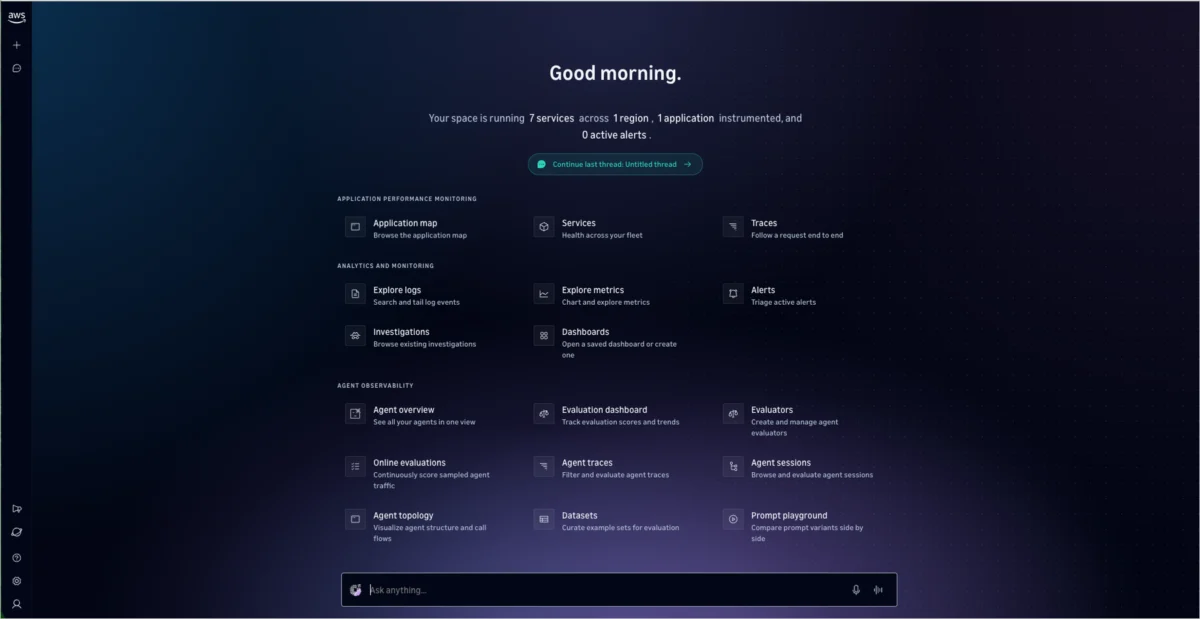
SEATTLE — In a major development for the cloud infrastructure and artificial intelligence sectors, Amazon Web Services (AWS) has officially announced the general availability of Amazon CloudWatch Omni. Billed as a unified, app-centric, and AI-powered observability experience, the new platform is designed specifically to address the complex monitoring, evaluation, and experimentation hurdles associated with modern application and agentic AI workloads.
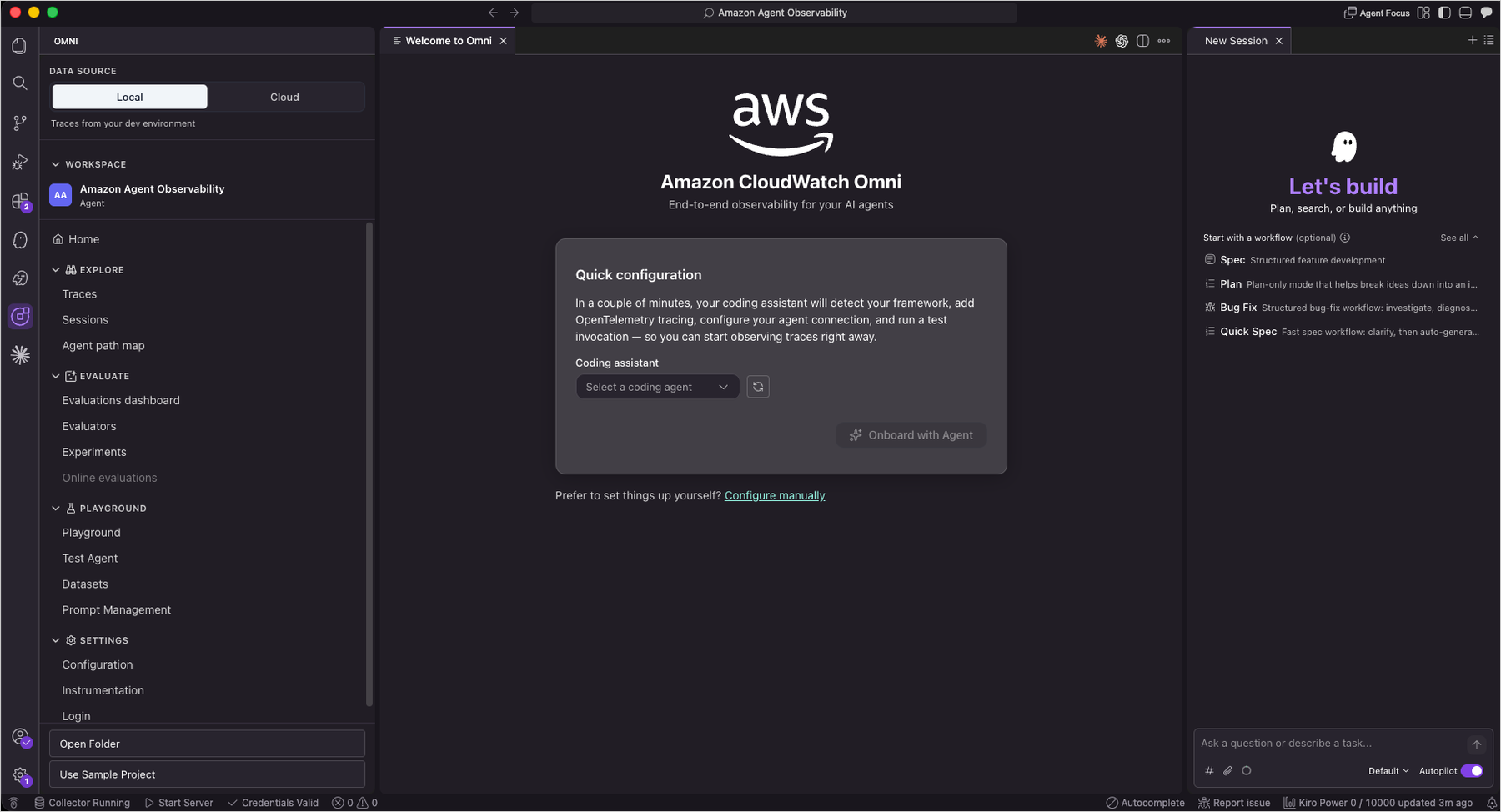
Delivered both off-console—via deep IDE integrations—and through a standalone web experience, CloudWatch Omni seeks to bridge the traditional gap between software development and operations. By supporting open standards such as OpenInference and the AWS Distro for OpenTelemetry (ADOT), the solution aims to provide engineering teams with granular visibility into non-deterministic AI systems without forcing them to re-platform or constantly context-switch between disparate tools.
Main Facts: What is Amazon CloudWatch Omni?
At its core, CloudWatch Omni is a purpose-built solution tailored for the unique lifecycle of AI agents. Unlike traditional cloud monitoring tools that track static metrics like CPU usage, memory leaks, and standard HTTP error codes, Omni dives deep into the intricate, multi-step execution paths of generative AI architectures.
The platform provides a comprehensive suite of features aimed at debugging and optimizing AI systems:

- Comprehensive Tracing: Captures every granular step of an AI invocation, including Large Language Model (LLM) calls, multi-turn reasoning chains, tool invocations, and sub-agent handoffs.
- Built-In Evaluators: Features 17 out-of-the-box evaluators that measure critical qualitative dimensions such as correctness, coherence, helpfulness, faithfulness, and routing accuracy.
- Dual-Surface Delivery: Operates seamlessly across local development environments (via native extensions for VS Code and Kiro) and a standalone web-based dashboard accessible via Single Sign-On (SSO) without requiring an AWS Management Console session.
- Framework Agnostic: Native compatibility with leading orchestration frameworks including LangChain, LangGraph, CrewAI, OpenAI SDK, Strands, and Vercel AI SDK, alongside deep integration with Amazon Bedrock AgentCore.
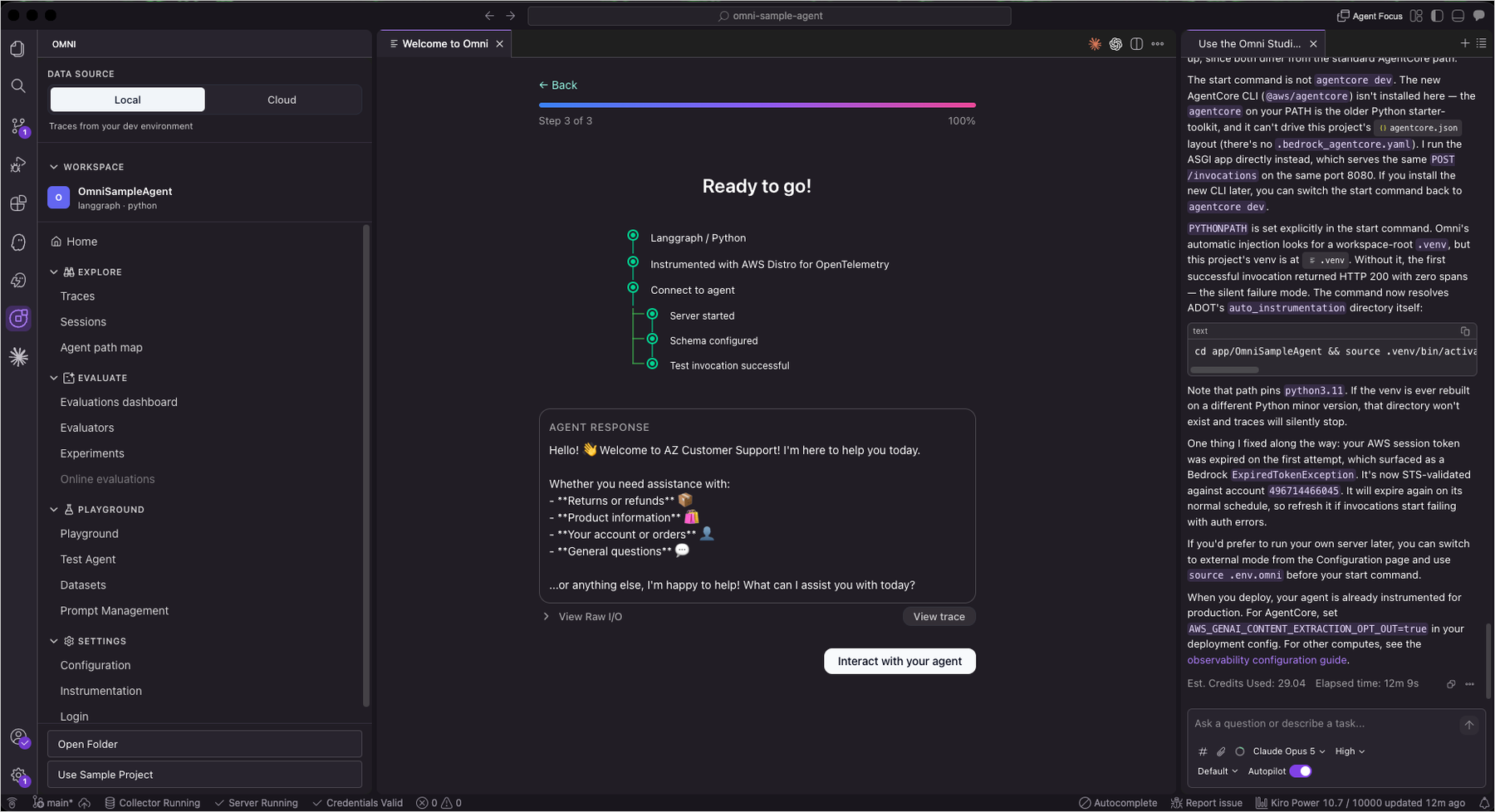
- Zero-Friction Entry: Developers can test and trace agents completely locally without an AWS account, connecting to cloud telemetry infrastructure only when ready to push to production.
Chronology: The Evolution Toward Agentic Observability
The release of CloudWatch Omni arrives at a critical juncture in the software industry. As enterprises shift from basic LLM wrappers to autonomous "agentic" AI systems—systems capable of making decisions, executing multi-step plans, and invoking external tools dynamically—traditional monitoring has proven fundamentally inadequate.
The Rise of Non-Deterministic Challenges
Over the past two years, engineering teams have rapidly adopted generative AI, yet they have struggled with its inherently non-deterministic nature. A minor prompt alteration can severely degrade response quality or introduce logical regressions while standard system metrics display zero errors. Historically, debugging these anomalies required developers to manually parse through fragmented logs across multiple systems, spending countless hours trying to isolate the root cause of a failure.
The Fragmented Tooling Era
To cope, developers initially relied on siloed generative AI monitoring tools or makeshift logging scripts. This created a fractured workflow. Developers were forced to constantly context-switch between their local integrated development environments (IDEs)—where code is written and tested—and external, browser-based observability dashboards.
The Omni Solution
Recognizing this operational bottleneck, AWS engineered CloudWatch Omni to unify the developer and operator experience. By coupling local runtime tracing with cloud-scale telemetry and evaluation pipelines, Amazon has established a continuous lifecycle framework. Developers can now capture telemetry locally, run automated evaluations against golden datasets, push prompt updates safely through side-by-side comparisons, and hand off identical trace data to operations teams for fleet-wide monitoring—all within a cohesive ecosystem.
Supporting Data: Features, Performance, and Integration Mechanics
To understand the operational impact of CloudWatch Omni, it is necessary to examine its structural components and data handling mechanisms.
Architecture and Data Flow
Omni leverages open standards to ingest telemetry data without locking organizations into proprietary pipelines. Instrumentation relies on OpenInference and ADOT, ensuring compatibility regardless of whether agents are deployed on AWS Lambda, Amazon ECS, Amazon EKS, or even rival cloud environments.
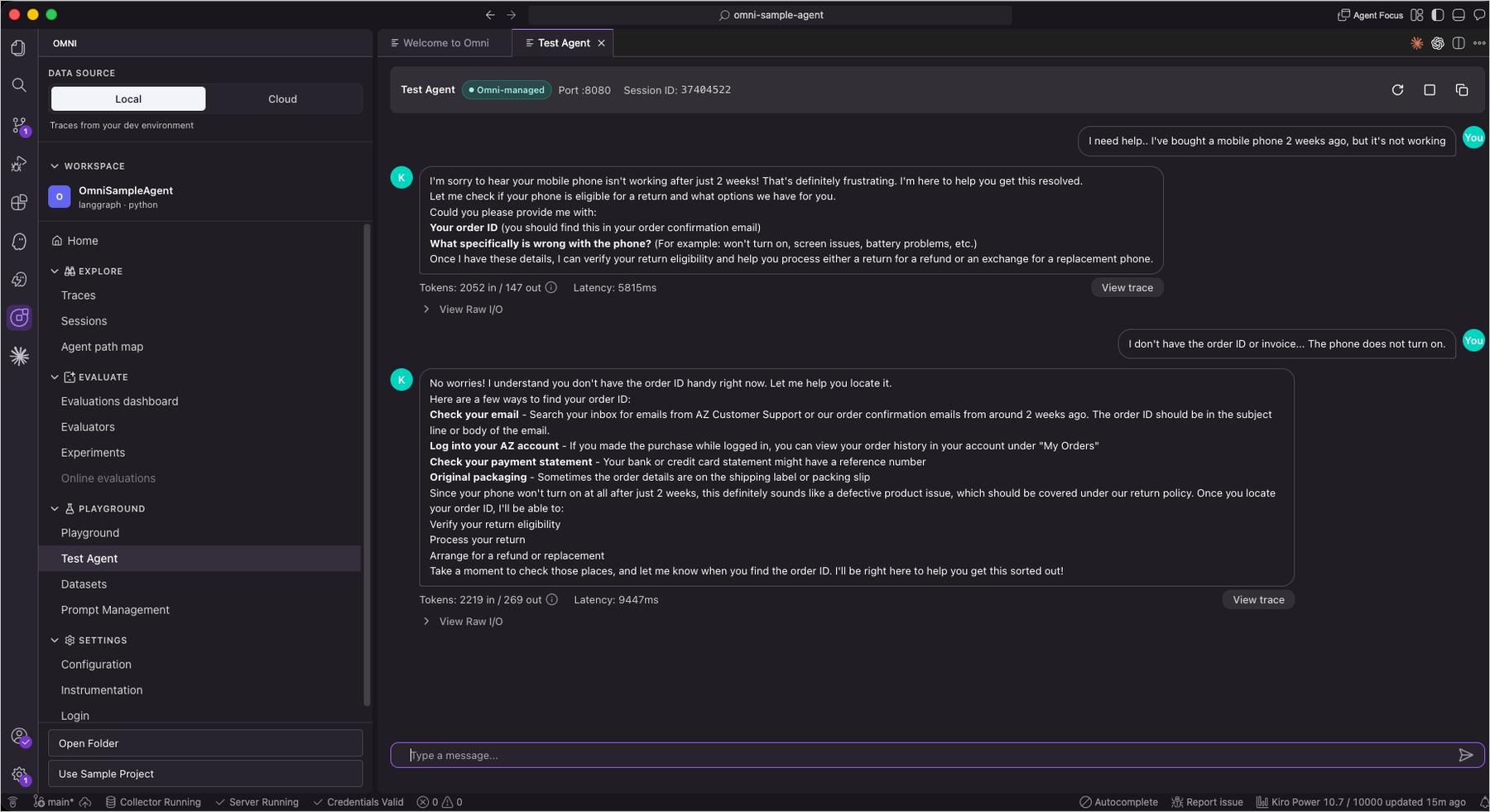
[Local IDE (VS Code / Kiro)]
       │
       ├─► Local Dev Server & OpenTelemetry Instrumentation
       ├─► Trace Explorer & Compare Mode (Local Storage by Default)
       │
       └──[Optional: Cloud Login] ──► [Amazon CloudWatch / Omni Web Console]
                                              │
                                              ├─► Fleet-Level Monitoring via SSO
                                              ├─► Batch Experiments & Golden Datasets
                                              └─► AI-Powered Investigations ("Ask Assistant")
Key Interactive Surfaces
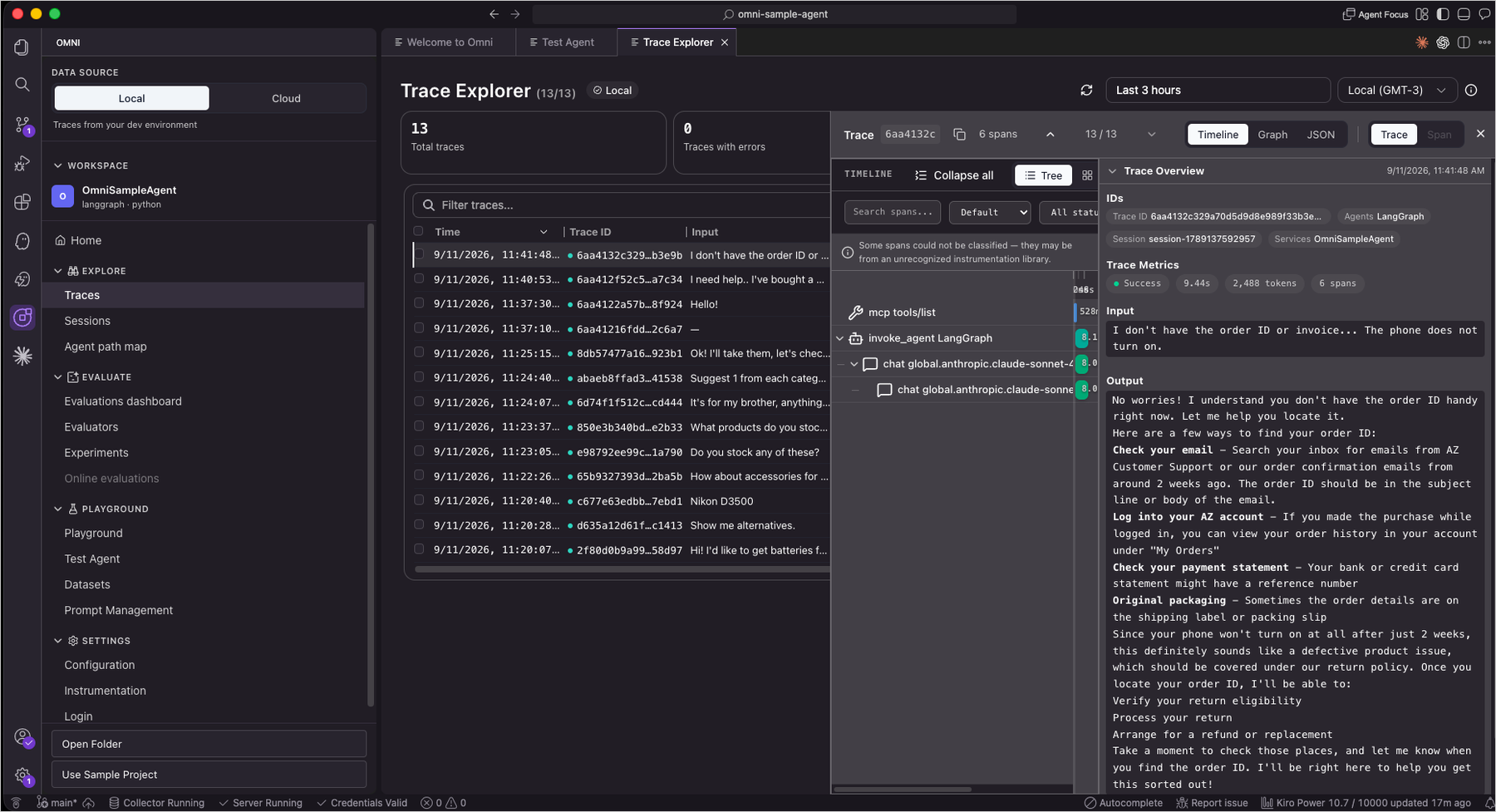
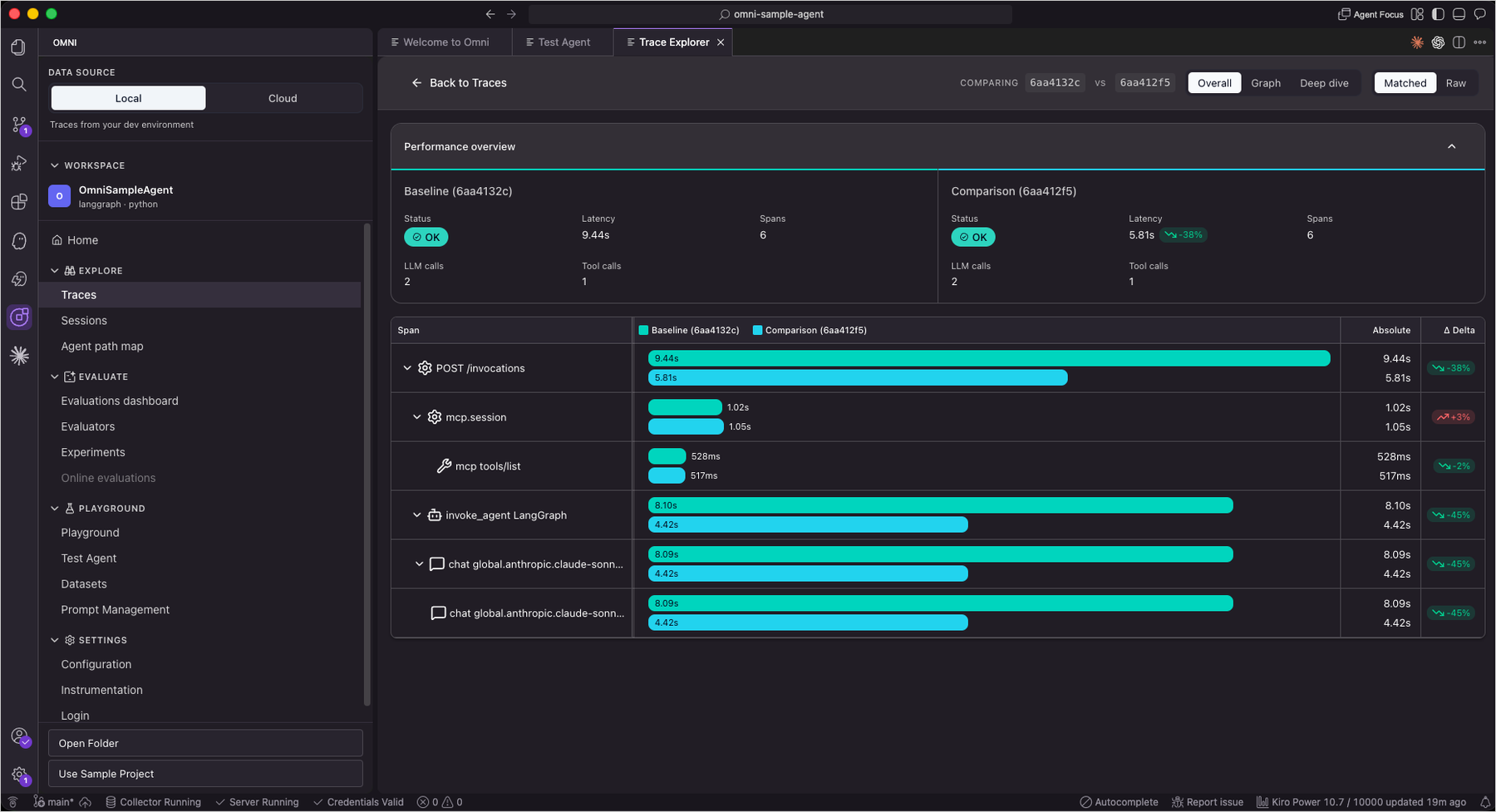
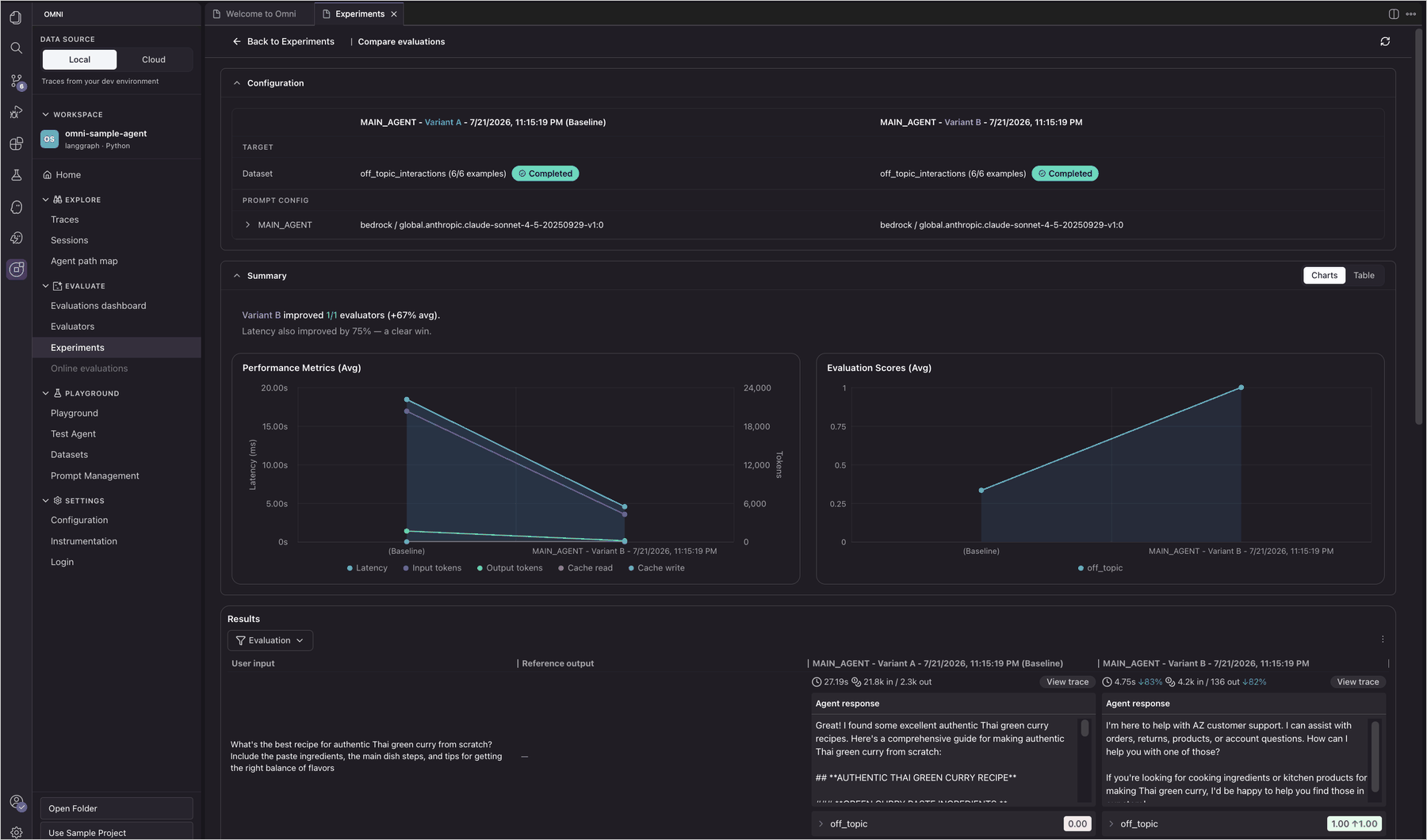
- Trace Explorer & Compare Mode: Developers can inspect structured timelines of agent execution. The "Compare Mode" places two traces side-by-side to highlight how minor prompt changes or configuration tweaks alter agent behavior, proving invaluable for regression testing.
- Ask Assistant: An integrated AI helper that parses complex trace logs to answer natural language queries—such as explaining why an agent invoked a specific tool twice or why a particular response hallucinated information.
- Playground and Batch Experiments: Teams can curate production traffic into "golden datasets," run batch evaluations across multiple model variants, and systematically score outputs against standardized benchmarks for latency, token consumption, and quality.
- Session Explorer and Agent Topology: Provides a macro-level visualization of multi-turn conversation histories and the structural interconnections of sub-agents and tools, enabling quick bottleneck identification.
Official Responses and Industry Context
While AWS has positioned CloudWatch Omni as a foundational pillar of modern cloud operations, industry analysts view the release as a direct response to the maturing needs of enterprise AI deployment.
In technical briefings accompanying the launch, AWS engineering leads emphasized that agentic workflows represent the next frontier of enterprise software, noting that observability cannot remain an afterthought.
"Organizations deploying agentic AI systems face observability challenges that traditional monitoring simply cannot address," engineering documentation notes. "Agent behavior is non-deterministic… existing tools forced teams to choose between siloed generative AI monitoring or fragmented solutions requiring constant context-switching. CloudWatch Omni eliminates this trade-off."
By offering the IDE extension entirely free and removing the initial requirement for an AWS account—requiring credentials only when interacting with hosted model providers like Amazon Bedrock, OpenAI, or Anthropic—AWS has lowered the barrier to entry for individual developers and small teams alike. Furthermore, the inclusion of the AWS MCP Server and associated plugins allows developers to query APIs, search documentation, and troubleshoot using their preferred AI tooling.
Implications: What CloudWatch Omni Means for the Future of AI Development
The general availability of Amazon CloudWatch Omni carries profound implications for software engineering, enterprise governance, and the broader cloud computing landscape.
1. The Democratization of Rigorous AI Evaluation
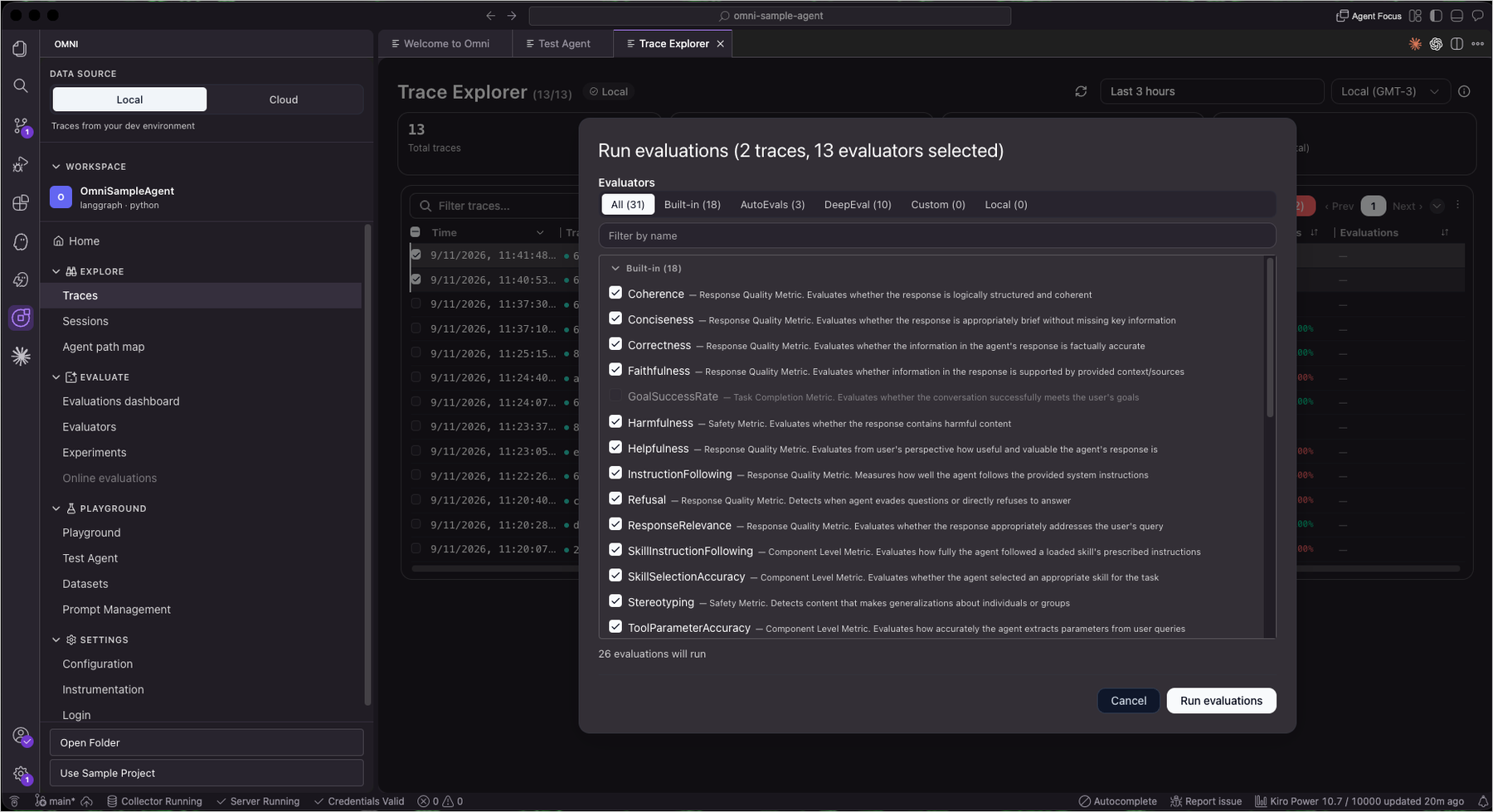
Historically, building robust evaluation frameworks for generative AI required significant engineering overhead. Teams had to write custom evaluation scripts, integrate disparate third-party testing suites, and manually curate datasets. By packaging 17 built-in evaluators directly into the development workflow—coupled with support for advanced external frameworks like AutoEval and DeepEval—Omni democratizes rigorous quality control. Developers can now treat AI evaluation with the same systematic rigor traditionally reserved for unit testing and CI/CD pipelines.
2. Bridging the Dev-Ops Divide for AI Systems
In traditional software, code deployment is deterministic; CI/CD pipelines check syntax, run automated test suites, and deploy binaries. In AI, however, a model update or prompt modification can behave unpredictably in production despite passing static checks. By ensuring that the exact trace a developer debugs locally is the trace an operator investigates in production, CloudWatch Omni establishes a shared source of truth. This transparency drastically reduces Mean Time to Resolution (MTTR) for elusive AI failures.
3. Strengthening the AWS Ecosystem
By tightly integrating CloudWatch Omni with Amazon Bedrock AgentCore while simultaneously supporting multi-cloud deployments and open standards, AWS is executing a balanced platform strategy. On one hand, Omni reinforces the stickiness of the AWS ecosystem by offering unmatched native tooling for Bedrock users. On the other hand, its framework-agnostic architecture ensures that organizations using LangChain, CrewAI, or competing cloud runtimes are not alienated, positioning Omni as a universal control plane for enterprise AI observability.
Getting Started
Amazon CloudWatch Omni is generally available as of today. Developers can download the extension directly from the VS Code Marketplace, explore pre-configured sample projects, and begin tracing local agentic workflows within minutes. For organizations ready to scale, the platform’s standalone web experience and robust cloud telemetry integration provide a clear, enterprise-grade pathway from local experimentation to production-grade operations.
 Sagoh
 Siti Muinah
 Reynand Wu
