
 By Reynand Wu
SEATTLE — In a major push to address the operational complexities of next-generation artificial intelligence, Amazon Web Services (AWS) has announced the general availability of Amazon CloudWatch Omni. Designed as a purpose-built observability, evaluation, and experimentation solution, CloudWatch Omni seeks to solve one of the most persistent bottlenecks in modern software engineering: monitoring, debugging, and optimizing non-deterministic AI agents.
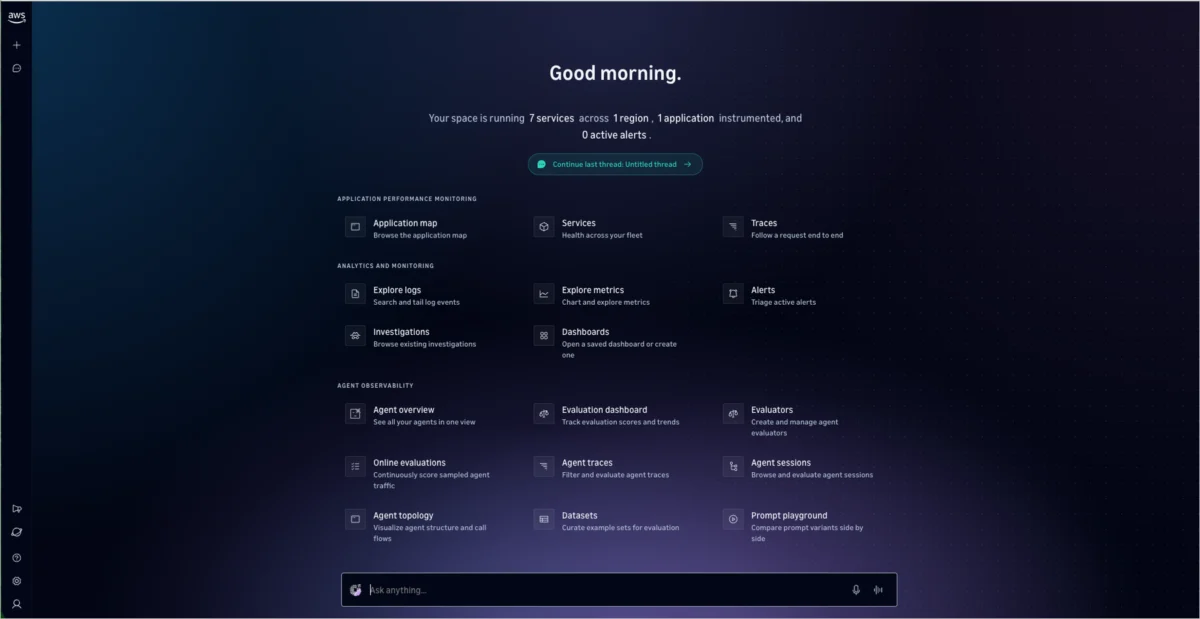
Delivered through a hybrid model that spans developer integrated development environments (IDEs) and a standalone web-based operations console, the platform unifies application and AI workload monitoring across multiple model providers, frameworks, and runtimes without requiring rigid re-platforming.
Main Facts: What is CloudWatch Omni?
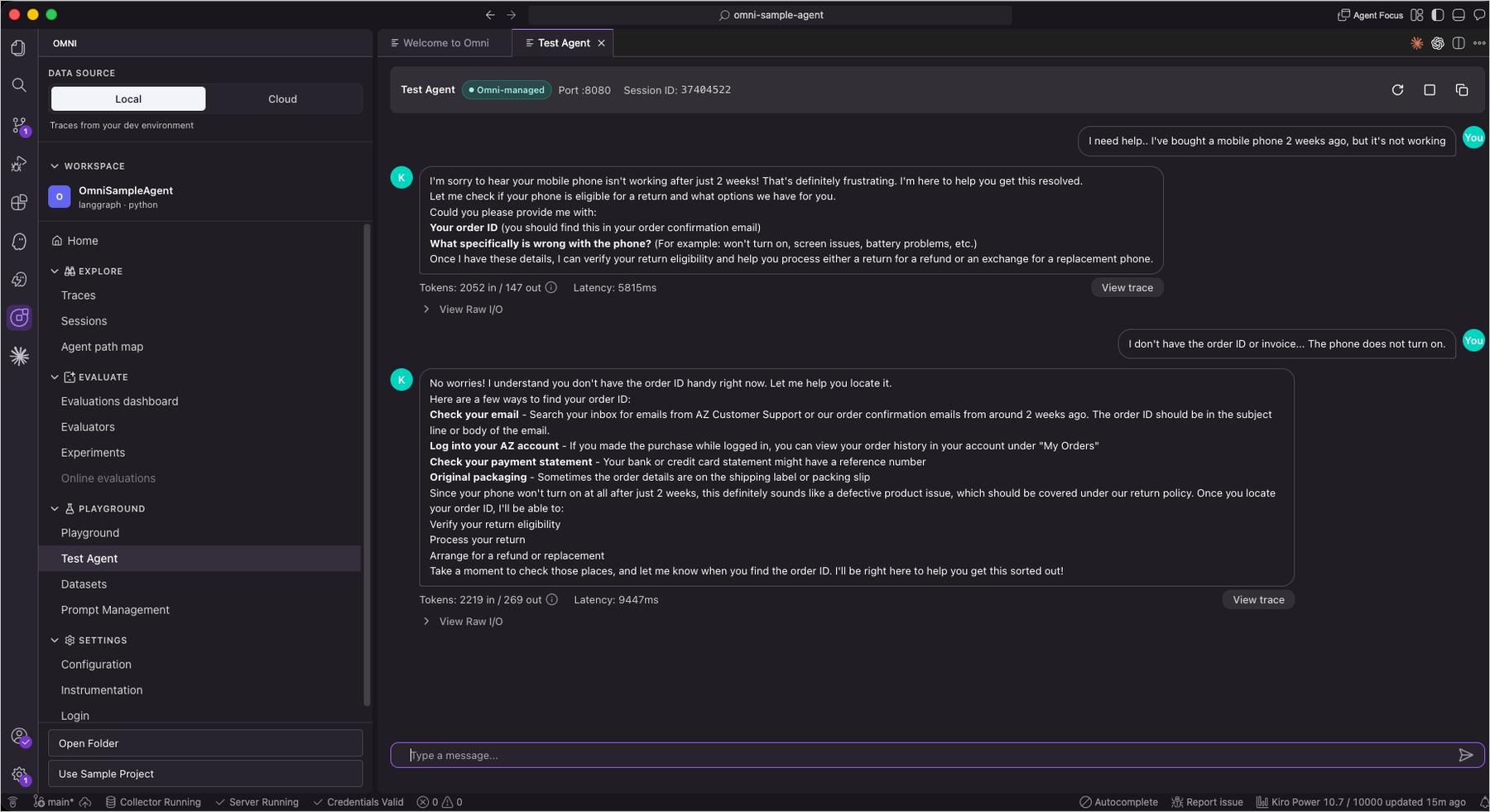
At its core, CloudWatch Omni bridges the traditional divide between software development and production operations for generative AI systems. Built on open standards such as OpenTelemetry, OpenInference, and AWS Distro for OpenTelemetry (ADOT), the platform provides end-to-end visibility into autonomous AI agents, multi-turn conversations, and complex agentic workflows.
Unlike standard monitoring tools that track basic application metrics like CPU usage, latency, and error rates, CloudWatch Omni addresses the non-deterministic nature of AI. Because minor prompt alterations can drastically degrade output quality even when code executes without throwing an error, traditional logging often leaves engineers guessing. Omni captures every trace, records granular execution timelines—including LLM calls, prompt compositions, and tool invocations—and evaluates performance using 17 built-in metrics.
The platform is structured around two distinct operational surfaces:
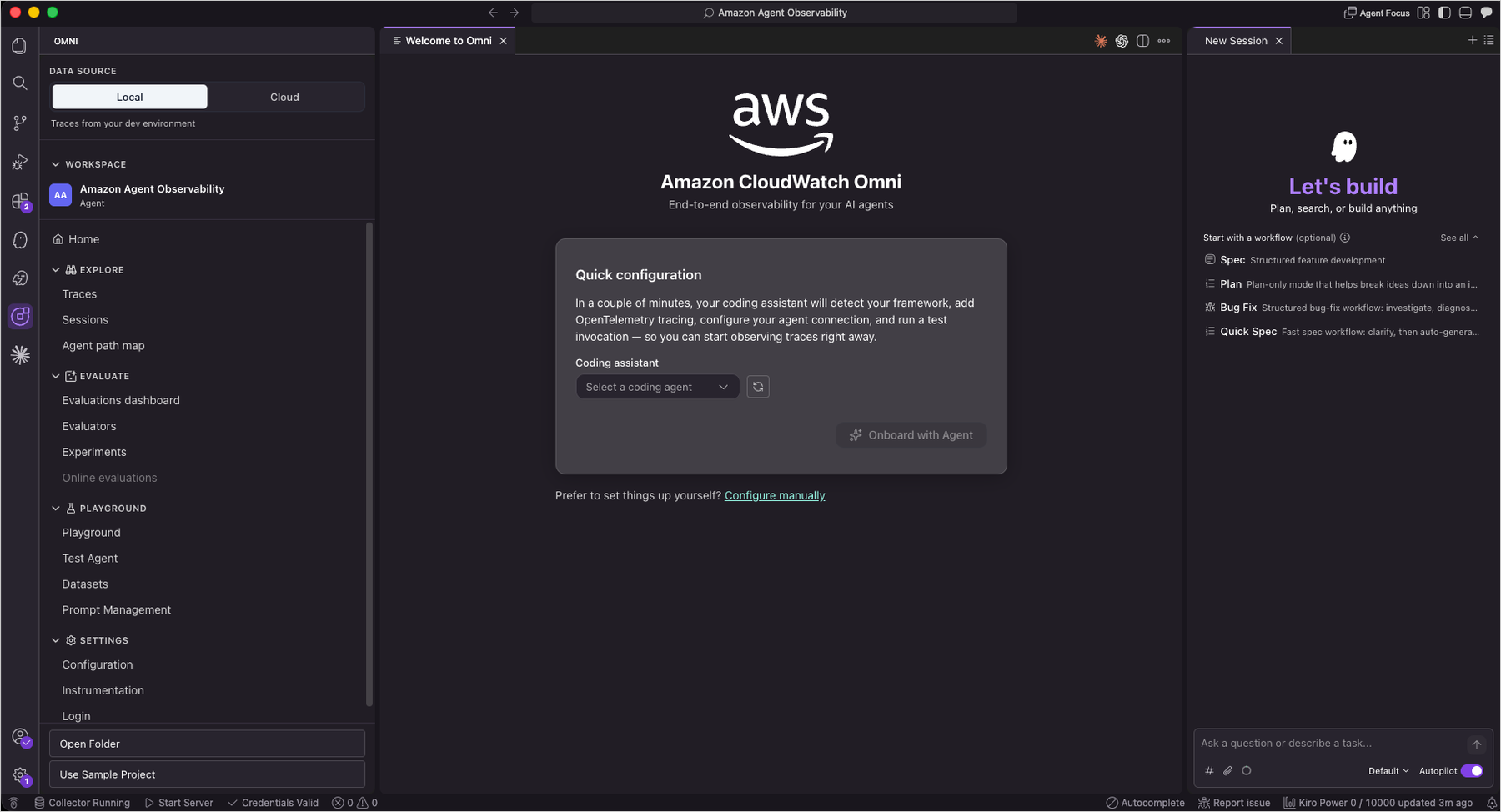
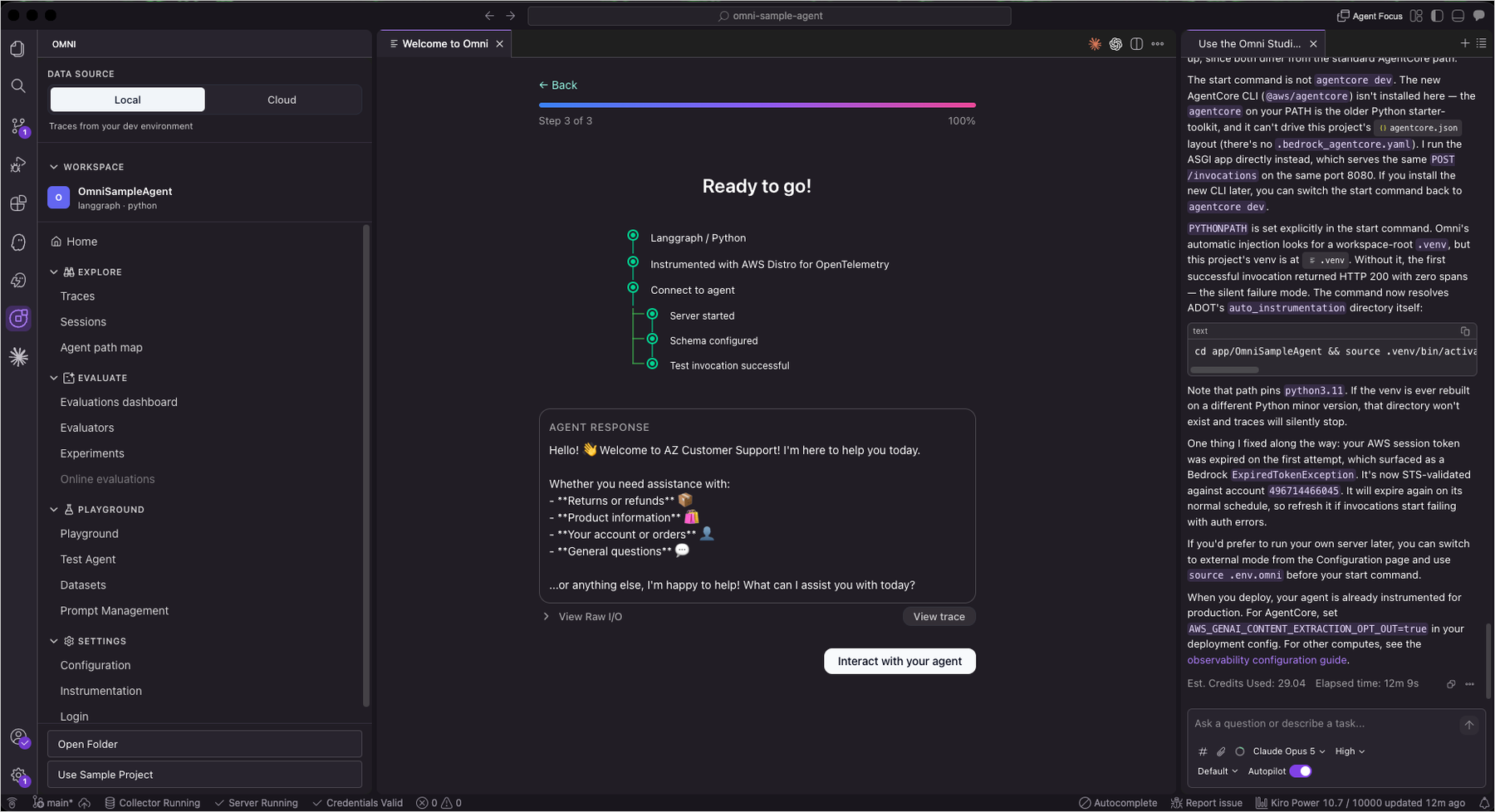
- The Developer Experience (IDE Integration): Available via extensions for Visual Studio Code and Kiro, developers can trace, test, and evaluate agents locally, leveraging AI code assistants to automate instrumentation.
- The Operations Experience (Standalone Web Console): Accessible via Single Sign-On (SSO) entirely separate from the AWS Management Console, operations teams can monitor agent fleets, review telemetry data, and investigate production incidents without needing direct AWS console access.
Chronology: The Evolution Toward Agentic Observability
The journey to CloudWatch Omni reflects the rapid maturation of AI deployment paradigms over the past several years.

- The Early Generative AI Era: Initially, developers relied on basic API logging and simple text interfaces to monitor large language models (LLMs). As applications evolved from static prompt-response chains to dynamic, multi-agent frameworks capable of executing code and calling external tools, these legacy methods proved insufficient.
- The Fragmented Monitoring Phase: Engineering teams were forced to adopt siloed third-party AI observability tools while keeping their traditional infrastructure monitoring separate, resulting in constant context-switching and fragmented data silos.
- The Open Standards Movement: As frameworks like LangChain, LangGraph, CrewAI, and the Vercel AI SDK gained dominance, demand grew for open-standards-based telemetry that could transcend specific vendor ecosystems.
- General Availability (Present Day): With the launch of CloudWatch Omni, AWS has unified these disparate requirements. The platform integrates seamlessly with Amazon Bedrock AgentCore, LangChain, OpenAI SDK, and open-source evaluators like DeepEval and AutoEval, offering a streamlined pathway from local sandbox development to scaled cloud operations.
Supporting Data and Technical Architecture
CloudWatch Omni’s technical capability rests on deep instrumentation, structured tracing, and rigorous evaluation frameworks.
Granular Trace Exploration
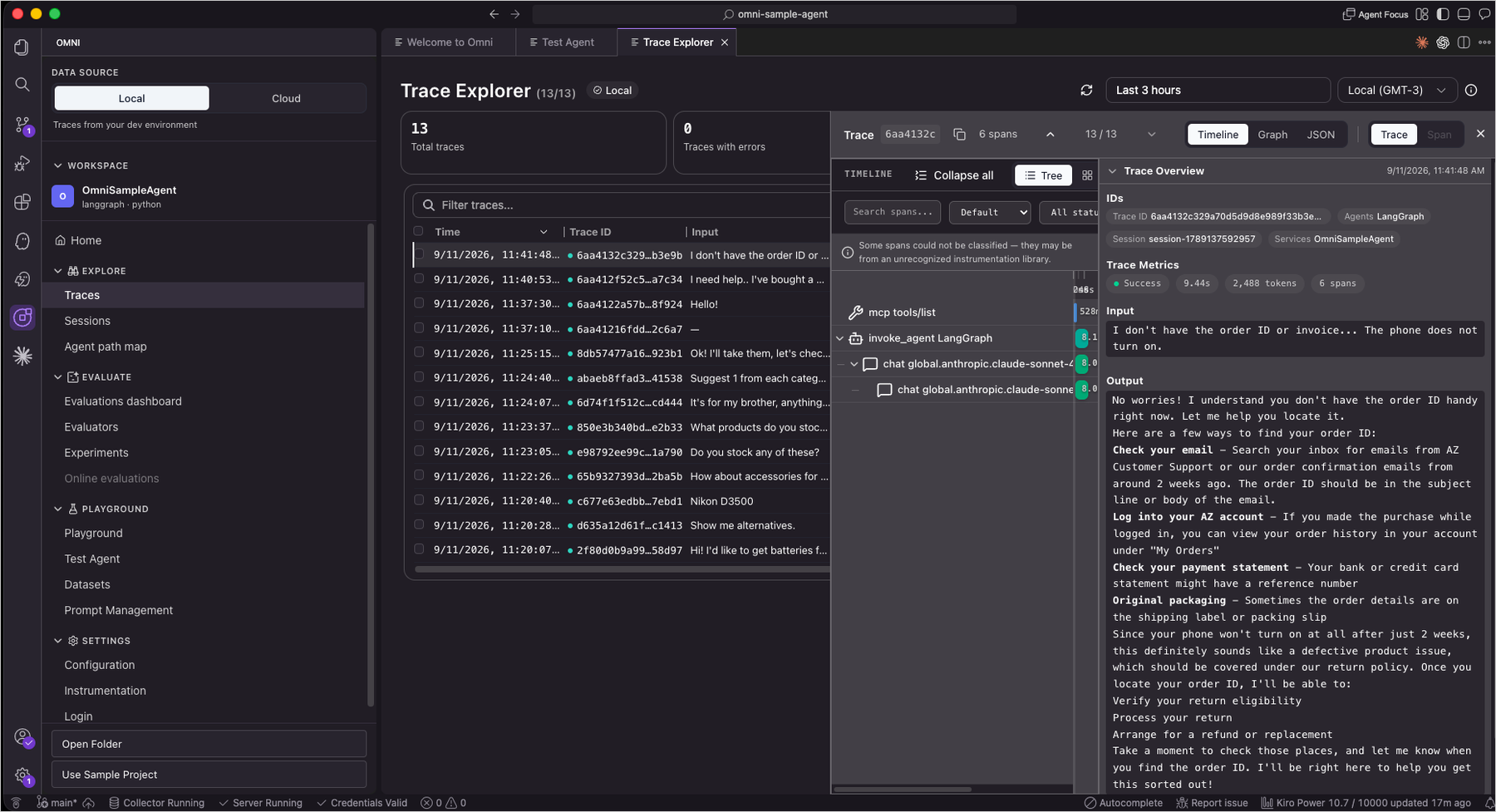
When an AI agent fails or takes an unexpected logical path, CloudWatch Omni’s Trace Explorer provides a hierarchical timeline of every step. Engineers can drill down into individual spans to inspect:
- Input prompts and raw model outputs
- Token consumption metrics and request latencies
- Tool selection rationale and sub-agent handoffs
- Compare Mode: Allows developers to place two traces side-by-side to visually analyze how minor configuration or prompt changes alter agent behavior.
- Ask Assistant: An embedded AI analysis feature that parses complex traces to answer targeted diagnostic questions, such as, "Why did the agent execute this tool call twice?"
Evaluation-Driven Development
Observability without quality measurement is incomplete. CloudWatch Omni includes 17 built-in evaluators measuring critical dimensions such as:
- Factual faithfulness and hallucination detection
- Response coherence and semantic helpfulness
- Routing and tool-selection correctness
Using the Playground environment, developers can execute batch experiments against curated "golden datasets" derived from production traffic. This enables automated regression testing, side-by-side model and prompt configuration comparisons, and continuous benchmarking before code is deployed to production.
Flexible Data Flow and Privacy
CloudWatch Omni maintains a flexible security and storage posture. By default, all telemetry and trace data are stored locally on the developer’s machine during the initial build phase. Through the optional Cloud Login feature, teams can bridge their local IDEs to their AWS accounts—or use the platform entirely locally—ensuring strict control over sensitive data handling.
Furthermore, the suite supports major agent runtimes across Python and TypeScript, and integrates cleanly with containerized and serverless environments running on AWS Lambda, Amazon ECS, and Amazon EKS.
Official Responses and Industry Perspective
AWS representatives emphasize that CloudWatch Omni was built to eliminate the friction that slows down enterprise AI adoption.
"Organizations deploying agentic AI systems face observability challenges that traditional monitoring simply cannot address," noted Daniel Abib, AWS product engineering lead. "Agent behavior is non-deterministic. By combining deep tracing, built-in evaluators, and a dual-surface workflow tailored for both developers and operators, CloudWatch Omni bridges the gap between experimentation and reliable production operations."
Industry analysts have noted that the decision to make the IDE extension completely free to use—and accessible without requiring a pre-existing AWS account (aside from API keys for third-party model providers like OpenAI or Anthropic, or AWS credentials for Amazon Bedrock)—lowers the barrier to entry significantly. By supporting open standards like OpenInference and ADOT, AWS is positioning CloudWatch Omni as an open ecosystem play rather than a locked-in proprietary silo.
Implications for the Future of Enterprise AI
The rollout of CloudWatch Omni carries significant implications for software engineering teams, enterprise IT budgets, and the broader AI tooling market.
1. Standardization of Agent Evaluation
As enterprises transition from simple conversational bots to autonomous agents capable of managing business logic, financial transactions, and automated customer service, failure states carry high financial and reputational risks. Systematic, evaluation-driven development will likely transition from an optional best practice to a mandatory compliance standard. Platforms like CloudWatch Omni provide the systematic rigor required to audit autonomous systems.
2. Bridging the Developer-Operator Divide
Historically, developers used local debugging tools while operations teams relied on centralized dashboards, leading to communication friction during incident response. By sharing a unified underlying telemetry dataset—where a developer can debug an identical trace that an operator investigates via an SSO-secured web portal—Omni fosters closer alignment across DevOps and AI engineering squads.
3. Impact on Third-Party Tooling
While specialized AI observability startups have populated the market over the last three years, the inclusion of a natively integrated, enterprise-grade solution within the broader AWS CloudWatch ecosystem poses a competitive challenge. Enterprises already standardized on AWS infrastructure may find it compelling to consolidate their application logs, metrics, and AI agent traces under a single pane of glass.
Getting Started
Amazon CloudWatch Omni is generally available today.
- Developers can download the free extension directly from the VS Code Marketplace or utilize supported IDEs like Kiro.
- Teams can begin building immediately via sample projects or leverage AI code assistants (such as Claude Code, Codex, and Kiro) to automatically handle OpenTelemetry instrumentation and local development server setup in minutes.
- Operators can access the standalone web experience via secure enterprise SSO without requiring an AWS Management Console login.
Comprehensive documentation, API references, and instrumentation guides are available through the official AWS documentation portal and the AWS Builder Center.
 Jia Lissa
 Nana Wu
 Ali Ikhwan
