
 By Azzam Bilal Chamdy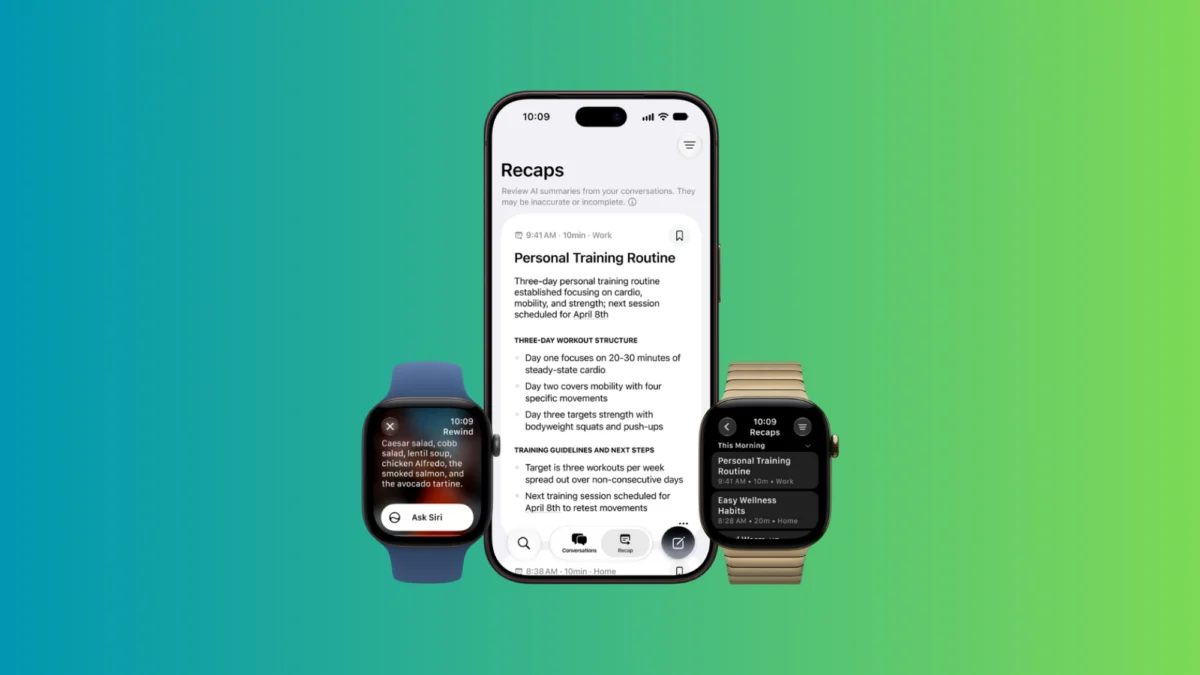
During its September 9 keynote address, Apple unveiled its latest generation of wearable technology: the Apple Watch Series 12 and the Apple Watch Ultra 4. Among a suite of incremental hardware upgrades, fitness enhancements, and health tracking tools, one marquee feature immediately commanded the tech world’s attention—and sparked immediate controversy.
Marketed under the umbrella term "Audio Intelligence," the new software suite introduces capabilities that passively listen to ambient audio throughout the user’s day, processing, summarizing, and indexing conversations on demand. While Apple has engineered an intricate, privacy-first infrastructure to handle this unprecedented stream of conversational data, the feature has reignited a fierce debate over ambient surveillance, personal data security, and the elusive concept of consent in an always-connected society.
This in-depth analysis breaks down the anatomy of Apple’s new Audio Intelligence features, the cryptographic and hardware safeguards protecting users, the severe legal and ethical grey areas surrounding non-consensual bystander recording, and the broader implications for the future of wearable artificial intelligence.
1. Main Facts: What is Apple’s Audio Intelligence?
The introduction of Audio Intelligence on the Apple Watch Series 12 and Ultra 4 fundamentally changes how smartwatches interact with their environment. Rather than waiting for a direct voice command (such as "Hey Siri") or manual activation, the watch functions as an intelligent, continuous listener designed to capture the nuances of daily life.
The system relies on two primary features:
- Live Rewind: An on-demand audio capture utility that allows users to query their watch about things said earlier in the day, generating real-time recaps of missed or forgotten conversations.
- Siri Recap: A daily summarization tool that compiles snippets of tracked ambient conversations into digestible, text-based summaries available on demand.
At first glance, the prospect of a wearable device continuously listening to private chats, business meetings, casual coffee shop banter, and intimate family moments sounds like a dystopian privacy nightmare. However, Apple anticipated this backlash, structuring the entire data pipeline around a strict ethos of on-device processing and ephemeral storage.
According to Apple’s technical documentation, the raw audio captured by the watch’s microphones is never recorded or stored permanently. It is processed in real time, stripped of identifying metrics, summarized, and instantly overwritten in local hardware memory. Only truncated, encrypted metadata leaves the user’s device, and the final text summaries delivered back to the user are end-to-end encrypted.
2. Chronology: The Evolution to Always-On Wearable AI
The path to the Apple Watch Series 12 did not happen overnight. It represents the culmination of a multi-year hardware and software strategy by Apple to integrate generative artificial intelligence directly into low-power wearable form factors.
- Late 2023 – 2024 (The Foundation of Apple Intelligence): Apple introduces its proprietary AI framework, Apple Intelligence, focusing initially on iPhones, iPads, and Macs. Privacy architectures like Private Cloud Compute are established to handle heavy cloud-based AI workloads without exposing user data to third parties.
- September 2025 (Hardware Prep Work): Rumors circulate regarding Apple’s ambitions to bring contextual, sensor-heavy AI tracking to the wrist. Industry analysts note that upcoming microchips will require advanced secure enclosures to handle continuous environmental streaming.
- September 9, 2026 (The Keynote Reveal): Apple officially pulls back the curtain on the Apple Watch Series 12 and Ultra 4. The keynote highlights health innovations, but the crown jewel of the software presentation is Audio Intelligence. Apple executives emphasize that the feature is strictly opt-in and anchored by hardware-level security.
- Post-Launch 2026 (The Industry Reckoning): Within hours of the announcement, privacy advocates, legal scholars, and cybersecurity experts begin dissecting Apple’s whitepapers. While technical watchdogs praise Apple’s cryptographic ingenuity, legal professionals raise urgent questions regarding all-party consent laws and the vulnerability of saved iCloud summaries.
3. Supporting Data: How Audio Intelligence Works Under the Hood
To understand how Apple balances continuous listening with user privacy, one must examine the complex data pipeline connecting the Apple Watch Series 12 to Apple’s cloud infrastructure.
The S11 Chip and the Secure Exclave
The Series 12 and Ultra 4 are powered by the new S11 chip, which features a dedicated hardware partition known as the Secure Exclave. This partitioned local storage compartment is completely walled off; even the watch’s native operating system (watchOS) lacks direct access to it.
When the Apple Watch picks up ambient audio, the stream goes straight into this protected, hardware-level buffer. Here, the audio is immediately encrypted and securely transmitted over an encrypted local tunnel to a matching Secure Enclave on the user’s paired iPhone.
Local Transcription and Minimization
Once the audio data reaches the iPhone, it is processed locally using an advanced, on-device AI model. This model performs several critical tasks:
- It transcribes the conversation.
- It creates a summarized version that is roughly half the length of the original audio.
- It strips out non-essential filler and personal identifying markers.
Once the summary is generated, the original raw audio data in the buffer is permanently overwritten.
Private Cloud Compute and Third-Party Relays
After local processing, the truncated transcript is bundled with generic metadata—such as rough location data and timestamps—and prepared for cloud analysis. Crucially, none of the audio data is tied to the user’s Apple ID at this stage.
Apple utilizes a third-party relay network to obscure the user’s IP address during the upload to Apple Private Cloud Compute servers. This ensures that even Apple employees cannot trace the incoming data stream back to a specific user or device.
Once inside the Private Cloud Compute environment, Siri AI finalizes the summary. If the user has opted into Siri Recap, these summaries are generated and sent back to the device. Apple programs these summaries to auto-delete every seven days unless the user explicitly chooses to save them.
The Vulnerability of Saved Data
While Apple’s transit and processing security is exceptionally robust, a major risk vector emerges at the point of storage.

If a user chooses to save a conversation summary using Siri Recap, that data is uploaded to standard iCloud storage and can be integrated into productivity apps like Apple Notes or Apple Journal. While enterprise-grade server breaches at Apple are exceedingly rare, account-level compromises happen with alarming regularity. For instance, security databases revealed that over 900,000 compromised iCloud logins were exposed in a single credential-stuffing leak tracked early in the year.
If an attacker manages to bypass a user’s multi-factor authentication or gains physical access to an unlocked iPhone, they gain a master key to months of intimate, searchable conversation summaries stored in one convenient location.
4. Official Responses and Industry Perspectives
Apple’s stance on Audio Intelligence has been defensive yet transparent, leaning heavily on technical definitions to deflect legal and ethical criticisms.
Apple’s Technical Defense
Apple has repeatedly emphasized that because the audio stream is continuously overwritten within the hardware-level Secure Exclave, no audio recording ever officially exists.
In its official security whitepaper, Apple notes:
"Audio Intelligence features do not create audio recordings that can be accessed by the operating system, apps, the user, or Apple. There is no recording to share, forward, or produce if requested by any party, because no recording exists."
By sidestepping the creation of permanent audio files, Apple attempts to navigate around traditional wiretapping and eavesdropping statutes. In the eyes of the company’s legal team, a fleeting, hardware-shredded buffer is mathematically and legally distinct from a recording.
Criticisms from Privacy Advocates and Legal Scholars
Civil liberties groups and legal experts are largely unimpressed by these semantic distinctions. The core objection is not merely about where data is stored, but about consent.
While Apple has implemented minor safety measures—such as an audible chime and a visual cue on the watch face when Live Rewind is actively triggered—critics point out severe flaws:
- The Chime Problem: The chime is subtle, easily drowned out in loud environments, and only applies to Live Rewind.
- The Silent Threat of Siri Recap: Siri Recap operates entirely in the background without any audio or visual indicators. Bystanders have zero way of knowing their words are being parsed into text summaries.
- Vague Guidelines: Apple’s official documentation offers little more than a casual warning advising users to "be mindful of those around you," leaving the burden of ethical behavior entirely on the individual consumer.
5. Implications: Legal Grey Areas and the Future of Wearable Surveillance
The deployment of Audio Intelligence on millions of wrists worldwide creates profound legal, social, and psychological implications.
The Clash with Wiretapping and Privacy Laws
A major flashpoint for the Apple Watch Series 12 will undoubtedly be its legality in various jurisdictions:
- United States: At least 12 U.S. states enforce strict all-party (or two-party) consent laws, making it illegal to record confidential or private conversations without the explicit consent of all participants.
- International Markets: Across the European Union, the General Data Protection Regulation (GDPR) imposes stringent restrictions on processing personally identifiable information without explicit disclosure and consent.
While Apple’s technical workaround—arguing that no "recording" is made because the data is instantly vaporized—may satisfy software engineers, judges and regulators may view the generation of permanent text summaries from non-consenting bystanders in a different light. If an individual’s private statements at a business lunch or doctor’s office are transcribed and saved by someone else’s smartwatch, a legal violation has arguably occurred, regardless of how quickly the temporary audio buffer was overwritten.
The Social Erosion of Trust
Beyond the courtroom, the cultural implications are deeply unsettling. The widespread adoption of always-on wearable AI threatens to fundamentally alter human interaction.
When people realize that friends, family members, colleagues, or strangers across a restaurant table might be wearing devices actively summarizing their words into searchable databases, natural conversation will chill. The social contract of confidentiality—the unwritten rule that casual, spoken words evaporate into the air—is replaced by the anxiety that everything said could be indexed, summarized, and stored in someone’s iCloud account.
Conclusion: How to Manage Audio Intelligence
Given the significant security risks and ethical dilemmas surrounding continuous audio processing, it is fortunate that Apple’s Audio Intelligence features are entirely opt-in. They are not enabled by default out of the box on the Apple Watch Series 12 or Ultra 4. Users retain granular control over whether they wish to activate Live Rewind, Siri Recap, or related background utilities.
For consumers who value both cutting-edge technology and interpersonal trust, the safest approach may be leaving these features disabled entirely—ensuring that your conversations remain yours, and yours alone.
 Layla Zulfa
  Asro
Asro  Reynand Wu