
 By Layla Zulfa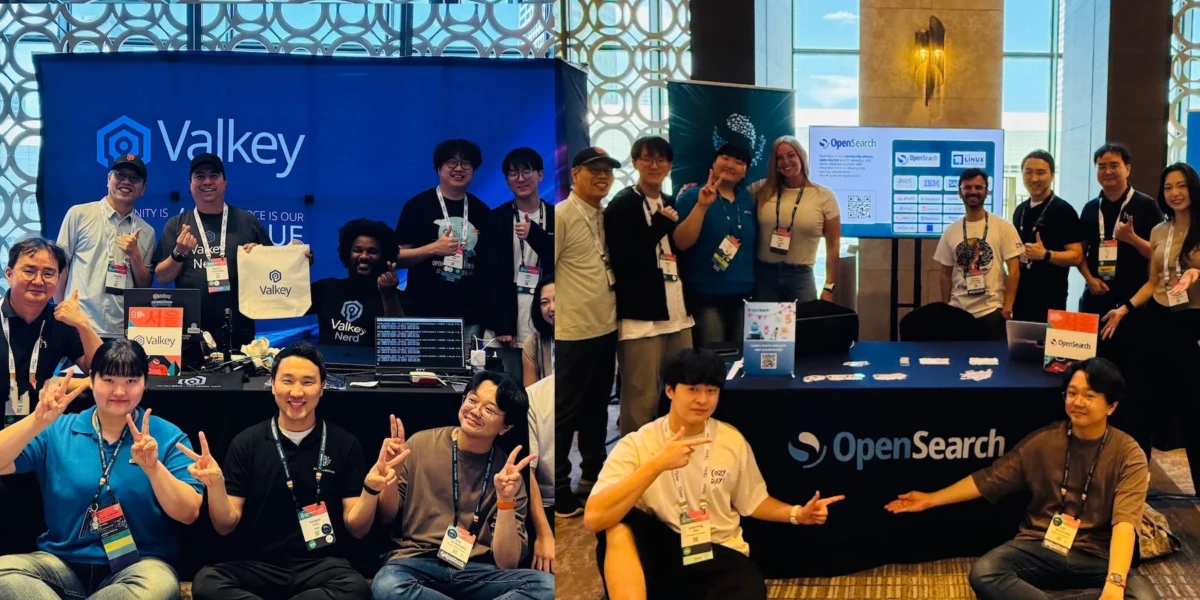
Main Facts
The intersection of enterprise cloud computing and grassroots open-source collaboration was on full display last week as Amazon Web Services (AWS) contributors converged on Seoul, South Korea. Participating in two major technological gatherings—the Open Source Summit Korea 2026 and the MCP DevSummit Seoul 2026—AWS engineers joined forces with the global and regional maintainers of two critical Linux Foundation projects: OpenSearch and Valkey.
Over the course of the four-day event, developers, architects, and community leaders engaged in hands-on workshops, architectural whiteboarding sessions, and localized user group meetups. A centerpiece of the engagement was the vibrant OpenSearch Korean community booth, powered by local volunteer leaders who fielded questions from enterprise adopters and students alike, culminating in a packed regional user group meetup.
These community-centric events serve as a vital bridge between upstream open-source software (OSS) development and hyperscale cloud operations. As enterprises increasingly rely on community-driven technologies to power mission-critical workloads, the presence of major cloud providers like AWS highlights a strategic shift: the boundary between proprietary cloud services and open-source innovation is increasingly porous, collaborative, and mutually reinforcing.
Furthermore, the timing of these engagements closely tracks significant engineering milestones for both projects. OpenSearch recently rolled out version 3.7, introducing breakthrough capabilities in unified observability and vector search performance, while Valkey made waves with version 9.1, bringing a redesigned I/O threading model and massive memory optimizations. Both technologies are now deeply integrated into managed AWS infrastructure—specifically through Amazon OpenSearch Service and Amazon ElastiCache—allowing organizations to seamlessly scale upstream open-source software with enterprise-grade security, automated management, and predictable performance.
Chronology of Events and Technical Milestones
To understand the weight of last week’s gatherings in Seoul, it is necessary to trace the trajectory of recent software releases and community milestones that have shaped the OpenSearch and Valkey ecosystems throughout the first half of 2026.
The Spring and Summer 2026 Timeline
- May 19, 2026: The Valkey project officially released Valkey 9.1. This major update focused on modernizing resource utilization, introducing a revamped I/O threading model alongside critical security enhancements.
- June 9, 2026: The OpenSearch project announced the general availability of OpenSearch 3.7. This release targeted deep observability workflows and massive vector-processing optimizations, streamlining how developers query and alert across logs, traces, and metrics.
- June 23, 2026: AWS expanded its managed offerings by introducing support for Valkey 9.1 on Amazon ElastiCache, making the performance and security upgrades accessible for node-based clusters and multi-tenant architectures.
- July 30, 2026: AWS integrated OpenSearch version 3.7 into Amazon OpenSearch Service, granting managed-service customers immediate access to accelerated vector search and advanced Query Insights.
- Mid-August 2026: AWS contributors, upstream maintainers, and regional developers gathered in Seoul for Open Source Summit Korea 2026 and MCP DevSummit Seoul 2026, bridging global engineering roadmaps with local community execution.
During the four-day Seoul summits, these chronological milestones provided the technical foundation for discussions. Rather than speaking in abstract theoretical terms, community leaders and AWS engineers were able to walk developers through live benchmarks of Valkey 9.1’s memory footprints and demonstrate OpenSearch 3.7’s unified SLO tracking interfaces.
Supporting Data and Technical Architecture
The enthusiasm at Open Source Summit Korea 2026 was fueled not just by community camaraderie, but by hard performance data. Both OpenSearch and Valkey have delivered substantial architectural enhancements in their recent iterations, making them exceptionally attractive for modern, high-throughput cloud architectures.
OpenSearch 3.7: Redefining Scale and Observability
OpenSearch is widely adopted as an enterprise-grade search and analytics suite designed to tackle unstructured data at scale. With the release of OpenSearch 3.7, the project expanded its utility beyond traditional full-text search into unified observability and artificial intelligence (AI) infrastructure.
- Unified Observability Interface: Version 3.7 introduced native tools that allow DevOps and SRE teams to query logs, distributed traces, and infrastructure metrics through a single pane of glass. This release streamlined alerting and Service Level Objective (SLO) tracking, reducing the cognitive load of managing disparate monitoring tools.
- Vector Search Acceleration: In the era of Retrieval-Augmented Generation (RAG) and generative AI, vector search performance is paramount. OpenSearch 3.7 delivered vector retrieval speeds up to 5.5 times faster than previous iterations.
- Managed Implementation: Running OpenSearch 3.7 on Amazon OpenSearch Service (as of July 30, 2026) enables organizations to leverage these accelerated vector searches, enhanced search relevance tuning, and advanced Query Insights without managing the underlying cluster infrastructure manually.
Valkey 9.1: Efficiency at the Speed of Memory
Forked as a high-performance, open-source key-value datastore, Valkey supports diverse workloads ranging from high-speed caching and real-time session stores to message queues and primary databases. Valkey 9.1 represents a massive leap forward in resource optimization.
- Throughput Gains: Through a newly redesigned I/O threading model, Valkey 9.1 delivers up to a 17% increase in overall throughput, allowing systems to handle heavier concurrent request loads with lower latency.
- Memory Footprint Reduction: For memory-constrained environments, efficiency is everything. Valkey 9.1 achieved up to a 20% reduction in memory usage for strings under 128 bytes, translating into significant cost savings for large-scale deployments caching small objects.
- Enterprise-Ready Infrastructure: Through Amazon ElastiCache (available since June 23, 2026), developers can deploy Valkey 9.1 across node-based clusters. This integration brings enterprise-grade access controls, high availability, and multi-tenant isolation to an already high-velocity open-source engine.
Official Responses and Community Perspectives
The collaborative spirit of the Seoul summits underscored a broader philosophy within the modern technology sector: open-source projects thrive when hyperscalers and community developers act as equal partners.
Speaking about the significance of regional community engagement, local OpenSearch community leaders emphasized the importance of grassroots participation. By volunteering at the booth and hosting the Seoul user group meetup, Korean developers demonstrated that the value of open source extends far beyond code repositories—it relies on localized mentorship, knowledge transfer, and shared problem-solving.
AWS representatives at the event reiterated their commitment to upstream-first development models. By contributing code, fixing bugs, and integrating upstream releases into managed services like Amazon OpenSearch Service and Amazon ElastiCache, AWS aims to lower the barrier to entry for enterprise adoption while ensuring that the core projects remain truly open, vendor-neutral, and community-driven.

The Linux Foundation events in Seoul provided a vital forum for these discussions, allowing engineers to break out of digital silos and engage in face-to-face architectural reviews. The enthusiasm observed at the MCP DevSummit Seoul and Open Source Summit Korea points to a maturing ecosystem where open-source governance and enterprise backing successfully reinforce one another.
Implications for Developers and Enterprise Architecture
The convergence of recent software releases, managed cloud integrations, and active regional developer communities carries profound implications for software architects, data engineers, and enterprise decision-makers.
1. Accelerated AI and Search Workloads
With OpenSearch 3.7 delivering up to a 5.5x speedup in vector search performance, organizations building semantic search engines or generative AI applications can scale their vector databases without suffering exponential cost or latency penalties. Because these capabilities are baked directly into Amazon OpenSearch Service, enterprises can deploy production-grade AI search architectures with minimal operational overhead.
2. Cost Optimization Through Memory Efficiency
In distributed caching and message-broker architectures, memory is often the single most expensive resource. Valkey 9.1’s 20% memory reduction for small strings offers immediate financial relief for microservices architectures that rely heavily on caching strings, tokens, and small payloads. When paired with the 17% boost in throughput, engineering teams can achieve higher performance ceilings while provisioning fewer cluster nodes.
3. The Maturation of the Open-Source Cloud Stack
The active participation of AWS in community events across Seoul and globally signals a stable, predictable path for open-source technologies. Enterprises that historically hesitated to adopt community-driven projects due to fears of fragmentation or lack of support now have a clear roadmap. They can build on robust, vendor-neutral foundations like Valkey and OpenSearch, confident that both a passionate global developer community and tier-one cloud providers are actively investing in their longevity.
Looking Ahead
As the 2026 conference season progresses, developers looking to engage directly with project maintainers and AWS contributors can find upcoming schedules on the official OpenSearch Events and Valkey Events portals. Meanwhile, the broader builder community can continue tracking weekly infrastructure launches through the AWS What’s New page and connect with peers via the AWS Builder Center.
 Neng Nana
  Suro Senen
  Lina Hope