
 By Nana Wu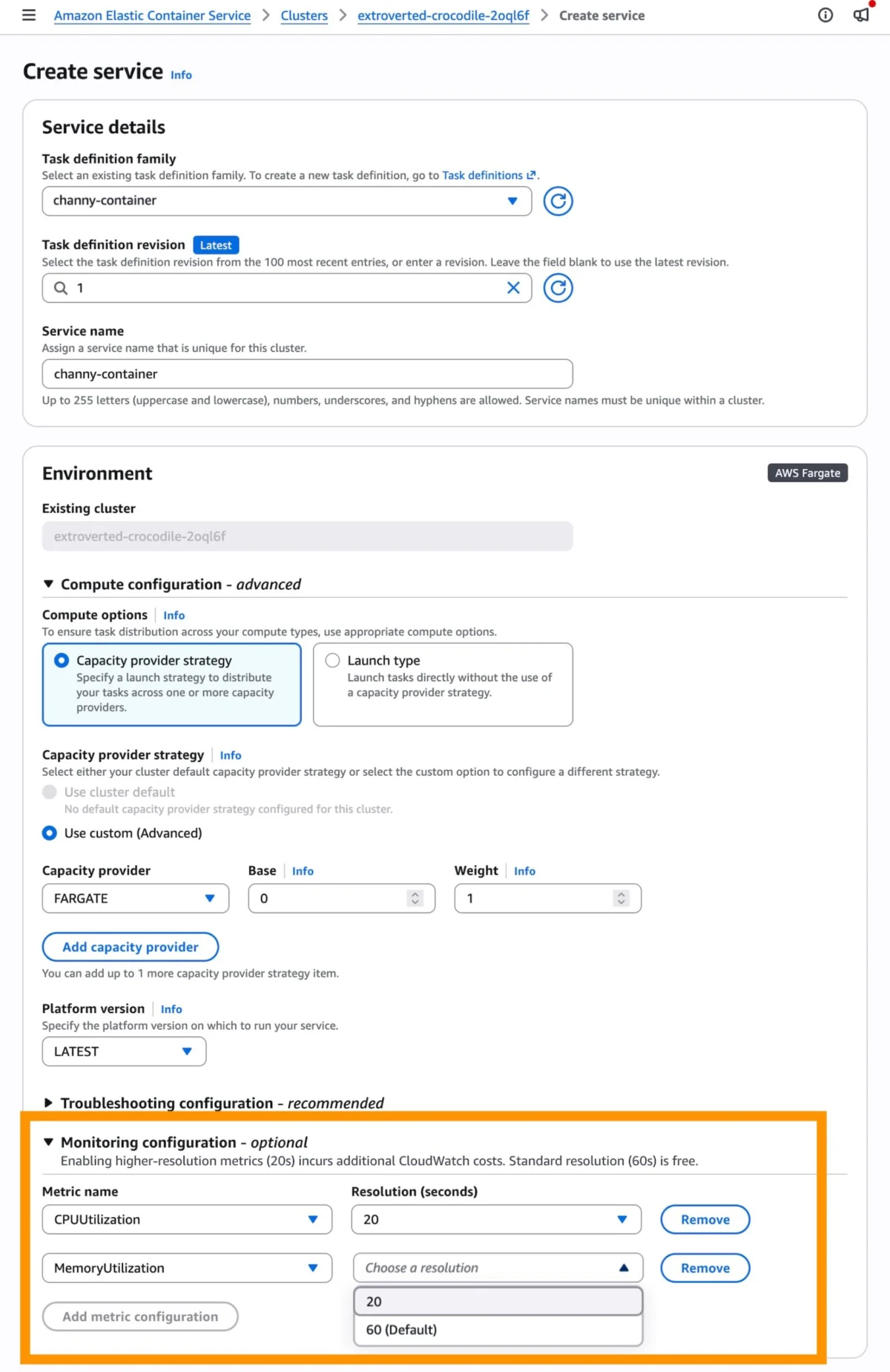
In the rapidly evolving landscape of cloud-native computing, the ability to respond to shifting traffic patterns is the difference between a seamless user experience and a service outage. Today, Amazon Web Services (AWS) announced a significant leap forward in container orchestration efficiency with the launch of high-resolution service auto scaling for Amazon Elastic Container Service (Amazon ECS). By reducing metric intervals from 60 seconds to 20 seconds, AWS is empowering developers to build more responsive, cost-effective, and resilient applications.
Main Facts: A Paradigm Shift in Responsiveness
The core of this update lies in the refinement of the feedback loop between workload demand and infrastructure provisioning. Traditionally, Amazon ECS relied on standard 60-second resolution metrics via Amazon CloudWatch to make scaling decisions. While sufficient for many steady-state applications, this latency created a "scaling gap" during sudden, unpredictable traffic spikes.
With the new update, ECS service auto scaling now supports 20-second high-resolution metrics. This architectural shift allows the service to detect and respond to load changes nearly three times faster than previously possible. The feature is universally applicable across all major ECS compute options, including AWS Fargate, ECS Managed Instances, and standard Amazon EC2 instances.
By decoupling the standard resolution constraints and implementing optimized metric publishing, AWS has successfully minimized the time required for a service to recognize a need for more resources and execute the necessary task provisioning.
Chronology of the Enhancement
The journey toward faster auto scaling has been a multi-year effort in infrastructure optimization.

- Initial Baseline: For years, Amazon ECS users operated under the 60-second metric granularity provided by CloudWatch. While this provided stability, it forced architects to over-provision resources to account for the minute-long delay in scaling reactions.
- The Development Phase: AWS engineering teams focused on the bottleneck points within the scaling lifecycle: metric generation, ingestion into CloudWatch, evaluation by the Application Auto Scaling engine, and the final triggering of the ECS API to launch tasks.
- Optimization Trials: Throughout early 2026, internal benchmarking focused on identifying how to compress the time-to-scale without compromising the reliability of the underlying orchestration layer.
- Public Release: In mid-2026, the feature was pushed to production environments, marking a major milestone for developers managing high-velocity web services and microservices architectures.
Supporting Data: Quantifying the Impact
The performance gains introduced by this update are not merely incremental; they represent a fundamental improvement in operational throughput. AWS internal benchmarking tests highlight a stark contrast between standard resolution and the new high-resolution capability.
Scaling Latency Improvements
The most critical metric in auto scaling is the "Time to Trigger." In benchmarking tests, the time required to initiate a scale-out event dropped from 363 seconds to 86 seconds. This represents a 76% improvement, effectively making the scaling process 4.2 times faster.
Total Provisioning Efficiency
Even more impressive is the "Total Time to Scale," which measures the duration from the initial traffic spike to the point where new tasks are fully provisioned and ready to handle requests. This metric improved from 386 seconds to 109 seconds, a 72% reduction in time, effectively enabling systems to stabilize 3.5 times faster than before.
These data points underscore the transition from reactive, "delayed-response" infrastructure to near real-time elasticity. For an enterprise handling thousands of requests per second, shaving nearly five minutes off the scaling window can prevent significant request queuing and latent errors during sudden surges.
Official Perspectives and Technical Implementation
Channy Yun, a principal developer advocate at AWS, emphasized that this update is designed to bridge the gap between application demand and resource availability.

Implementation Workflow
To leverage these performance gains, developers must navigate a straightforward, albeit intentional, configuration process:
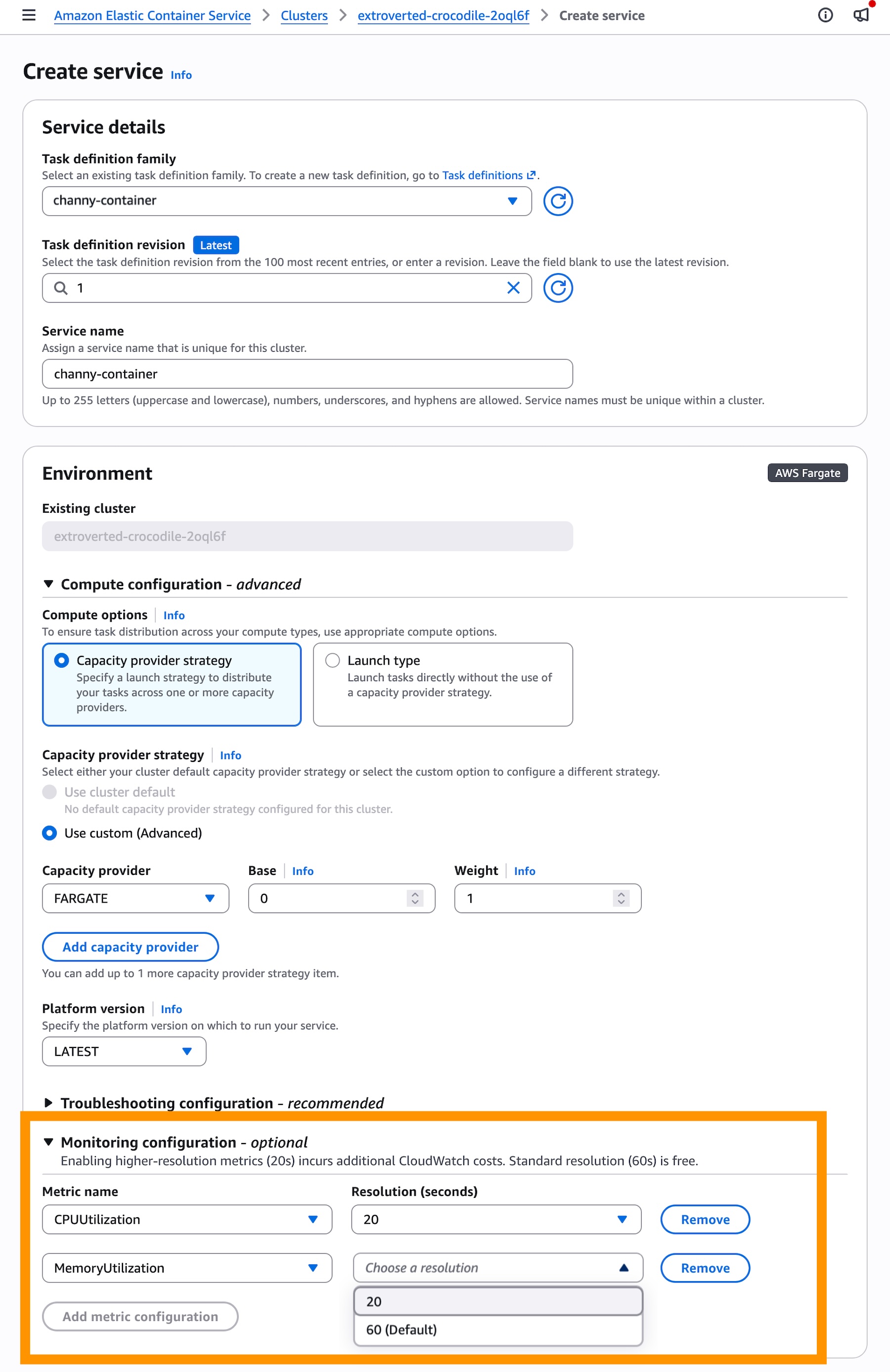
- Metric Activation: High-resolution metrics must be explicitly enabled during the service creation or update process within the ECS console.
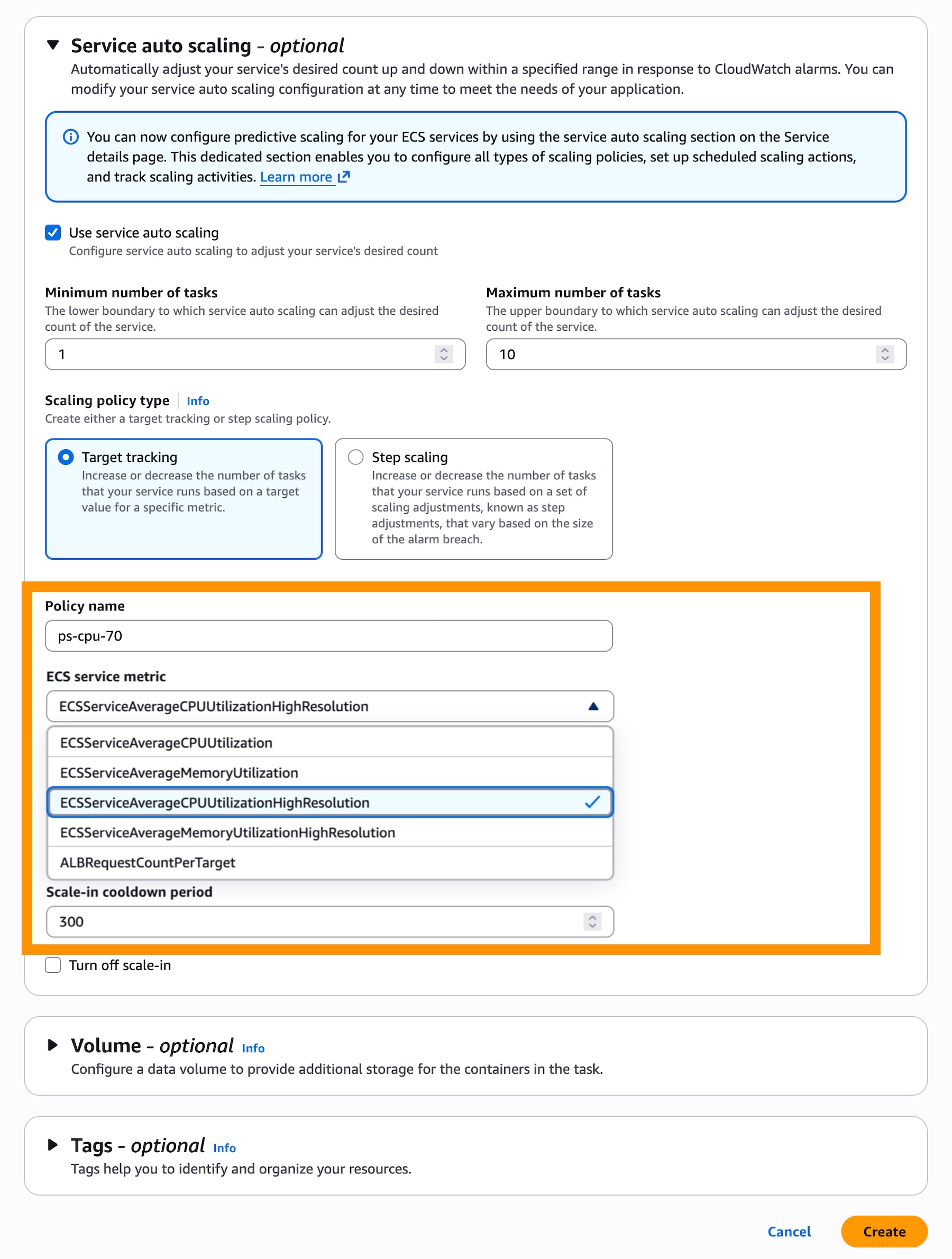
- Policy Selection: Once the metrics are active, users must select the
ECSServiceAverageCPUUtilizationHighResolutionorECSServiceAverageMemoryUtilizationHighResolutionmetrics within their target tracking scaling policy. - Deployment: Using the AWS CLI, SDKs, or AWS CloudFormation, teams can programmatically roll out these changes across their infrastructure fleets.
It is important to note that while the ECS service auto scaling feature itself incurs no additional cost, the transition to high-resolution CloudWatch metrics introduces a new pricing dimension. Because high-resolution metrics generate more data points per minute, they are billed according to CloudWatch’s custom metric pricing model. Architects are encouraged to weigh the cost-benefit ratio, particularly for services where the 60-second resolution remains perfectly adequate.
Implications for Modern Software Architecture
The introduction of 20-second scaling intervals has profound implications for how organizations approach capacity planning and system resilience.
1. Reduction of "Buffer" Over-provisioning
Many teams historically maintained a "buffer" of idle capacity—often 20% to 30%—to absorb traffic bursts while waiting for auto-scaling to kick in. Faster scaling allows teams to operate with leaner clusters, effectively reducing the cost of idle compute resources.
2. Enhanced Performance for Bursty Workloads
Applications characterized by "bursty" traffic (such as event-driven architectures, e-commerce during flash sales, or news-driven media platforms) stand to gain the most. In these environments, the speed of the infrastructure response is a critical factor in maintaining the Service Level Agreements (SLAs) promised to end-users.
3. Refinement of Predictive Scaling
When combined with existing predictive and scheduled scaling models, high-resolution metrics provide a more granular dataset for machine learning models to analyze. The improved data fidelity allows AWS’s internal ML algorithms to detect anomalies and traffic trends with greater precision, further refining the "proactive" aspect of the ECS scaling suite.
4. Architectural Simplicity
Previously, to achieve sub-minute scaling, developers often had to architect complex workarounds, such as using custom scripts to monitor load balancers or utilizing third-party tools to bypass standard CloudWatch intervals. By bringing this functionality into the core AWS service, the company is effectively simplifying the "well-architected" stack, allowing developers to rely on native, supported solutions rather than "hacked-together" operational workarounds.
Looking Ahead: The Future of Elasticity
The move to 20-second metrics is a clear signal that the future of cloud computing is defined by fluidity. As containers continue to be the primary unit of deployment for microservices, the orchestration layer must be as dynamic as the code it manages.
While 20 seconds is a significant improvement over 60, the industry will undoubtedly continue to push toward even lower latencies. However, the current update strikes an ideal balance for most enterprise workloads, providing a substantial boost in agility without introducing the overhead associated with true "real-time" (sub-second) polling, which would be unnecessary for most containerized applications.
For developers and systems engineers, the call to action is clear: evaluate your current services that suffer from "latency-induced bottlenecks" during peak hours and consider migrating those specific services to the high-resolution metric tier. By doing so, teams can ensure their infrastructure is not just present, but reactive—capable of meeting the demands of modern, unpredictable digital traffic.
As Channy Yun noted in the launch announcement, feedback is the lifeblood of these improvements. Whether through AWS re:Post or direct support channels, the ongoing dialogue between the engineering community and AWS will determine the next iteration of auto-scaling intelligence. For now, the 20-second threshold stands as the new gold standard for high-performance container orchestration on AWS.
 Neng Nana
  Suro Senen
  Lina Hope