
 By Basiran
SEATTLE — In an era where malicious actors leverage frontier artificial intelligence models to weaponize newly discovered software flaws into working exploit code within mere minutes, enterprise security teams face a rapidly escalating existential crisis. Traditional vulnerability management tools, while effective at surfacing potential risks, have inadvertently created a secondary problem: alert fatigue. Modern software estates routinely inundate security operations centers (SOCs) with thousands of disparate, often unactionable alerts daily, leaving development and security teams overwhelmed, bogged down by manual triage, and vulnerable to missed threats.
Addressing this growing paradigm, Amazon Web Services (AWS) has officially announced the general availability of AWS Continuum for code vulnerabilities. Designed to fundamentally streamline application security, AWS Continuum does not merely scan and report flaws; it independently finds, validates, isolates, tests, and formulates automated remediation patches delivered directly into code repositories as pull requests. By merging deep application-context analysis with isolated sandbox validation, AWS Continuum aims to bridge the historical chasm between security discovery and engineering execution.
Currently available in the US East (N. Virginia) and US West (Oregon) AWS Regions, Continuum introduces a context-driven methodology that promises to transition organizations from reactive alert-wrangling to proactive, intelligent risk mitigation.
Main Facts: What Is AWS Continuum?
At its core, AWS Continuum for code vulnerabilities is an advanced cloud security service engineered to parse the immense noise of traditional code scanners, isolate genuinely exploitable risks, rank them by true business impact, and autonomously generate developer-ready fixes.

Unlike legacy static application security testing (SAST) tools or basic software composition analysis (SCA) scanners that assign generic severity scores based solely on isolated code snippets, Continuum evaluates vulnerabilities through a holistic lens. It answers the critical question that traditional tools miss: Can a threat actor actually reach, exploit, and cause meaningful damage with this vulnerability in our specific production environment?
Key operational pillars of AWS Continuum include:
- Context Graph Architecture: Continuum constructs a comprehensive relationship map by combining insights from code repositories (such as GitHub or Amazon S3 buckets) with runtime infrastructure metadata pulled directly from AWS environments via dedicated regional collectors.
- Sandbox Exploit Validation: For vulnerabilities it can successfully replicate, Continuum runs the exploit inside an isolated sandbox environment, generating concrete proof-of-concept (PoC) code, exact reproduction steps, and an authentic blast radius assessment.
- Automated Remediation Patches: Once a flaw is verified and prioritized, Continuum generates a targeted code patch, dependency upgrade, or configuration modification, submitting it directly to the connected repository as a standard pull request.
- Human-in-the-Loop Governance: To maintain rigorous enterprise safety standards, every remediation initially operates under mandatory human oversight. Code fixes require explicit review and merging by engineering teams, ensuring developers retain absolute control over production changes.
Chronology: The Evolution of Application Security and Continuum’s Birth
To fully appreciate the significance of AWS Continuum, industry analysts point to the shifting velocity of modern cyber warfare and software development over the past decade.
The Era of Static Scanning (2010s)
For years, organizations relied on basic vulnerability scanners integrated into CI/CD pipelines. These tools generated endless lists of Common Vulnerabilities and Exposures (CVEs) flagged with generic severity ratings (Critical, High, Medium, Low). However, these ratings lacked contextual awareness. A critical vulnerability residing inside a completely isolated, developer-only utility script was treated with the exact same urgency as a medium-tier vulnerability sitting one network hop away from a core financial database.

The Rise of Generative AI and Automated Exploitation (2023–2025)
The threat landscape shifted dramatically with the widespread adoption of frontier generative AI models. Cybercriminals began utilizing large language models to automate the conversion of raw vulnerability disclosures into active, weaponized exploit code within minutes of a patch or advisory release. Consequently, the window of vulnerability—the time between public disclosure and active exploitation—shrank from weeks to hours. Security teams found themselves completely overwhelmed trying to manually verify whether thousands of daily scanner alerts posed an actual, real-world danger.
The Birth of Contextual Security and AWS Continuum (2026)
Recognizing that throwing more human analysts at the alert backlog was an unsustainable strategy, AWS engineering teams developed Continuum. By marrying cloud infrastructure telemetry (via AWS Config and network topology maps) with deep code parsing and sandbox simulation, Continuum represents the next logical step in cloud-native application security. Following rigorous internal testing and preview phases, AWS officially rolled out general availability in October 2026, targeting the enterprise cloud market where application estates span hundreds of interconnected microservices.
Supporting Data: How Continuum Operates Under the Hood
Understanding the technical mechanics of AWS Continuum reveals how the service achieves its high degree of precision, moving past traditional false-positive traps.
1. Constructing the Context Graph
Continuum establishes its foundational awareness by ingesting data from two primary conduits:
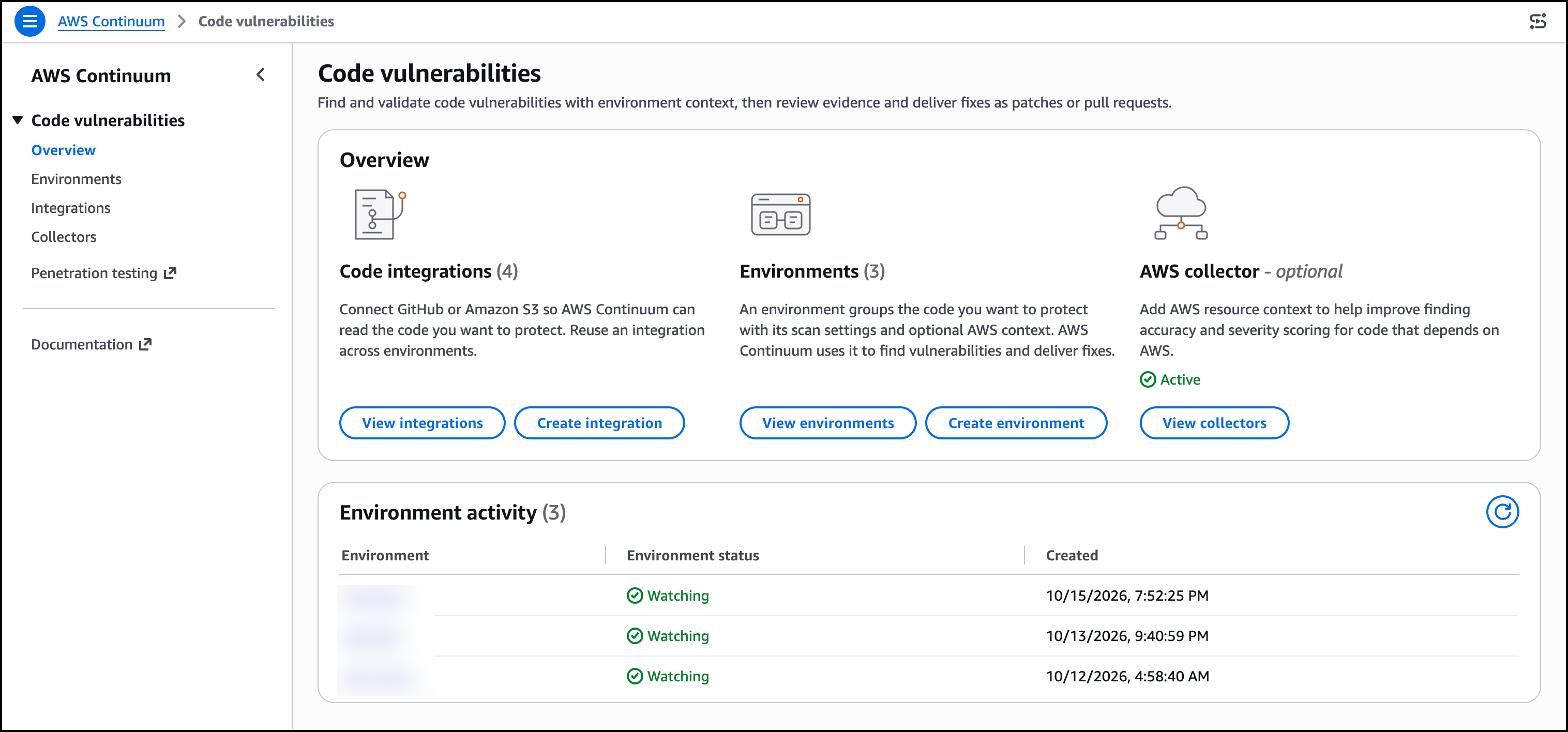
- Code Repositories: Connected via direct integrations with platforms like GitHub or hosted within secure Amazon S3 buckets.
- AWS Environment Telemetry: Deployed via an AWS Continuum collector configured within specific AWS accounts and regions. This collector inventories live resources via AWS Config, examining network access control lists (ACLs), security groups, subnet configurations, and IAM policies.
By correlating code dependencies with live runtime architecture, the context graph maps out service dependencies, data sensitivity levels, asset ownership, and potential attack paths. It identifies critical enterprise data stores, payment processing pipelines, and authentication gateways, automatically prioritizing vulnerabilities based on how close an attacker’s hypothetical pathway runs to these high-value systems.
2. Evidence Levels and Sandbox Simulation
When raw scanners flag an issue, Continuum does not rely on guesswork. It evaluates the finding against the code and its surrounding environmental context, assigning a concrete evidence level.
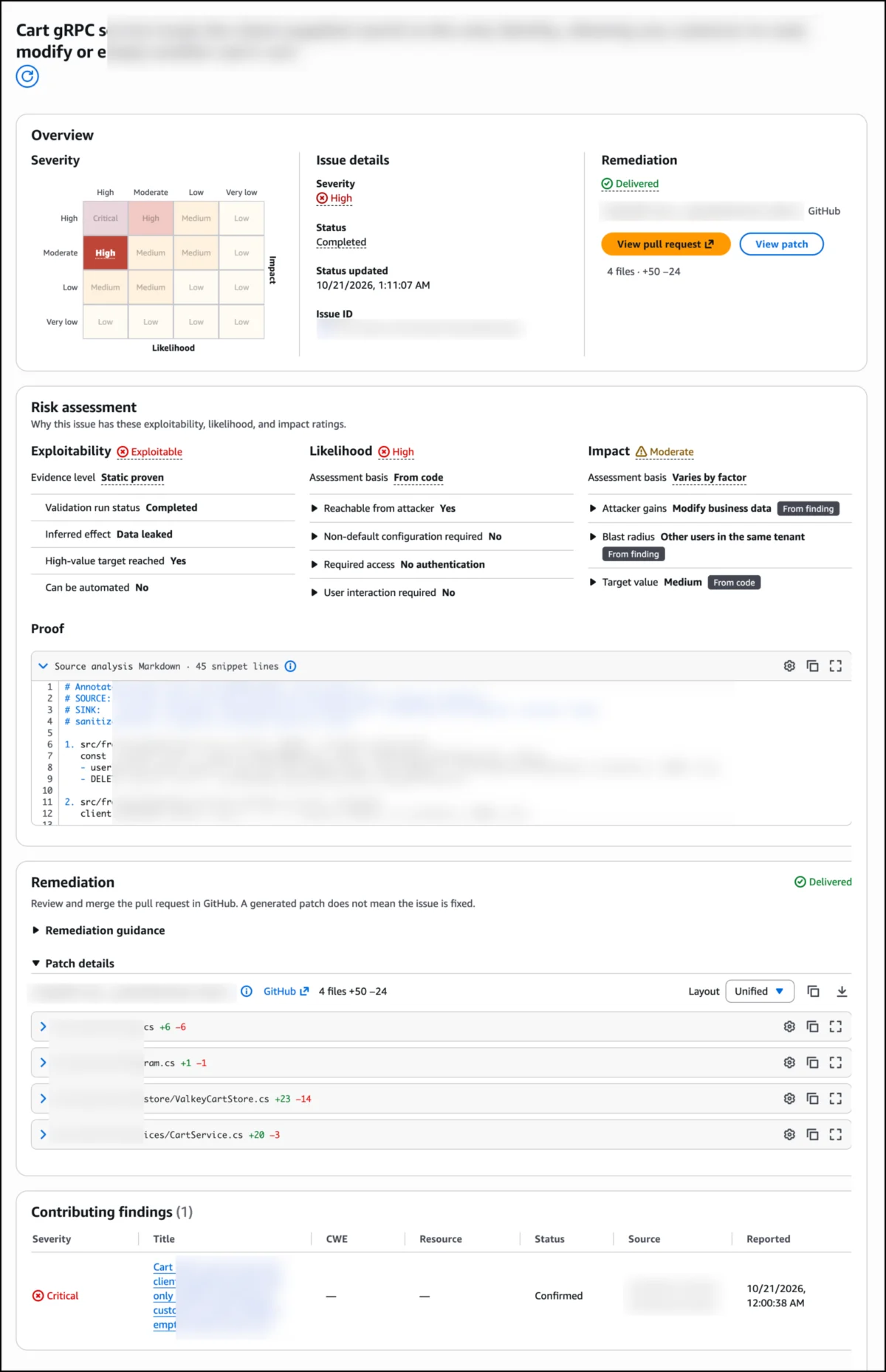
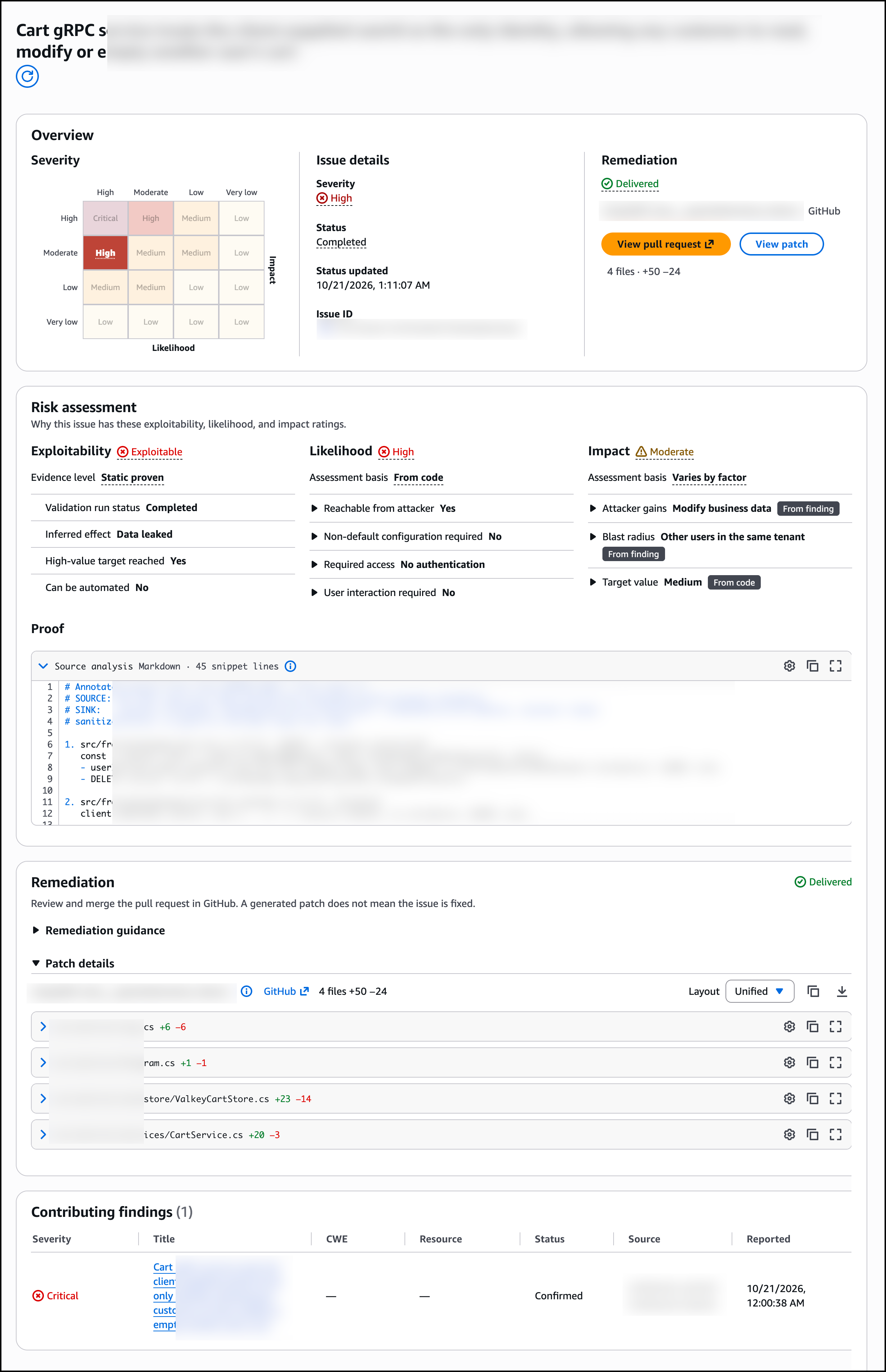
If static analysis proves the vulnerable code path can be reached, Continuum attempts to reproduce the exploit within a secure, isolated sandbox. The resulting dashboard provides security engineers with an exhaustive breakdown:
- Exploitability Verdict: Confirmed as Exploitable or Unreachable/Mitigated.
- Likelihood Metrics: Evaluates network accessibility, authentication requirements, and user interaction prerequisites.
- Impact Analysis: Measures potential data modification capabilities and tenant-level blast radius.
- Proof-of-Concept: Attaches granular source analysis and reproduction instructions directly to the issue record.
3. Automated Pull Request Generation
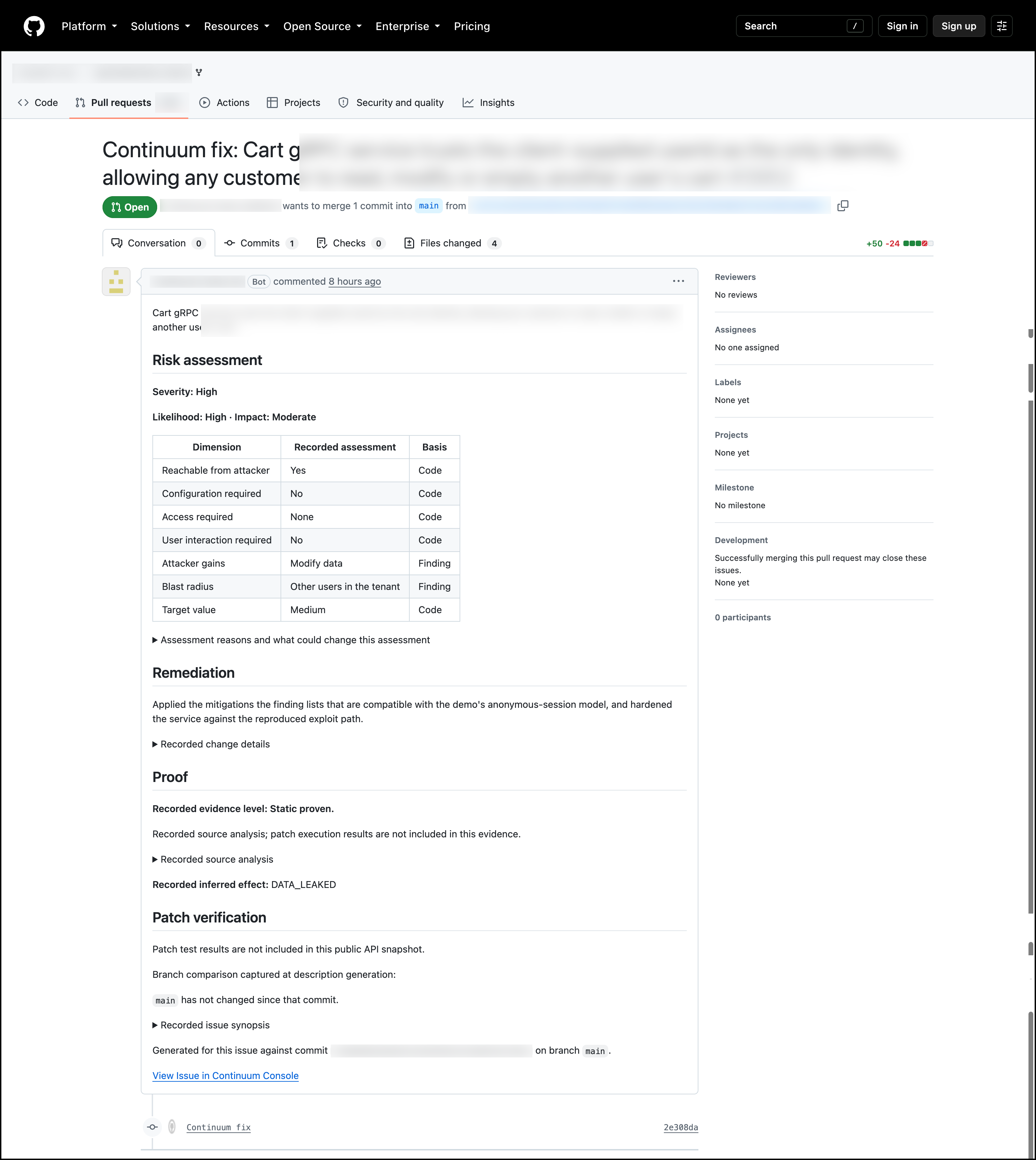
Once validated, Continuum formulates an exact fix—whether it involves updating an out-of-date npm package, rewriting insecure logic in a microservice, or adjusting an infrastructure configuration file. This fix is pushed directly to the connected code repository as a standardized pull request (e.g., titled "Continuum fix").
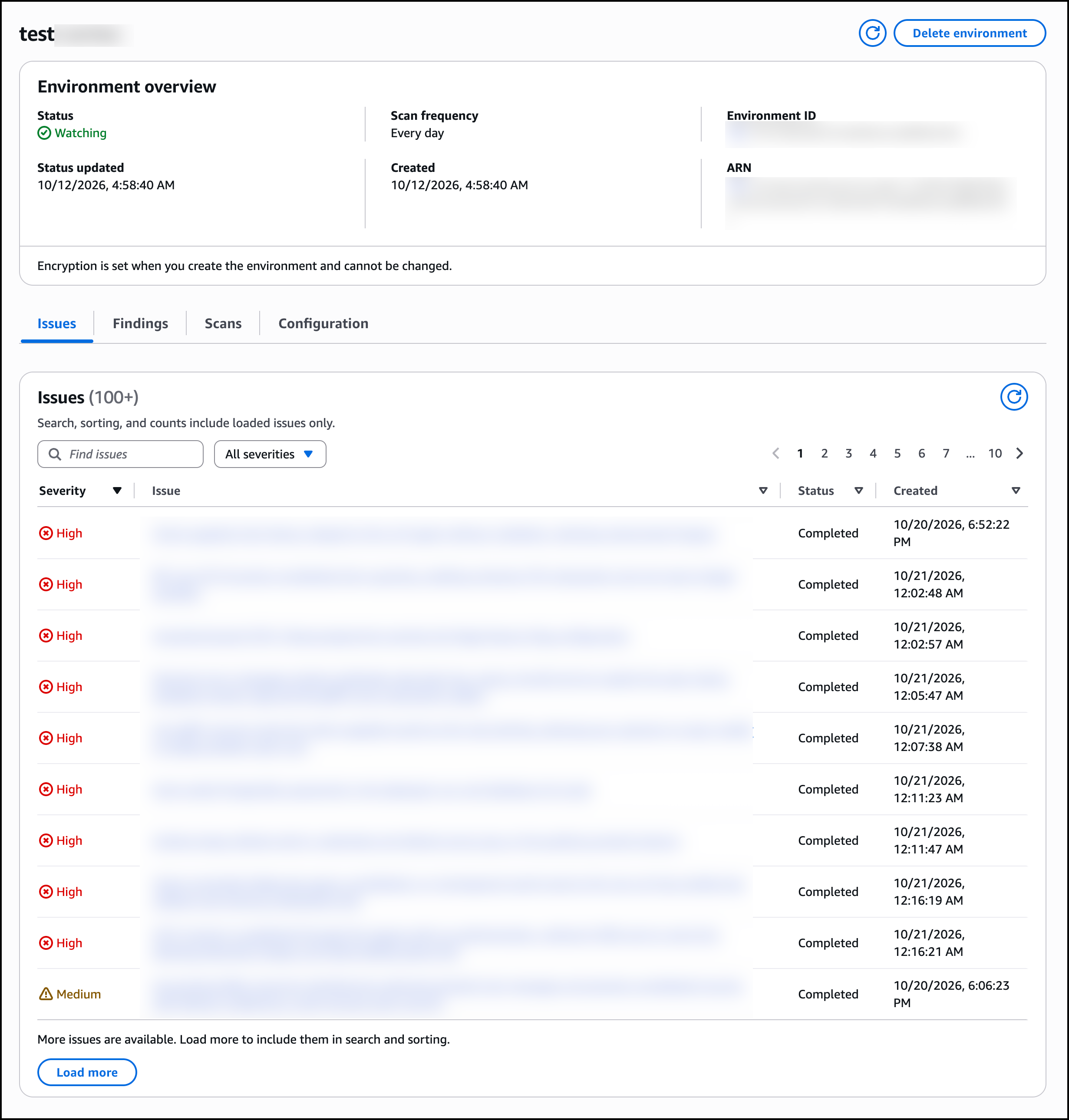
The pull request description mirrors the rich metadata found in the AWS Continuum console, embedding the risk assessment, proof-of-concept, and remediation summary right where developers naturally review code.
Official Responses and Perspectives
Industry leaders and AWS architects emphasize that Continuum is not designed to replace human engineering judgment, but rather to eliminate the tedious operational friction that slows down secure software delivery.
"If your organization runs a large application estate, your scanners likely produce thousands of findings a day, and many of them need no action," noted Esra Kayabali, AWS product engineering, in the official service launch documentation. "A finding can be unreachable, unexploitable, or already mitigated by a runtime control. Generic severity scores don’t tell you what a threat actor can actually reach. To close that gap, Continuum proves which findings are exploitable and bounds the risk of each fix it proposes."
Security analysts interviewed following the release have praised the platform’s focus on evidence over alarmism. For years, CISOs have grappled with developer friction; developers frequently ignore security alerts because too many turn out to be false positives or theoretical risks that cannot manifest in production. By delivering verified proof alongside a fully coded, ready-to-merge pull request, AWS Continuum fundamentally flips the script, making secure coding practices significantly easier to execute than ignoring them.
Furthermore, AWS has outlined a roadmap for future iterations of Continuum. While initial deployments strictly enforce a human-in-the-loop requirement where every patch must be manually approved and merged, future updates will introduce configurable confidence gates. Organizations will soon be able to establish automated trust policies—allowing Continuum to autonomously apply specific classes of low-risk, highly predictable fixes (such as minor dependency patches backed by high test coverage and historical success rates) without manual bottlenecks.
Implications for Enterprise Security and Development Teams
The commercial rollout of AWS Continuum for code vulnerabilities carries profound implications for the broader cybersecurity and software engineering industries.
Bridging the SecDevOps Divide
Historically, security teams and software developers operated in functional silos. Security teams prioritized risk mitigation above all else, often issuing broad, untailored mandates that engineers found disruptive to deployment velocity. Conversely, developers prioritized feature delivery and release speed, occasionally treating security remediation as an afterthought.
By delivering code-level patches directly into native developer workflows (such as GitHub pull requests) complete with transparent proof-of-concept data, Continuum aligns security goals directly with engineering processes. Developers review security patches using the exact same code-review rituals they use for feature development.
Transforming Compliance and Audit Readiness
In highly regulated sectors—such as financial services, healthcare, and government contracting—proving that known vulnerabilities have been triaged and patched within strict service-level agreements (SLAs) is an arduous audit requirement. Continuum’s comprehensive logging of validation runs, evidence levels, blast radius assessments, and remediation timestamps creates an immutable, verifiable audit trail. Compliance officers can instantly verify not only that a vulnerability was detected, but that its exploitability was tested, its business impact weighed, and its remediation reviewed.
Raising the Bar Against AI-Driven Attacks
As malicious actors increasingly weaponize generative AI to scale up attack frequencies, enterprise defenders must respond with asymmetric automation of their own. Manual code review and triage cannot match the speed of AI-generated exploits. By deploying autonomous discovery, sandbox simulation, and patch generation tools like AWS Continuum, enterprises can neutralize the speed advantage traditionally held by automated threat actors.
Conclusion and Availability
AWS Continuum for code vulnerabilities marks a definitive evolutionary leap in how cloud-native applications are defended. By cutting through the deafening noise of raw scanner data, leveraging runtime context graphs, and automating the generation of verified code fixes, AWS is empowering organizations to secure massive application estates with unprecedented precision and speed.
AWS Continuum for code vulnerabilities is available today for enterprise customers operating within the US East (N. Virginia) and US West (Oregon) AWS Regions. Organizations interested in calculating potential pricing models or exploring comprehensive integration tutorials can visit the official AWS Continuum product pages and consult the AWS Continuum User Guide in the AWS documentation portal.
 Siti Muinah
 Reynand Wu
 Jia Lissa
