
 By Lina Hope
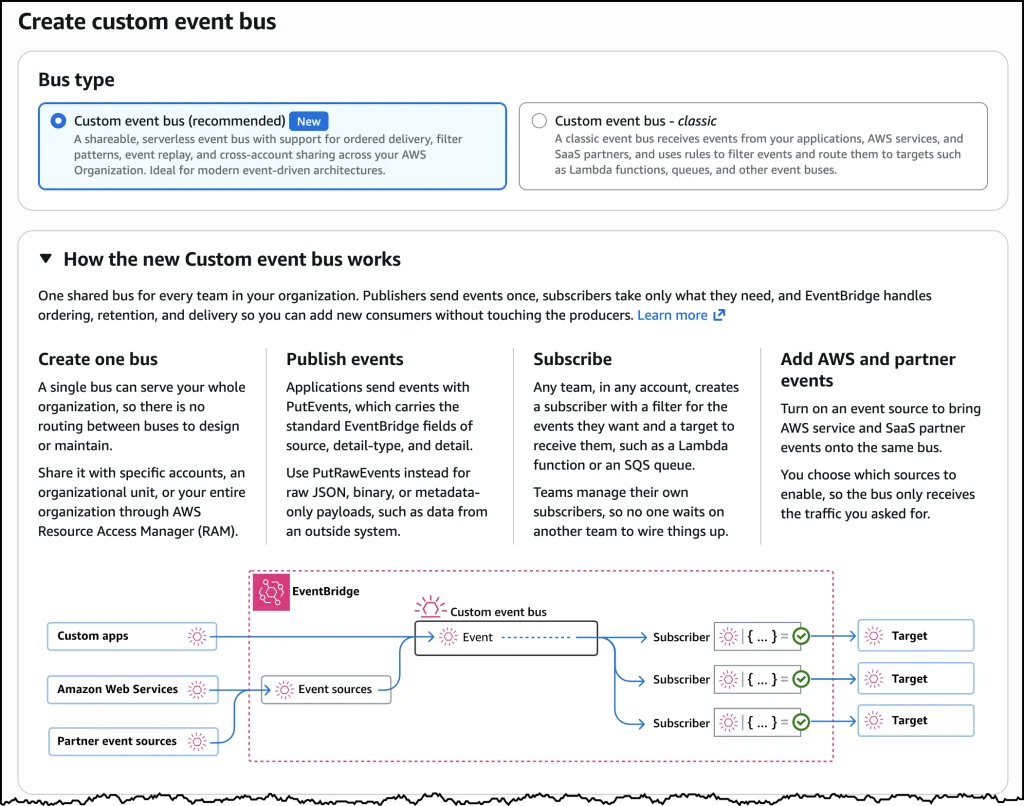
SEATTLE — Amazon Web Services (AWS) has officially announced a major architectural evolution for serverless application development with the introduction of the enhanced custom event bus in Amazon EventBridge. Purpose-built to eradicate the operational friction traditionally associated with scaling event-driven architectures across sprawling multi-account enterprise environments, the new capability consolidates fractured routing models into a single, centralized, and globally scalable infrastructure.
The announcement addresses a critical pain point that has frustrated enterprise platform engineering teams for years: the paradox of scale in serverless computing. While event-driven paradigms promise agility and loose coupling, scaling them across dozens or hundreds of AWS accounts has historically forced organizations into complex webs of cross-account rules, bus-to-bus configurations, and expensive workarounds.
By introducing native organization-wide sharing, rigorous event-ordering guarantees, unified Subscriber resources, advanced content-based deduplication, and a restructured throughput-based pricing model, AWS aims to redefine how modern, distributed applications manage asynchronous communication.
Main Facts: What is the Enhanced Custom Event Bus?
The newly released enhanced custom event bus is an architectural leap forward for Amazon EventBridge, designed to replace cumbersome multi-bus setups with a unified, organization-wide event backbone.
Core Capabilities and Features
- Organization-Wide Resource Sharing: Powered natively by AWS Resource Access Manager (AWS RAM), platform teams can now deploy a single, centralized event bus and share it across every AWS account within an entire AWS Organization, Organizational Unit (OU), or via targeted IAM roles and users. This eliminates the need for manual cross-account permissions or complex bus-to-bus routing logic.
- Granular Event Ordering (
EventGroupId): While asynchronous architectures typically assume out-of-order event consumption is acceptable, certain domains—such as logistics tracking or financial transactions—require strict sequencing. Publishers can now attach anEventGroupIdto messages, ensuring that events sharing the same identifier are delivered sequentially to subscribers utilizing ordered delivery. - The Unified "Subscriber" Resource: Previously, routing events to targets required managing disparate rules, targets, retry policies, and dead-letter queues (DLQs) across multiple resources. The new Subscriber resource rolls these components into a single, cohesive, manageable unit, complete with variable start times for application hydration and historical event replays.
- Advanced Payload Handling & JSONata Transformations: The enhanced bus supports content-based deduplication (hashing payloads to achieve exactly-once delivery semantics for up to five minutes), automatic deserialization of Apache Avro and Protocol Buffers into JSON, and native JSONata expressions allowing subscribers to reshape data payloads before they hit downstream targets.
- A Scale-Optimized Pricing Model: Moving away from the legacy per-event pricing model that penalized multi-bus architectures with compounding cross-account fees, the new bus introduces an ingress-and-egress throughput model. Publishers pay strictly for ingested volume, while subscribers pay for delivered volume.
Chronology: The Evolution of EventBridge Scaling
To understand the significance of the enhanced custom event bus, it is necessary to examine how enterprise serverless architectures have evolved—and where previous iterations fell short.
Phase 1: The Single-Account Paradigm
When Amazon EventBridge first gained widespread enterprise traction, organizations typically initiated their serverless journey with a single custom event bus housed within a single AWS account. This approach worked exceptionally well during proof-of-concept stages and for small, tightly knit engineering organizations where a single team owned the entire software lifecycle.
Phase 2: The Multi-Account Fragmentation
As enterprise adoption accelerated, security best practices and organizational boundaries dictated a shift toward multi-account environments. Organizations divided workloads across dozens of dedicated accounts (e.g., development, staging, production, and domain-specific microservices).
To facilitate communication across these boundaries, teams were forced to implement cross-account rules and connect multiple custom event buses. This workaround inadvertently reintroduced the very operational complexity that serverless architectures were engineered to eliminate. Platform engineering teams lost centralized visibility into event flows, subscription dependencies became opaque, and routing charges compounded rapidly. Furthermore, teams needing strict event ordering had to introduce auxiliary services—such as placing Amazon Simple Queue Service (Amazon SQS) queues between event buses and AWS Lambda functions—adding latency, cost, and maintenance overhead.
Phase 3: The Unified Enterprise Era
Recognizing these compounding friction points, AWS engineers embarked on developing a purpose-built solution for enterprise-scale event routing. The result is the enhanced custom event bus.
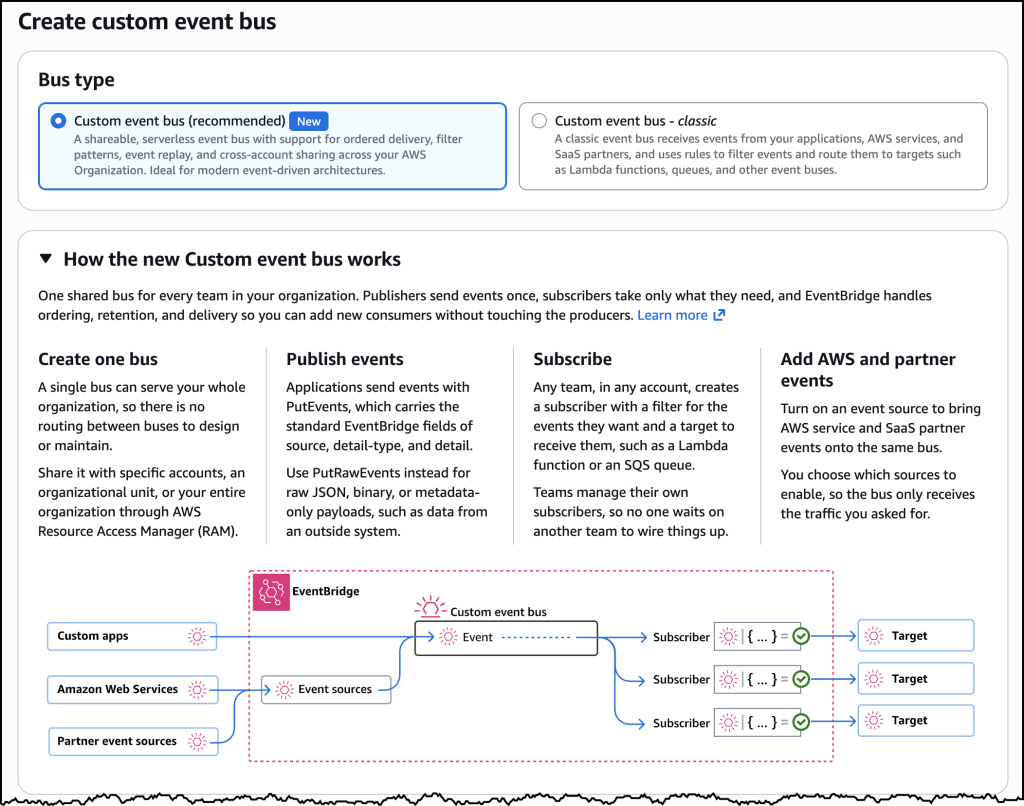
During the rollout, legacy buses have been designated as "Custom event bus — classic" to ensure uninterrupted continuity for existing production workloads. Meanwhile, the new "Custom event bus" becomes the recommended option for modern workloads, empowering platform teams to provision a single, high-capacity central backbone that accommodates up to 10,000 distinct subscribers out-of-the-box, with higher quotas available upon request.
Supporting Data and Technical Architecture
The technical mechanics of the enhanced custom event bus reveal a deeply thought-out engineering response to real-world serverless bottlenecks.
Resource Sharing via AWS RAM
In the AWS Management Console, platform administrators can now navigate to the Create custom event bus page, select the new custom event bus option, and toggle on event bus sharing. By linking directly with AWS RAM, administrators can scope sharing permissions precisely:
- Scope: Entire AWS Organization, specific Organizational Units (OUs), individual AWS Account IDs, or specific IAM principals.
- Autonomy: Application teams can independently publish events without needing to coordinate destination schemas with consumers, while subscribers can establish their own independent filtering rules without altering publisher infrastructure.
Solving the Ordering Dilemma Without SQS Workarounds
Event-driven systems thrive on asynchronous decoupling, but real-world enterprise applications frequently encounter domain logic where sequence matters. For example, in a supply chain routing application, truck telemetry data indicating location updates must be processed in chronological order. Out-of-sequence updates cause routing algorithms to execute decisions against stale data, leading to logistical errors.
The enhanced custom event bus solves this by introducing dual-mode delivery on the same bus:

- Asynchronous Unordered Delivery: Standard subscribers process events concurrently for maximum throughput and low latency.
- Ordered Delivery via
EventGroupId: Publishers tag relevant events with anEventGroupId. EventBridge maintains strict sequence delivery for those specific streams.
To support this orderly processing reliably, AWS integrated synchronous invocation modes for targets such as AWS Lambda. The event bus confirms successful execution down the line before acknowledging event receipt, effectively cutting out the intermediary SQS queues that developers previously relied upon to force sequential, reliable processing.
Content-Based Deduplication and Schema Agility
Handling network timeouts and retries cleanly is a persistent challenge in distributed systems. Without idempotency tokens, transient failures often result in duplicate events hitting downstream consumers.
- Deduplication: The enhanced bus offers content-based deduplication, which hashes payload contents and automatically drops identical duplicate payloads arriving within a five-minute window. This elevates EventBridge’s traditional at-least-least-once delivery model to exactly-once semantics for deduplicated streams.
- Payload Deserialization & Transformation: Organizations heavily invested in binary serialization frameworks like Apache Avro or Protocol Buffers can now stream these formats directly into EventBridge. The service automatically deserializes payloads into JSON, enabling granular filtering without forcing consumers to write custom parsing code. Furthermore, JSONata expressions allow subscribers to reshape data structures dynamically on the fly before they reach downstream APIs.
Official Responses and Strategic Vision
While AWS has framed the release as a natural evolution of its serverless ecosystem, early industry reception highlights profound implications for cloud architects and enterprise financial operations (FinOps) teams.
Platform architects have long praised EventBridge for its deep integration with AWS Lambda, Step Functions, and third-party SaaS providers via partner event buses. However, the operational overhead of managing multi-bus governance often led architectural review boards to question whether event-driven models were sustainable at massive enterprise scale.
By centralizing visibility, standardizing subscriber management into a single resource, and decoupling ingress from egress in the pricing structure, AWS is signaling a clear commitment to making enterprise-grade event-driven architectures as frictionless to operate as single-function scripts.
Industry analysts note that the introduction of the new throughput pricing model is particularly strategic. By ensuring publishers pay for ingestion and subscribers pay for delivery, AWS removes the financial penalty historically associated with cross-account event sharing, aligning cloud expenditure directly with organizational value generation.
Implications for Enterprise Architecture and FinOps
The rollout of the enhanced custom event bus carries profound downstream impacts across multiple disciplines within modern IT organizations:
1. Platform Engineering and Governance
Platform teams regain absolute centralized governance. Rather than auditing dozens of fragmented cross-account rules scattered across disparate application accounts, platform engineers can maintain a single bird’s-eye view of all event flows, publisher permissions, and subscriber dependencies from a central hub. This dramatically simplifies compliance auditing, security posture management, and enterprise data taxonomy enforcement.
2. Developer Velocity and Agility
Application teams no longer need to wait for infrastructure provisioning tickets to clear or coordinate complex cross-account IAM trust policies every time a new microservice needs to consume an event. Because subscribers can be spun up independently against the shared bus, time-to-market for new event-driven microservices drops significantly.
3. Financial Optimization (FinOps)
The shift to an ingress-and-egress throughput pricing model changes cost allocation models. In legacy architectures, multi-bus routing charges compounded invisibly as data traversed account boundaries. The new model establishes clear financial accountability: data producers absorb the predictable cost of ingestion, while data consumers shoulder the cost of delivery based on their specific subscription volume. This makes cloud financial forecasting far more transparent and defensible.
4. Migration Paths for Legacy Workloads
AWS has ensured business continuity by strictly separating legacy implementations. Existing custom event buses remain untouched, operating seamlessly under the "Custom event bus — classic" designation with zero required code changes. Organizations can adopt the new enhanced custom event bus incrementally at their own pace, migrating mission-critical workloads over as architectural refactoring cycles permit.
Availability
The enhanced custom event bus is available today across a broad footprint of global AWS Regions, including:
- Americas: US East (N. Virginia, Ohio), US West (Oregon)
- Europe: Europe (Ireland, Frankfurt, Stockholm, Spain)
- Asia Pacific & Middle East: Hong Kong, Malaysia, Mumbai, Singapore, Sydney, Thailand, Tokyo
Organizations can provision their first enhanced custom event bus immediately using the AWS Management Console, the AWS Command Line Interface (AWS CLI), or via automated EventBridge APIs. Detailed documentation and implementation guides are currently accessible via the official AWS EventBridge documentation portal.
 Sagoh
 Siti Muinah
 Reynand Wu
