
 By Pevita Pearce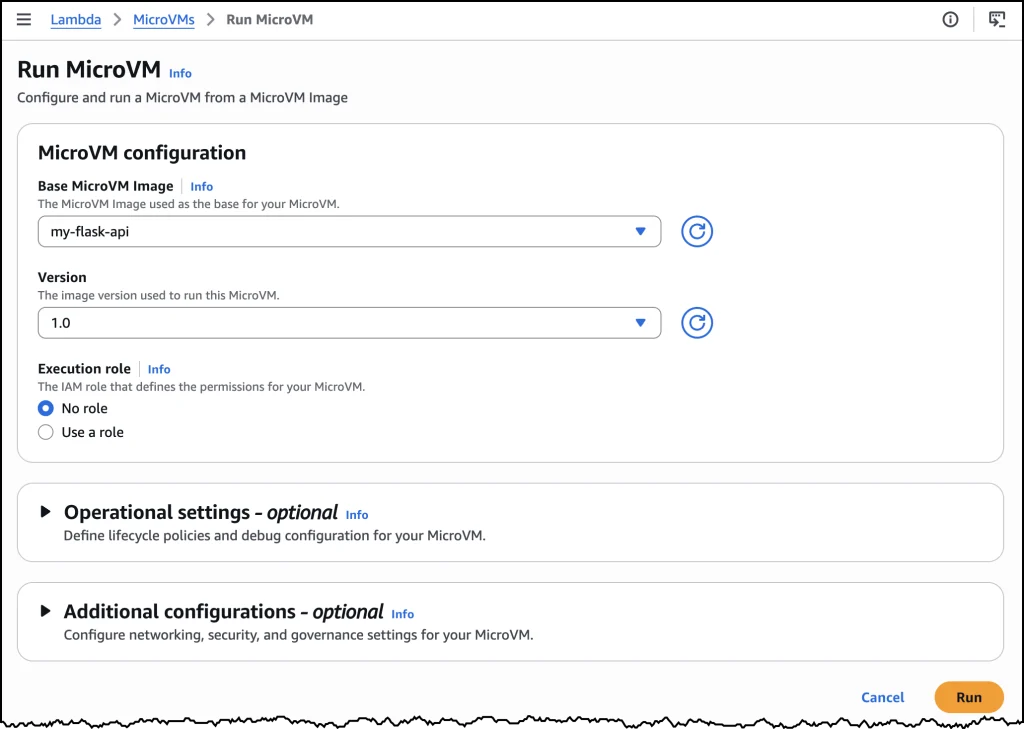
In a major expansion of its serverless ecosystem, Amazon Web Services (AWS) has announced the launch of AWS Lambda MicroVMs. This new compute primitive represents a fundamental shift in how developers handle multi-tenant, untrusted, or stateful code execution. By leveraging the industry-proven Firecracker virtualization technology—the same engine that powers the company’s massive Lambda function infrastructure—AWS is now enabling developers to provide end-users with dedicated, secure, and stateful execution environments that launch in milliseconds.
The Evolution of Compute: Solving the "Multi-Tenant Dilemma"
For years, software architects have struggled with a "trilemma" when building applications that execute user-provided or AI-generated code. Developers creating AI coding assistants, interactive data science platforms, vulnerability scanners, or browser-based game servers have historically been forced to choose between three imperfect models:
- Virtual Machines (VMs): These offer the strongest security isolation but suffer from slow boot times, often measured in minutes.
- Containers: While faster than VMs, they rely on shared-kernel architectures, which require massive engineering overhead to harden against malicious, untrusted code.
- Functions as a Service (FaaS): While optimized for ephemeral, event-driven request-response workloads, standard functions are not built for long-running sessions that require persistent memory and disk state across interactions.
The emergence of Lambda MicroVMs is a direct response to this engineering bottleneck. By providing virtual-machine-level isolation with the responsiveness of a container, AWS is effectively removing the need for teams to manage custom virtualization stacks, allowing them to focus entirely on application logic rather than infrastructure security.
A Chronology of Innovation: From Firecracker to Lambda
The foundation of this new service lies in Firecracker, an open-source virtualization technology designed by AWS specifically for serverless computing. Introduced several years ago, Firecracker was built to be ultra-lightweight, minimizing the memory footprint and the attack surface of virtualized environments.

The journey to Lambda MicroVMs follows a logical trajectory in AWS’s serverless roadmap:
- 2018: AWS open-sources Firecracker, enabling high-density, secure multi-tenancy.
- 2018–2025: Firecracker matures within the Lambda ecosystem, supporting over 15 trillion monthly invocations.
- Mid-2026: AWS recognizes the growing demand for "session-based" compute, driven by the AI boom and interactive coding environments.
- Today: The launch of Lambda MicroVMs formalizes the ability to expose these "snapshots" of stateful, secure environments directly to developers, bypassing the traditional cold-start limitations of cold-booting virtual machines.
Technical Architecture: How MicroVMs Achieve "Near-Instant" Performance
The "secret sauce" behind Lambda MicroVMs is the image-then-launch lifecycle. Unlike traditional VMs that must perform a full boot sequence (BIOS, kernel loading, user-space initialization) upon startup, Lambda MicroVMs utilize snapshotting.
The Lifecycle Process
- Image Creation: A developer supplies a Dockerfile and an artifact (like a ZIP file containing a web app). AWS Lambda builds this container, runs it, and captures a Firecracker snapshot of the running memory and disk state.
- Snapshotted Boot: When a new session is triggered, the MicroVM doesn’t "boot" in the traditional sense; it resumes from the pre-initialized snapshot. This allows the application to be "live" the moment the VM is provisioned.
- State Retention: Because the snapshot includes the memory and disk state, developers can maintain long-running sessions. When a user is inactive, the system suspends the MicroVM, preserving the state, and resumes it instantly upon the next request.
This architecture means that even complex applications, such as a Python-based Flask API or a machine learning inference model, are ready to serve traffic immediately, regardless of how heavy their initial dependency loads might be.
Supporting Data and Performance Specifications
Lambda MicroVMs are designed to handle significant workloads while maintaining high performance. Currently available in major AWS regions including US East (N. Virginia, Ohio), US West (Oregon), Europe (Ireland), and Asia Pacific (Tokyo), the service supports robust hardware configurations:

- Computing Power: Up to 16 vCPUs per MicroVM.
- Memory Capacity: Up to 32 GB of RAM per session.
- Storage: Up to 32 GB of persistent disk per session.
- Runtime: Supports up to 8 hours of total execution time per session.
The efficiency gains are measured not just in milliseconds, but in engineering productivity. By offloading the security and orchestration of these environments to AWS, teams can reduce the "infrastructure tax" on their product roadmaps, moving from custom-built container orchestration to a managed, high-performance primitive.
Implications for Industry and Developers
The implications of this launch are far-reaching, particularly for the burgeoning field of generative AI and interactive software development.
Secure AI-Driven Development
As AI coding assistants become more sophisticated, they are increasingly expected to execute the code they write to test for bugs or verify output. Running this code on a user’s local machine or an unhardened server is a significant security risk. Lambda MicroVMs provide a "sandbox" where AI-generated code can execute with full kernel-level isolation, ensuring that even if the code is malicious or poorly written, it cannot compromise the underlying host or other users’ sessions.
Interactive Data Analytics
Data platforms that allow users to upload custom scripts or Jupyter-style notebooks require persistent state. With Lambda MicroVMs, these applications can pause a user’s session when they walk away—saving the company money on idle compute—and resume the environment in milliseconds the moment the user returns. This "suspend-to-disk" capability is a game-changer for cost optimization in high-concurrency environments.

The End of "Custom Hardening"
For many startups, building a secure, multi-tenant environment meant investing in heavy-duty security engineering. Teams had to worry about side-channel attacks, kernel vulnerabilities, and container breakouts. Lambda MicroVMs essentially commoditize this security. Because each MicroVM is siloed by Firecracker, the "blast radius" of a security incident is strictly contained to that specific user’s session.
Official Guidance and Integration
AWS has been clear that Lambda MicroVMs are not a replacement for traditional Lambda Functions. The two services are designed to be complementary:
- Lambda Functions: Continue to be the gold standard for event-driven, request-response tasks that require rapid, ephemeral execution.
- Lambda MicroVMs: Are the specialized tool for stateful, long-running, or highly isolated sessions where code security and environment persistence are paramount.
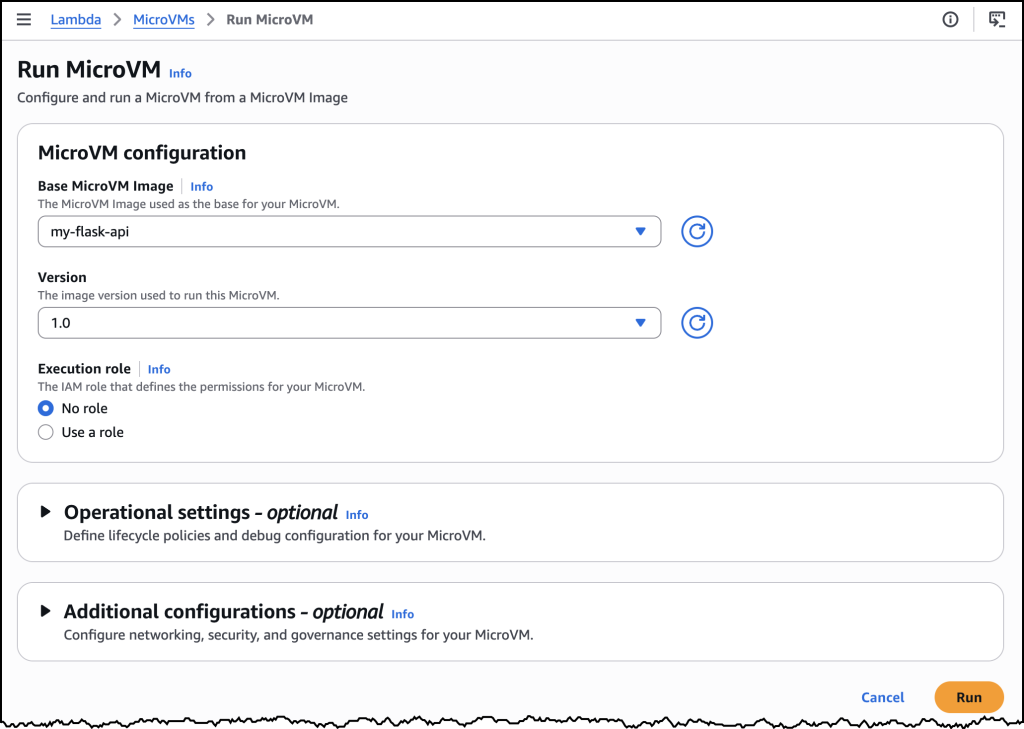
For developers looking to integrate this into their existing workflows, the AWS CLI and console now offer native support for managing MicroVM images and lifecycles. By defining idle policies—such as maxIdleDurationSeconds—developers can fine-tune the cost-to-performance ratio of their applications, ensuring that they only pay for what they use while maintaining a seamless experience for the end-user.
Conclusion: A New Era of Serverless Maturity
The introduction of AWS Lambda MicroVMs signals a shift in the serverless narrative. We have moved past the era where "serverless" simply meant "small functions that run quickly." We are now entering an era of "intelligent serverless," where developers can deploy complex, stateful, and secure environments with the same ease that they once deployed simple API endpoints.
By abstracting away the complexities of virtualization while keeping the performance and security benefits of Firecracker, AWS has provided a powerful new primitive. For the developer building the next generation of AI tools, interactive platforms, or secure multi-tenant services, the barrier to entry has never been lower, and the potential for scale has never been higher. As organizations continue to move their workloads to the cloud, tools like Lambda MicroVMs will undoubtedly become the standard for building safe, efficient, and highly responsive digital experiences.
 Neng Nana
  Suro Senen
  Lina Hope