
 By Jia Lissa
By Global Science & Culture Desk
Published: September 2026
Main Facts: The Intersection of Art, Data, and Gender Bias
When French CNRS research director and textile artist Lauriane Mouysset launched her debut data visualization project, “À sa place” (“In Her Place”), she expected it to resonate far beyond the physical walls of a contemporary art gallery. Designed to accompany her embroidered portrait series “Guerrières”—which highlights overlooked women in science—the digital piece was published online on February 11, 2025, timed precisely for the International Day of Women and Girls in Science.
Yet, the digital object failed to circulate virally. While physical visitors at the Pavillon Vendôme contemporary art center in Clichy, France, interacted with the piece via QR code, its initial online release stalled. Confined to echo chambers of pre-existing activist networks, the visualization proved too cryptic for the rapid-fire consumption of social media feeds.

This failure triggered an unexpected methodological journey. To make her digital installation viable for civic circulation, Mouysset was forced to abandon the elliptical, slow-reveal aesthetics typical of the contemporary art world in favor of ruthless clarity. In doing so, she stumbled upon a profound realization: clarity is not merely a tool for communication; it is a tool for inquiry. Re-evaluating her dataset revealed that historical gender bias in science does not correct itself organically. Instead, closing the recognition gap requires deliberate, recent public acts of visibility—such as films, stamps, or awards.
Chronology: From Thread to Code and Back Again
The evolution of “À sa place” spans a meticulous multi-year timeline intersecting academic research, textile craftsmanship, and digital experimentation.
- 2022–2024 (The Textile Foundation): Working through Mouysset Studio, Lauriane Mouysset embarks on a body of textile work, embroidering colorful abstract masks over black-and-white vintage photographs of forgotten women scientists. This series forms the artistic bedrock of “Guerrières.”
- Autumn 2024 (The Gallery Invitation): Mouysset is invited to exhibit her embroidered portraits at the Pavillon Vendôme in Clichy. Desiring to extend the exhibit’s message regarding systemic invisibility, she resolves to build her first-ever data visualization.
- February 11, 2025 (The Digital Launch): Seeking to harness media momentum around the International Day of Women and Girls in Science, Mouysset publishes “À sa place” online six days ahead of the physical exhibition opening.
- February 11–17, 2025 (The Stalled Circulation): The piece circulates exclusively within sympathetic activist circles. Feedback confirms that while aesthetically pleasing, the visualization is too opaque for general social media traction.
- February 17, 2025 (Exhibition Opening & Diagnostic): “Guerrières” opens to the public in Clichy. QR codes placed among the embroideries successfully engage teenage visitors, but the digital piece’s broader online aspirations remain unfulfilled.
- Spring 2025 (The Redesign): Aided by AI assistant Claude and built using vanilla HTML, CSS, and JavaScript over 30 cumulative hours, Mouysset undergoes a 10-iteration overhaul of the project. She shifts from a vague narrative about "historical erasure" to a sharp, two-part structural argument based on Wikipedia page-view metrics.
- 2026 (The Final Synthesis): The refined version replaces the initial draft on her digital portfolio, establishing a new hybrid blueprint for future artistic-civic projects.
Supporting Data: Wikipedia Metrics and the Power of Public Acts
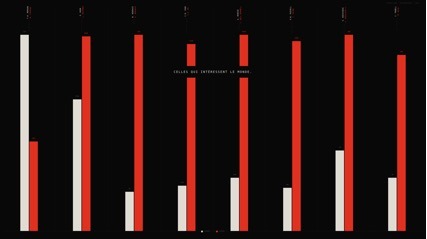
To ground her artistic statement in verifiable metrics, Mouysset turned to Wikipedia page views—retrieved via the Wikimedia Pageviews Analysis API for the period spanning July 2015 to December 2025—alongside Wikidata language versions. By analyzing male-female pairs of scientific cosignatories, she sought to quantify contemporary attention versus historical institutional memory.
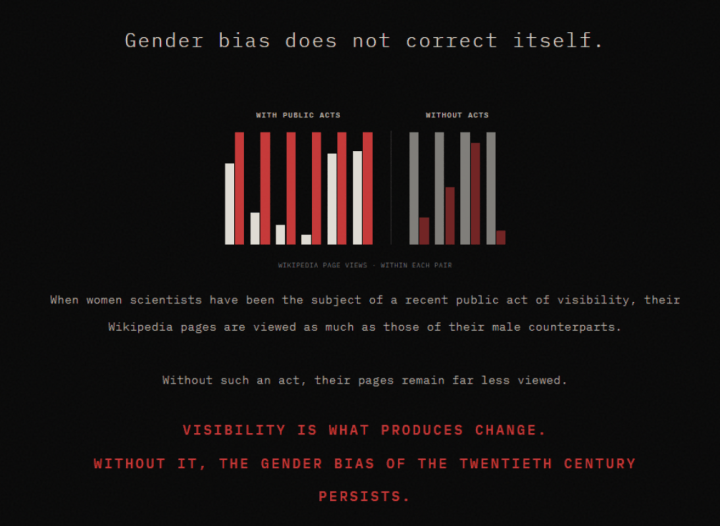
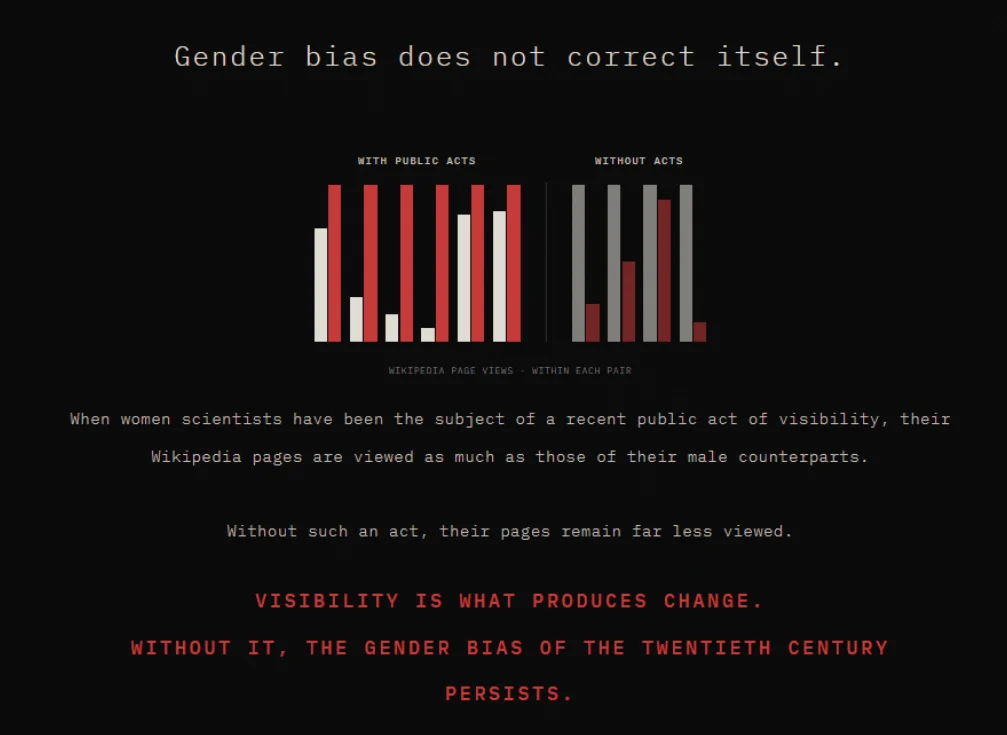
Initially assuming women scientists were naturally catching up in modern public interest, Mouysset’s deeper data dive uncovered a sharper, more conditional truth. When examining 10 distinct historical pairs, a stark dichotomy emerged: The gender gap only reverses where a recent public act of visibility has occurred.
Comparative Corpus Analysis (Female-to-Male Page View Ratios)
| Woman Scientist | Male Colleague / Rival | Recent Public Act of Visibility | F/M Ratio (Attention Index) |
|---|---|---|---|
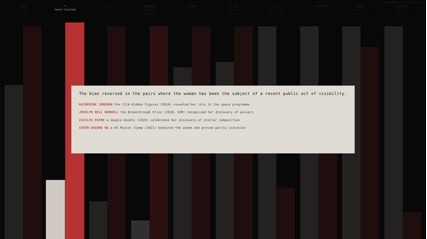
| Katherine Johnson | John Glenn | Hidden Figures (Film, 2016) | × 1.2 |
| Jocelyn Bell Burnell | Antony Hewish | Breakthrough Prize (2018) | × 5.7 |
| Cecilia Payne | Henry Norris Russell | Google Doodle (2019) | × 11.6 |
| Chien-Shiung Wu | Chen-Ning Yang | US Postal Stamp (2021) | × 3.5 |
| Rosalind Franklin | James Watson | ESA Rover (2019) | × 1.2 |
| Lise Meitner | Otto Hahn | Discovery of Meitnerium (1997) / 150th Birthday (2023) | × 1.4 |
| No Recent Public Act | |||
| Kathleen Lonsdale | John Desmond Bernal | None | × 0.9 |
| Marthe Gautier | Jérôme Lejeune | None | × 0.24 |
| Esther Lederberg | Joshua Lederberg | None | × 0.5 |
| Marguerite Perey | Glenn Seaborg | None | × 0.13 |
As demonstrated in the data, the six pairs featuring a public catalyst all show the woman outstripping her male counterpart in modern page views. Conversely, the four pairs lacking a distinct, modern cultural intervention remain heavily skewed toward male visibility.
Even the nuanced case of Lise Meitner—whose F/M ratio is a modest 1.4—proves the rule. Her public act (the naming of the chemical element meitnerium in 1997) occurred nearly three decades prior, demonstrating that the freshness of an act directly influences its virality and sustained cultural impact.

Official Responses and Institutional Context
Lauriane Mouysset approaches this intersection of disciplines from a unique vantage point. As a research director at the French National Centre for Scientific Research (CNRS)—where she specializes in the biodiversity crisis at the crossroads of ecology, economics, and philosophy—she brings rigorous academic discipline to her creative outlets. Her scientific standing was recognized with the CNRS Bronze Medal in 2024, alongside a residency at the French Academy in Rome (Villa Medici).
Simultaneously serving as an ambassador for Femmes & Sciences, a prominent French association dedicated to encouraging women in scientific paths, Mouysset bridges institutional science and grassroots advocacy.
Reflecting on her journey, Mouysset noted that her dual identity as a scientist and artist exposed a tension between two distinct communicative regimes:
"The regime of the work values ellipsis, the slowness of revelation, the elegance of a message left for the viewer to piece together. The regime of political digital media demands restraint, sequenced narration, explicit naming—because circulation is the condition of its function. The two regimes cannot be reconciled. One of them must give."
Rather than diluting the political message, stripping away artistic ambiguity allowed the core data to speak with uncompromised authority. This philosophy mirrors the frameworks outlined by data scholars Catherine D’Ignazio and Lauren Klein in Data Feminism, which advocates for analyzing power structures through transparent, accessible data practices.
Implications: The Grammar of Hybrid Civic Art
The failure and subsequent rebirth of “À sa place” carry vital implications for digital humanists, data visualizers, and socially engaged artists alike.
- The Fallacy of Cryptic Elegance: In traditional gallery settings, ambiguity invites contemplation. On digital platforms and social media feeds, however, ambiguity breeds friction. If an audience cannot instantly comprehend and rephrase a digital artifact, its potential for virality—and by extension, its political utility—dies instantly.
- Clarity as an Analytical Instrument: Mouysset’s redesign process proves that simplifying a graphic presentation does not dumb down the argument; rather, it purges intellectual laziness. Forcing the data into a clear, two-movement narrative (moving from the systemic overview to individual catalysts) corrected initial analytical missteps and exposed the true mechanism behind gender recognition in science.
- A Blueprint for Future Interventions: The project establishes a replicable methodology for hybrid art. By pairing emotional, tactile mediums (such as textile embroidery) with sharply articulated, publicly accessible digital visualizations, artists can engage audiences across physical gallery spaces and digital networks simultaneously.
Ultimately, Mouysset’s experiment demonstrates that institutionalized gender bias in scientific history is stubbornly static. It does not self-correct through the sheer passage of time. Instead, equality of remembrance is an active, manufactured outcome—one that requires intentional cultural interventions, viral visibility, and the unyielding discipline of clarity.
 Azzam Bilal Chamdy
 Asep Darmawan
 Suro Senen
