
 By Ali Ikhwan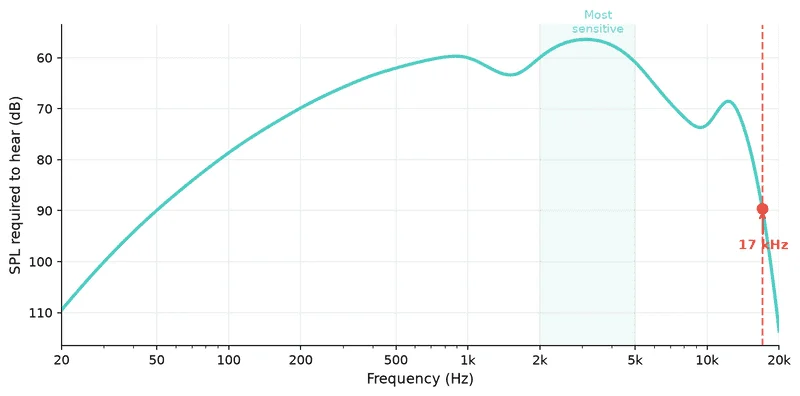
In the world of high-fidelity digital audio, there is perhaps no greater source of anxiety for producers and audiophiles than the sight of a "hard shelf" on a frequency spectrum analyzer. When SoundCloud updated its AAC encoding pipeline last year—marking its first significant shift in over a decade—many users noticed a startling change: their uploads, which once retained full energy up to 20 kHz, were now being sharply truncated at 17 kHz.
To the untrained eye, this looks like a clear degradation—a loss of data, a compromise of the source material, and a technological step backward. However, SoundCloud’s engineering team argues that the move to the Fraunhofer libfdk_aac encoder represents a sophisticated leap forward. By choosing to sacrifice the inaudible, they are significantly improving the fidelity of the sounds we actually hear.
The Evolution of SoundCloud’s Encoding Pipeline
For over ten years, SoundCloud relied on a legacy encoding system that prioritized maintaining full frequency bandwidth across all files. While this resulted in "prettier" spectrograms, it did so at a hidden cost to the integrity of the mid-range frequencies.
Last year, the platform made the decision to modernize its infrastructure by adopting Fraunhofer’s libfdk_aac. Fraunhofer, the German research organization famously credited with the invention of the MP3 format, has long been considered the industry gold standard for perceptual audio coding. The transition was not a cost-cutting measure or a glitch in the system; it was a deliberate engineering decision to move away from "mathematical transparency" and toward "perceptual transparency."
The Chronology of the Shift
- The Decade of Status Quo: For the platform’s first decade, the focus remained on legacy hardware and software compatibility, resulting in an encoder that treated all frequency data as equally vital, regardless of human auditory limits.
- The Shift to Perceptual Coding: In early 2023, SoundCloud engineers began auditing their pipeline, realizing that the legacy encoder was struggling to manage complex transients and high-density frequency information.
- The Deployment of
libfdk_aac: The implementation of the Fraunhofer encoder was rolled out, immediately introducing a low-pass filter at 17 kHz to optimize bit allocation. - The Community Feedback Loop: Almost immediately, producers began reporting "missing frequencies," leading to a wave of confusion regarding whether the platform was actively damaging user uploads.
Lossless Masters vs. The Realities of Lossy Compression
To understand why this change is an improvement, one must first distinguish between the medium of the "master" and the reality of streaming. A lossless file—such as a 24-bit WAV or a FLAC file—retains every single sample, bit for bit. It is a perfect digital representation of the recording.
However, streaming services cannot distribute lossless files to millions of concurrent users without incurring massive bandwidth and storage costs. Therefore, they use "lossy" compression (AAC, MP3, Ogg). The goal of lossy compression is to hit a target file size while remaining as transparent as possible to the human ear.
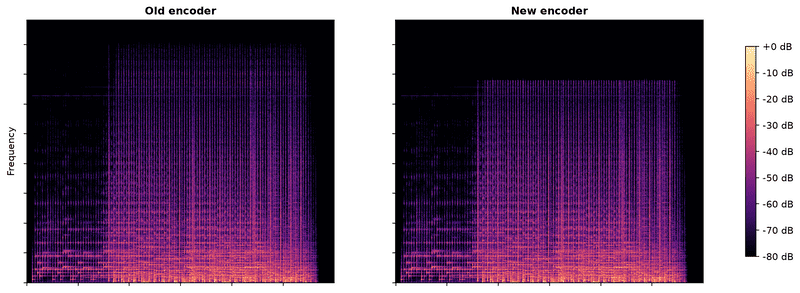
The fundamental problem is that the encoder has a finite "budget" of bits to spend for every small chunk of audio. If the encoder attempts to preserve everything—including the high-frequency airiness above 17 kHz—it has fewer bits to spend on the complex, information-dense mid-range.
The Science of Psychoacoustics: Why We Hear What We Hear
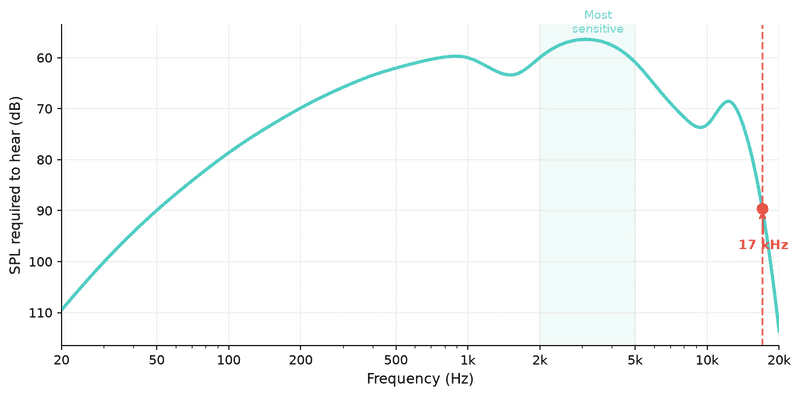
SoundCloud’s engineering team leans heavily on the principles of psychoacoustics to justify the 17 kHz cutoff. Human hearing is not a flat line. Our sensitivity peaks significantly between 2 kHz and 5 kHz, the range where human speech, vocal harmonics, and the core of most musical instruments reside. As frequencies rise above 10 kHz, the average adult’s sensitivity begins to drop off sharply.
The Bit-Budget Tradeoff
When an encoder receives a fixed bitrate, it must choose how to allocate those bits across the frequency spectrum. The choice is a mathematical one:
- Option A: Spread bits thin across the entire 0–20 kHz range, creating minor artifacts (quantization noise) throughout the most sensitive mid-range areas.
- Option B: Apply a low-pass filter to the "cheap" high-end (17 kHz and above), and spend those saved bits on cleaning up the mid-range.
By choosing Option B, the encoder ensures that the frequencies we are most evolutionarily adapted to hear are reproduced with the highest degree of accuracy. The "hard shelf" at 17 kHz is not a sign of poor quality; it is a sign of an encoder working efficiently to protect the "meat" of the music.
Supporting Data: Visualizing the Error
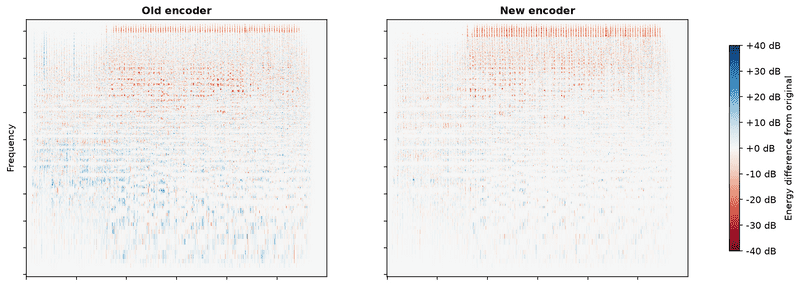
SoundCloud’s internal analysis provides a compelling visual argument for this change. When comparing the old encoder to the new libfdk_aac implementation, the difference in "error" (the difference between the encoded file and the original master) is stark.
In tests run by the engineering team, the old encoder showed "speckled" red patches throughout the mid-range. These red patches represent signal loss and distortion where the human ear is most sensitive. Furthermore, blue patches in the low end indicated the presence of "ghost" artifacts—unwanted signals created by the encoder’s struggle to manage the bandwidth.
Conversely, the new encoder shows a clean, stable profile throughout the low and mid-frequencies. The only significant "red" zone is the high-frequency cutoff at 17 kHz. Essentially, the encoder has consolidated all its "mistakes" into a frequency band that most listeners cannot perceive, leaving the rest of the track pristine.
The Question of 256 kbps
Critics of this change often point to the 256 kbps bitrate, arguing that at such a high data rate, the encoder should have enough "headroom" to maintain full bandwidth.
SoundCloud acknowledges this, noting that at 256 kbps, the difference between a filtered and unfiltered file is marginal. However, the libfdk_aac encoder remains conservative by design. Fraunhofer’s implementation is built on decades of empirical listening tests. Their research indicates that even at higher bitrates, the "hard shelf" approach yields a more consistent, error-free result across a wider variety of complex audio material.
Is this the correct decision for every single piece of audio? That remains a point of debate among hardcore audiophiles. However, the decision is not arbitrary. It is based on the consensus that an error-free mid-range is objectively better than a slightly more "complete" frequency spectrum that contains hidden, audible artifacts in the areas we hear best.
Implications for Producers and Listeners
For the average listener, this change is essentially invisible. Music sounds cleaner, and the "smear" that sometimes accompanied high-frequency-heavy electronic music or complex orchestral arrangements on the old platform has been largely eliminated.
For producers, the implication is a shift in mindset. Many have spent years obsessing over spectral balance, trying to ensure their masters extend perfectly to the Nyquist limit. SoundCloud’s update serves as a reminder that modern digital delivery is a collaborative process between the artist’s master and the platform’s delivery algorithm.
The Verdict: A Smarter Way to Stream
SoundCloud has effectively communicated that they are no longer prioritizing the "spectrogram look" over the "listening experience." By trusting the decades of research provided by Fraunhofer, they have optimized their platform for how humans actually process sound, not how software displays it.
Your track isn’t "broken" because it stops at 17 kHz. It is simply being handled by an encoder that understands that in the world of high-fidelity streaming, the most important space in the frequency spectrum is the one that actually touches your ears. As the platform continues to iterate, the industry is likely to follow, moving further away from the myth of "total frequency retention" and toward the reality of "perceptual perfection."
If you remain skeptical, the company invites you to test it yourself. Blind A/B tests often reveal that even trained ears struggle to identify the missing 3 kHz when the mid-range is significantly cleaner. In the end, the data supports the transition: the music sounds better, even if the graph looks different.
 rifanmuazin
  Layla Zulfa
  Evan Lee Salim