
 By Sagoh
SEATTLE — In a major step forward for enterprise cloud architecture, Amazon Web Services (AWS) has announced the official rollout of cross-account copy capabilities for Amazon Elastic Block Store (Amazon EBS) Volume Clones. Building upon the foundation of instant point-in-time volume cloning introduced last year, this new enhancement allows organizations to seamlessly replicate and securely distribute EBS volume copies across distinct AWS accounts.
The update directly addresses long-standing challenges in cloud-based software development life cycles (SDLC), specifically bridging the gap between secure production environments and isolated staging, testing, and experimentation workflows. By combining AWS Resource Access Manager (RAM) and AWS Key Management Service (AWS KMS), the feature enables teams to leverage live production data while maintaining strict security boundaries and satisfying compliance mandates.
Main Facts
The newly expanded Amazon EBS Volume Clone functionality introduces several core architectural and operational capabilities:
- Cross-Account Replication: Organizations can now create copies of EBS volumes directly into separate AWS accounts, moving beyond the single-account, single-Availability Zone (AZ) constraints of the original 2025 release.
- Target-Account Re-Encryption: When copying volumes across accounts, administrators have the option to re-encrypt the data using a designated AWS KMS key managed within the target account. This ensures compliance with multi-tenant data governance policies and principle-of-least-privilege access models.
- Integration with AWS RAM: Volume sharing is mediated securely via AWS Resource Access Manager, allowing resource owners to share volumes with specific accounts or entire AWS Organizations without exposing underlying storage infrastructure directly.
- Modern SDLC Enablement: Development and QA teams can refresh staging environments with up-to-date production datasets instantly, drastically reducing cycle times for troubleshooting, performance testing, and feature experimentation.
- Programmatic and AI Readiness: Beyond the standard Amazon EC2 and EBS management consoles, engineers can orchestrate and automate cross-account copying using the AWS MCP Server and supported plugins within modern AI-driven coding environments.
- Global Availability: The feature is available immediately across all AWS Regions that currently support Amazon EBS Volume Clones.
Chronology: The Evolution of EBS Cloning
To fully understand the significance of this cross-account update, it is helpful to trace the technical evolution of Amazon EBS storage features and data management capabilities.
Phase 1: Traditional Snapshots and Long-Copy Cycles
Historically, creating isolated copies of an EBS volume in AWS required taking an Amazon EBS Snapshot—an incremental, point-in-time backup stored in Amazon S3—and subsequently restoring or copying that snapshot to a new volume. While effective for disaster recovery and long-term retention, this process introduced operational friction:
- Snapshots required time to complete initialization and data transfer.
- Sharing snapshots across accounts necessitated modifying snapshot permissions, managing separate cryptographic keys manually, and provisioning new volumes from those shared snapshots in the target account.
- For large terabyte-scale datasets, these workflows introduced latency into continuous integration and continuous deployment (CI/CD) pipelines.
Phase 2: The Introduction of Instant Volume Clones
Recognizing the need for rapid data provisioning, AWS introduced Amazon EBS Volume Clones last year. This capability provided instant, point-in-time, block-level storage copies within the same Availability Zone. Instead of copying all underlying data blocks immediately, Volume Clones utilized a redirect-on-write architecture.
- Cloned volumes were immediately available for use upon creation.
- Underlying data blocks were shared between the source and clone until modifications were written, saving storage capacity and eliminating waiting periods.
- However, these initial clones were strictly bound to the local account and Availability Zone where the original volume resided, limiting their utility for multi-account enterprise architectures.
Phase 3: The Cross-Account Milestone
Today’s announcement marks the maturation of the Volume Clones feature. By bridging Volume Clones with AWS RAM and AWS KMS, AWS has removed the boundary between isolated cloud accounts. Enterprises operating within multi-account frameworks—such as those utilizing AWS Control Tower or AWS Organizations—can now execute cross-account data sharing and cloning natively, combining the speed of block-level redirection with enterprise-grade governance.
Supporting Data and Operational Workflows
The mechanics of executing a cross-account EBS volume clone rely on a structured, multi-step authorization and replication process. Understanding how AWS RAM, the Amazon EBS console, and AWS KMS interact is essential for cloud administrators implementing this feature.

Step-by-Step Execution Flow
-
Volume Identification and Initiation:
The owner of the source EBS volume navigates to the Amazon EBS console, selects the target volume, and chooses the Share volume option. -
Resource Sharing via AWS RAM:
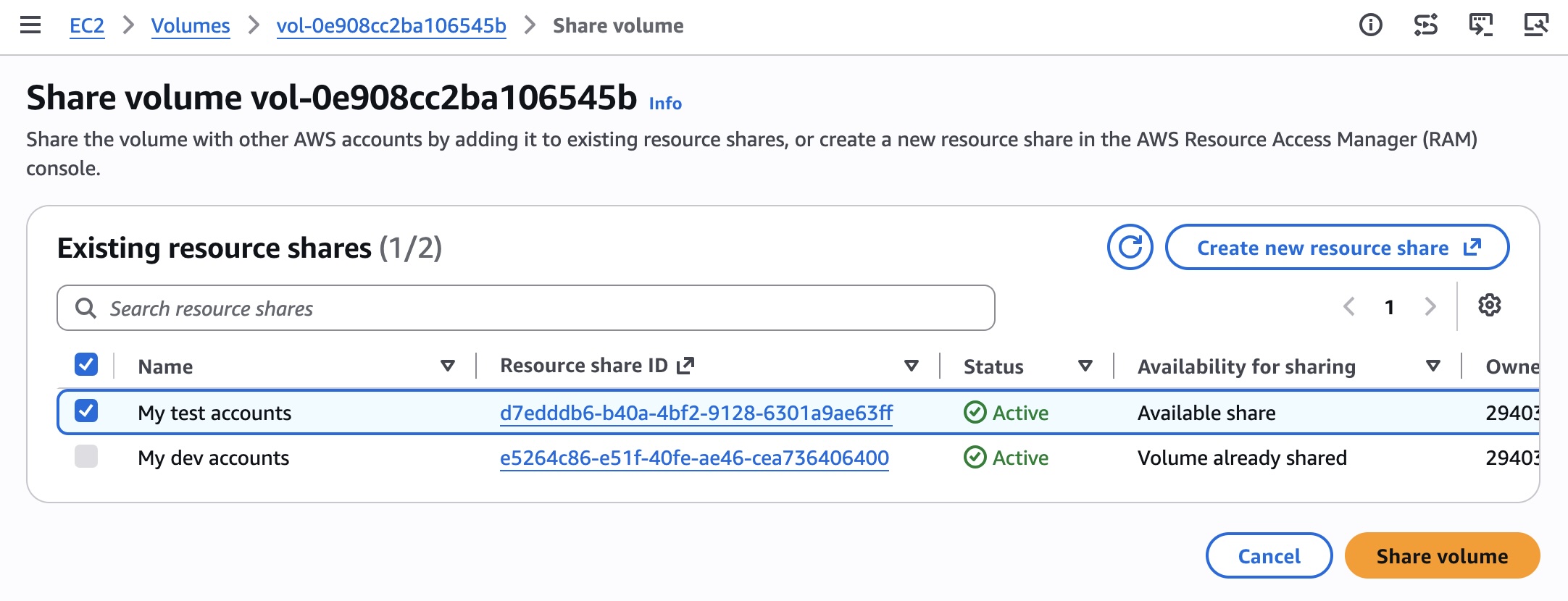
The volume owner adds the volume to an existing resource share or creates a new one using the AWS Resource Access Manager (RAM) console. This defines precisely which external AWS accounts or AWS Organization units are granted visibility into the storage asset. -
Acceptance in the Target Account:
Security and governance guardrails require that resource sharing is a two-way street. The designated target account must log into the AWS RAM console and explicitly accept the incoming resource share. -
Cloning and Re-Encryption:
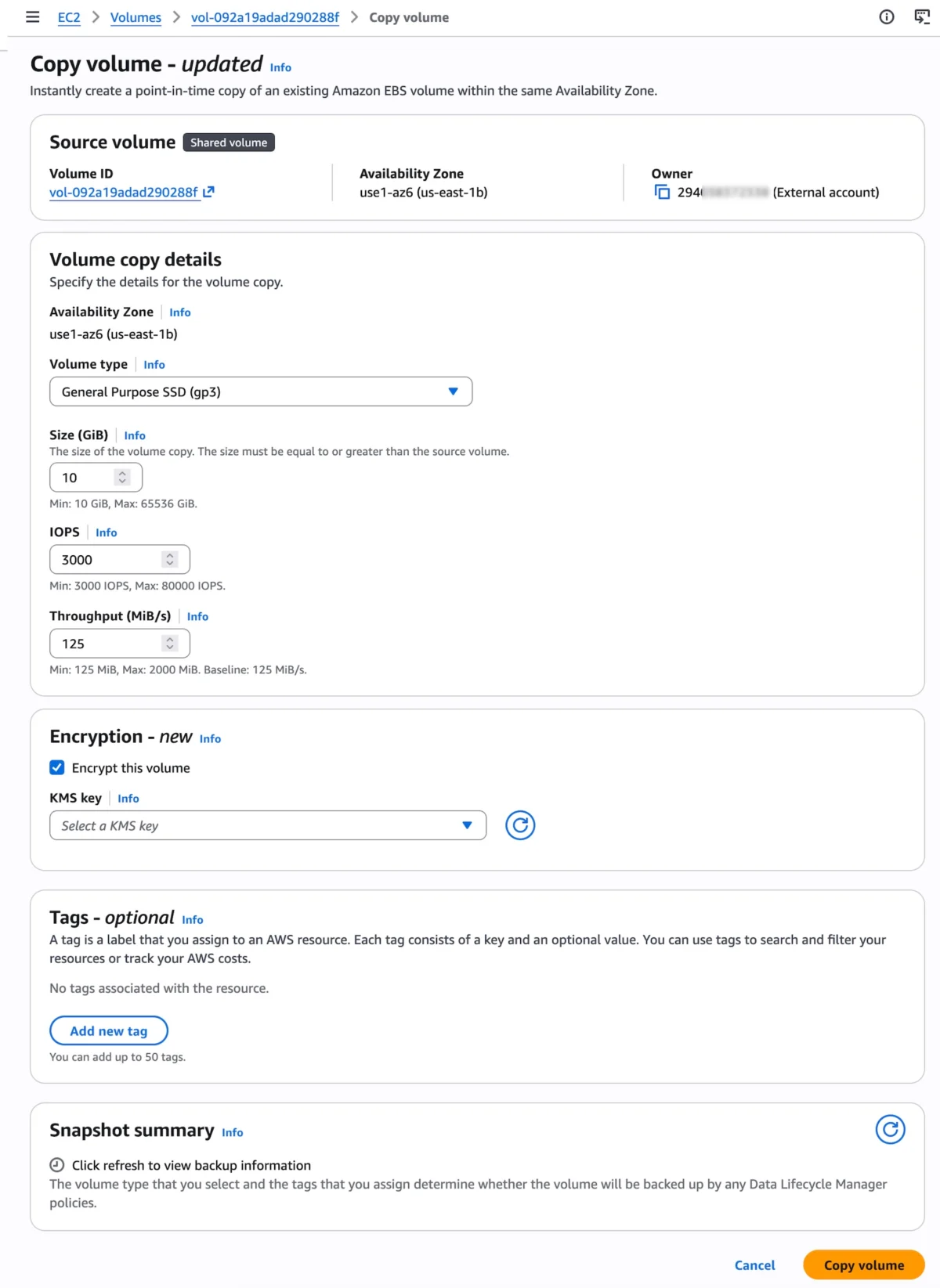
Once accepted, the shared volume appears natively within the EBS volume dashboard of the target account. The target administrator selects Copy volume, at which point they can optionally assign a distinct AWS KMS customer-managed key (CMK) to encrypt the newly created clone, ensuring data isolation from the parent account.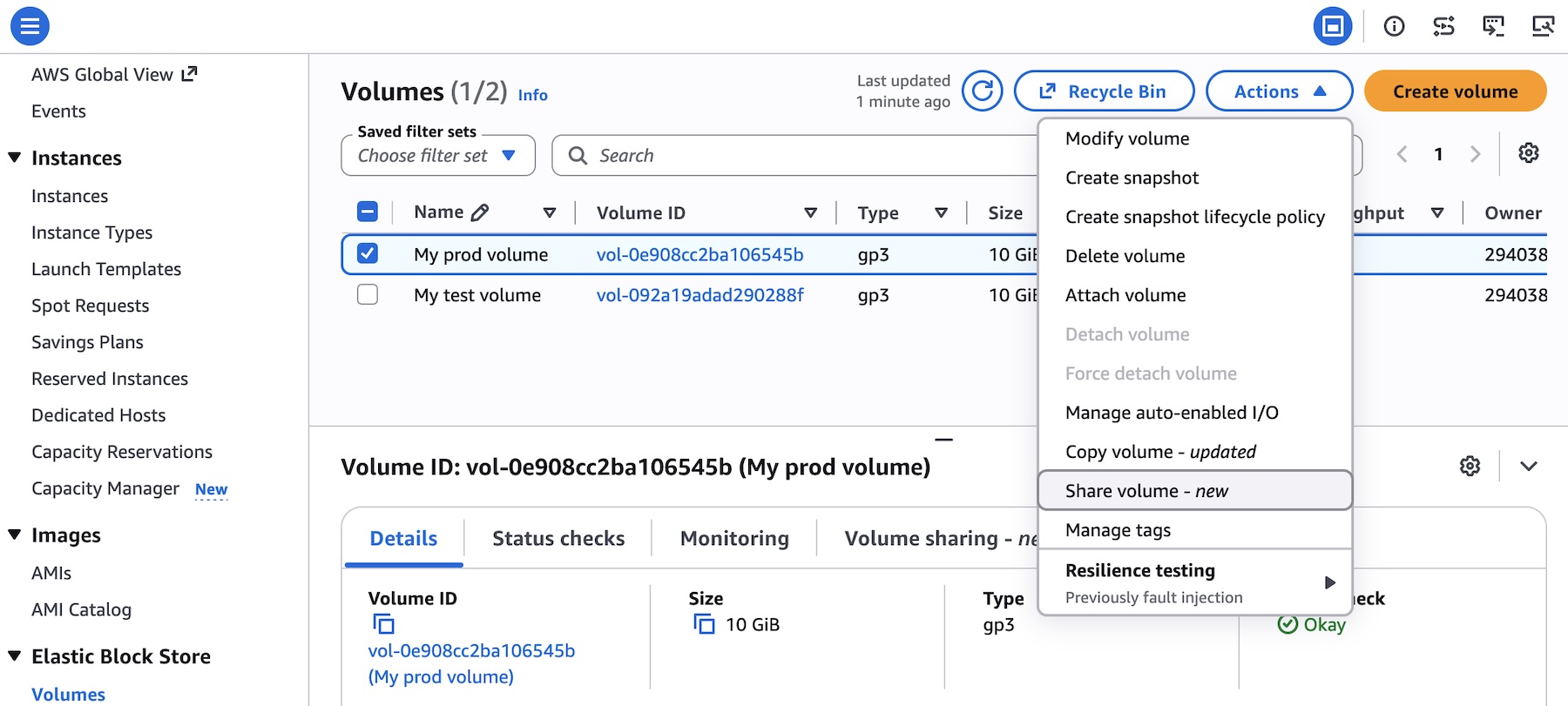
Programmatic and AI-Assisted Operations
For DevOps teams practicing Infrastructure as Code (IaC) or utilizing modern development workflows, manual console clicks are often secondary to API automation. AWS has ensured that cross-account volume operations are fully accessible programmatically via AWS SDKs and CLI commands. Furthermore, engineers can leverage the AWS MCP Server and associated plugins within their preferred AI coding assistants to query documentation, construct API calls, and troubleshoot IAM permissions related to cross-account EBS sharing.
Official Responses and Industry Implications
The release of cross-account EBS volume cloning has drawn positive reactions from cloud architects, security engineers, and DevOps practitioners managing large-scale AWS deployments.
Solving the "Production-to-Staging" Dilemma
In enterprise environments, maintaining parity between production and non-production environments has always been a delicate balancing act. Developers need realistic data to test database migrations, schema updates, and performance bottlenecks, but exposing production data to non-production accounts introduces severe security and regulatory compliance risks.
Industry analysts note that this feature directly addresses the compliance trilemma of speed, isolation, and governance:
- Speed: Because the underlying technology builds upon EBS Volume Clones, provisioning large datasets takes seconds rather than hours.
- Isolation: By copying volumes into separate accounts, organizations ensure that bugs, accidental deletions, or exploratory testing in sandbox environments cannot cascade back into production infrastructure.
- Governance: Target-account re-encryption ensures that even if production data is classified under strict regulatory frameworks (such as HIPAA, PCI-DSS, or GDPR), the copied data in the development account is immediately secured under the strict access keys of the secondary account owner.
AWS Leadership Perspective
In his release announcement, Channy Yun of the AWS News Blog emphasized the practical utility of the update:
"With this new feature, you can use your latest application data to develop, test, and experiment in a secondary environment, while protecting and isolating the information in the production environment. For example, you can create copies of a production environment to refresh test and development environments set up in separate accounts with the desired EBS encryption."
Implications for Cloud Architecture and Security
The integration of cross-account EBS volume copying into the core AWS storage portfolio carries several long-term implications for cloud design patterns:
1. Refinement of Multi-Account Best Practices
AWS has long advocated for multi-account architectures as a best practice for security, billing isolation, and blast-radius containment. However, friction in sharing heavy assets like block storage often led teams to cut corners—such as sharing IAM roles over single-account databases or relying on cumbersome snapshot restoration procedures. Native cross-account EBS cloning eliminates this friction, encouraging organizations to fully embrace strict account segregation without sacrificing developer velocity.

2. Enhanced Data Security Posture Management (DSPM)
With the ability to apply target-account KMS keys during the cloning process, security teams gain granular control over data lineage. Cryptographic segregation ensures that developers working in a sandbox environment have zero access to the production KMS keys used to encrypt the original volume, thereby neutralizing risks associated with compromised credentials in lower-tier environments.
3. Accelerated CI/CD and Analytics Pipelines
Data-heavy applications—such as those running relational databases, search clusters, or large-scale file systems on Amazon EBS—frequently struggle with test data management (TDM). By enabling instant, cross-account volume provisioning, data engineers can automate nightly or hourly refreshes of staging databases, allowing automated testing suites to run against production-accurate datasets without incurring prohibitive storage overhead or operational delay.
Conclusion
The expansion of Amazon EBS Volume Clones to support cross-account copying and re-encryption represents a significant maturation of AWS storage services. By intelligently combining the rapid block-level performance of Volume Clones with the robust governance frameworks of AWS RAM and AWS KMS, Amazon has delivered a tool that satisfies both the agility demands of modern developers and the rigorous compliance requirements of enterprise security teams.
The feature is available today across all qualifying AWS Regions. Cloud administrators, DevOps engineers, and security architects are encouraged to review the updated Amazon EBS User Guide, test the workflow within the Amazon EC2 console, and provide feedback through AWS re:Post channels to help shape the future trajectory of AWS storage innovation.
 Siti Muinah
 Reynand Wu
