
 By rifanmuazin
The race to build a functional, large-scale quantum computer is, at its heart, a challenge of connectivity. While individual quantum bits (qubits) have become increasingly sophisticated, the ability to link these fragile units across physical distances remains a significant bottleneck. A breakthrough from the Institute of Science and Technology Austria (ISTA) has now unveiled a potential paradigm shift: a fully autonomous method to entangle distant qubits using a "quantum bath" of correlated light.
Published in the journal Physical Review X, this experimental milestone brings to fruition a theoretical prediction that has challenged physicists for over two decades. By moving away from the cumbersome, high-maintenance active control systems that have dominated the field, the ISTA team has opened a new, potentially scalable door toward the realization of future quantum networks.
The Challenge of Distributed Entanglement
At the core of quantum computing is entanglement—a phenomenon so counterintuitive that Albert Einstein famously referred to it as "spooky action at a distance." When two particles become entangled, the state of one is inextricably linked to the state of the other, regardless of the physical space between them. For quantum computers to scale beyond a single processor, engineers must be able to distribute this entanglement across distant modules, effectively creating a "quantum internet."
Until now, the methodology for achieving this has been fraught with complexity. Historically, researchers have employed two primary strategies:
- Active Photon Transmission: A single photon is sent from one qubit to another, requiring precise active control and timing.
- Photon Matching: Both qubits emit a photon simultaneously, and these are then intercepted and matched.
The latter method, which was pivotal to the research recognized by the 2022 Nobel Prize in Physics, remains the gold standard for many experimental setups. However, it suffers from a fatal flaw in the context of practical scalability: it relies on "post-selection." Because the process is probabilistic rather than deterministic, it requires repeated measurements, and even then, entanglement is not guaranteed. If the measurement fails, the experiment must be reset, consuming valuable time and computing resources.
A Chronology of Discovery: From Theory to Laboratory
The path to the ISTA breakthrough began more than 20 years ago, when theoretical physicists first proposed that a "quantum bath"—a reservoir of correlated particles—could act as a natural synchronizer for distant qubits. The concept was elegant in its simplicity: rather than forcing qubits to entangle through human-orchestrated pulses, one could bathe them in a environment that naturally drives them toward an entangled state.
For two decades, however, this remained a "paper-and-pencil" solution. The idealized conditions required to maintain such a bath were considered impossible to reproduce in a real-world laboratory.
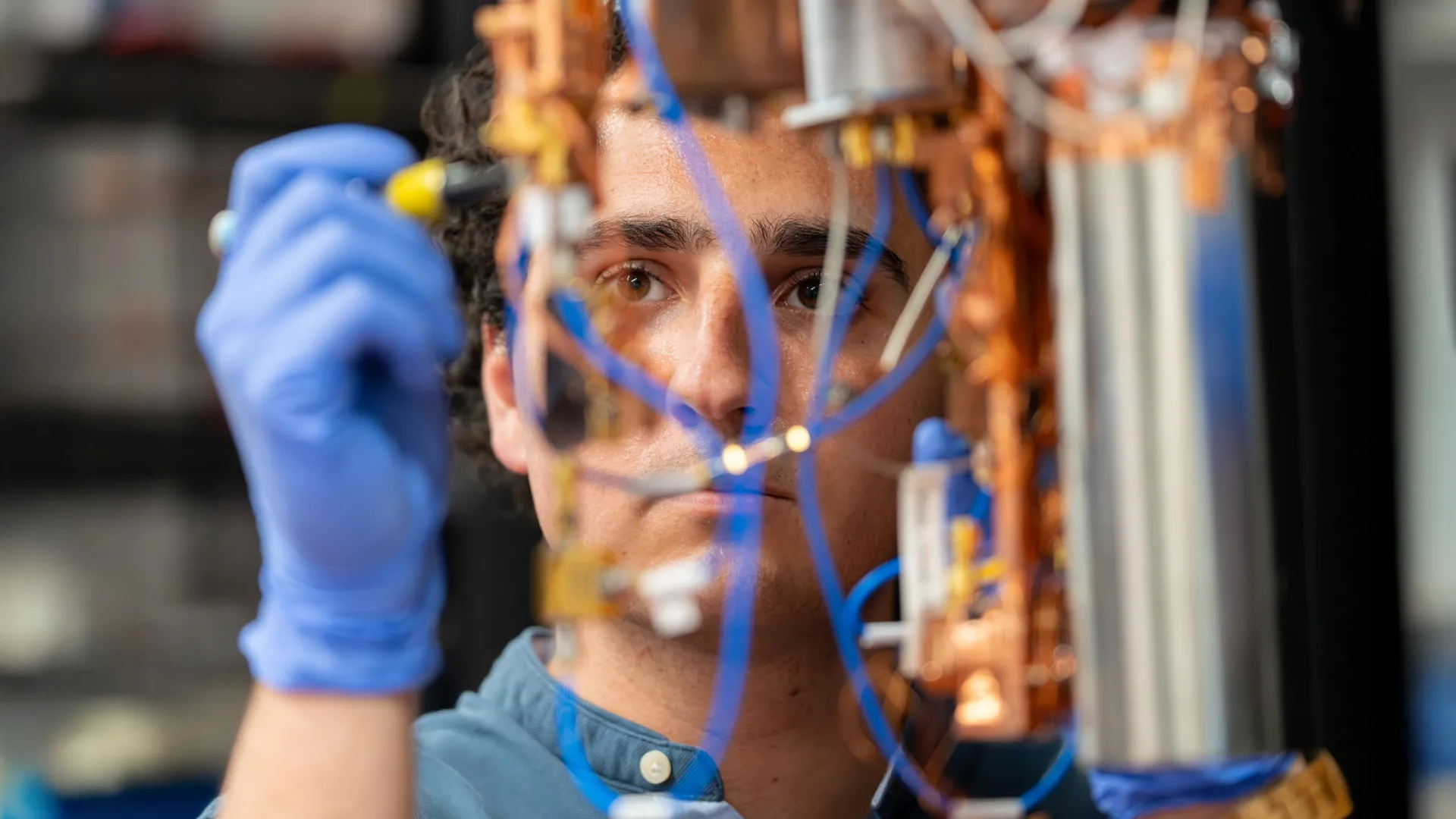
The recent work led by PhD student Alejandro Andrés-Juanes and Professor Johannes Fink at ISTA marks the first time this theory has been experimentally validated. By constructing a prototype device that utilizes a shared source of correlated microwave photons, the team created a stable environment where two physically separated qubits were "naturally" forced into entanglement.
This transition from abstract theory to physical manifestation required the team to overcome significant obstacles in materials science and microwave engineering. The researchers had to account for real-world noise, signal loss, and the inherent decoherence of the qubits, revealing, in the process, why previous attempts to build such a bath had stalled.
The Mechanics of the "Quantum Bath"
To understand the innovation, one must distinguish between the two types of entanglement that typically plague quantum researchers. The first, "continuous-variable" entanglement, is akin to a pendulum—a fluid, oscillating motion that is relatively easy to generate. The second, "discrete-variable" entanglement, is the "all-or-nothing" state required for the logic gates of a quantum computer.
"In this work, we aimed to overcome this mismatch between the readily available and the practically useful forms of entanglement," explains Alejandro Andrés-Juanes.
The ISTA team’s approach functions by making the environment the architect of the connection. In a traditional setup, entanglement is a fleeting spark that must be captured and utilized immediately before it decays. In the ISTA model, the "quantum bath" creates a continuous stream of correlated photons that actively stabilizes the entangled state.
"The quantum bath—meaning the qubits’ environment—is the source of entanglement," says Professor Johannes Fink. "It creates a new ground state through a continuous stream of correlated photons. This way, the entangled qubit state is stabilized, even beyond the qubits’ own lifetime, and remains always available as a resource for further quantum processing."
Because the state is constantly being "refreshed" by the bath, it effectively solves the problem of temporal fragility. The researchers no longer need to race against the decoherence of the qubits; the bath keeps the qubits in an entangled state as long as the system is active.
Supporting Data: Validating the Hidden State
Confirming that the qubits were truly entangled in this invisible, bath-driven environment required highly sophisticated measurement techniques. Since measuring a qubit forces it to collapse into a classical state (a 0 or a 1), researchers cannot simply "look" at the qubits to see if they are entangled.
Instead, the team utilized "quantum tomography." By performing a series of rapid, high-precision measurements lasting between 20 and 80 nanoseconds, the researchers reconstructed the system’s state by analyzing its behavior across thousands of snapshots. This process allowed them to verify that the qubits were, in fact, synchronized.
While the experiment is a landmark success, the researchers are transparent about its current limitations. As of the current publication, the system transfers roughly 10% of the bath’s available entanglement. While this is significantly lower than the efficiency of some actively controlled, short-range systems, the team emphasizes that the benefit lies in the autonomy of the process.
Official Responses and Scientific Implications
The broader implications of this research extend beyond the immediate achievement of entanglement. By demonstrating that a quantum bath can synchronize qubits, the ISTA team has provided a blueprint for modular quantum architectures.
"We present a relatively simple method that could be scaled up to synchronize multiple distant qubits," notes Andrés-Juanes. This scalability is the "Holy Grail" of the industry. If multiple modules can be linked via a common bath of correlated microwave photons, it could remove the need for the incredibly complex control hardware that currently limits the size of quantum processors.
Furthermore, the choice of microwave photons is strategically sound. Microwave technology is the backbone of current superconducting-qubit systems—the same technology used by industry giants like Google and IBM. By leveraging these existing foundations, the ISTA approach is much closer to practical implementation than experimental methods that require entirely different physical platforms (such as optical lasers or cold atom traps).
However, the team acknowledges that the bridge between microwave-based local entanglement and long-distance fiber-optic communication remains to be built. Professor Fink’s group is already looking toward the next phase of research: investigating how these microwave-based entanglement methods can be translated into optical photons, which are better suited for long-distance transmission over fiber-optic cables.
Conclusion: A New Foundation for Quantum Networks
The work performed at the Institute of Science and Technology Austria is more than just an experimental validation of a 20-year-old prediction. It represents a fundamental shift in how physicists view the environment of a quantum computer. Instead of fighting against the environment, this research suggests we can harness it.
By turning the "bath" into a resource, the ISTA team has moved the needle closer to fault-tolerant quantum computing. While the transition from a laboratory prototype to a commercial-grade quantum network will require further refinement of efficiency and transmission, the "autonomous" nature of this approach provides a compelling answer to one of the most difficult questions in the field: how to build a system that maintains its own connectivity, hour after hour, without the need for constant, human-directed intervention.
As the industry continues to scale, the ability to "set and forget" the entanglement between nodes may well become the defining feature of the next generation of quantum architecture. For now, the ISTA team has proven that in the world of quantum mechanics, sometimes the best way to control a system is to stop trying to force it, and instead, create the perfect conditions for it to connect itself.
 Ali Ikhwan
 Reynand Wu
 Ammar Sabilarrohman
