
 By Asep Darmawan
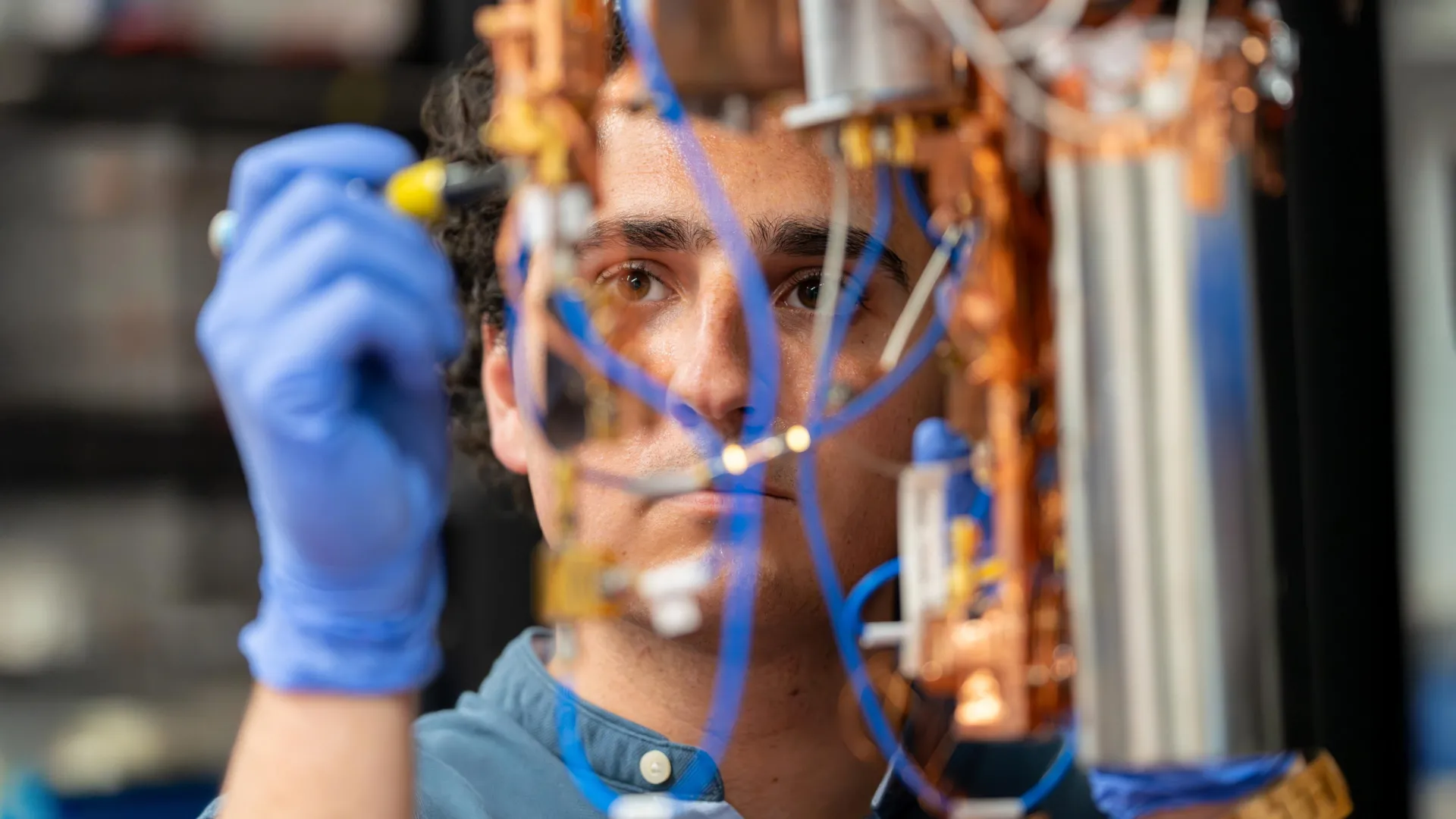
The pursuit of a scalable quantum computer has long been hindered by the "connectivity problem." While quantum bits—or qubits—can perform extraordinary feats of computation, they are notoriously fragile, requiring extreme isolation to maintain their quantum states. Yet, to build a powerful, modular quantum computer, these qubits must be linked across distances. For decades, the field has relied on active, high-maintenance methods to forge these connections.
However, a breakthrough from the Institute of Science and Technology Austria (ISTA) has fundamentally shifted this paradigm. Physicists have successfully demonstrated a fully autonomous method to entangle widely separated qubits using a "quantum bath" composed of correlated particles of light. This experimental milestone, published in the journal Physical Review X, validates a theoretical prediction that has remained dormant for over twenty years, offering a promising new architecture for future quantum networks.
The Connectivity Bottleneck: A Historical Overview
To understand the magnitude of the ISTA team’s achievement, one must first look at the history of quantum entanglement. Entanglement is the phenomenon where two or more particles become linked, such that the state of one instantaneously influences the state of the other, regardless of the distance separating them. It is the lifeblood of quantum computing, yet it is notoriously difficult to produce and maintain on demand.
The Evolution of Entanglement Strategies
For the past two decades, researchers have pursued two primary strategies to distribute entanglement between stationary qubits:
- Direct Photonic Transmission: In this model, an actively controlled photon is sent from one qubit to another, carrying quantum information through a transmission line. This requires precise timing and active feedback loops.
- Stochastic Matching: In this approach, each qubit emits a photon, and these two photons are then "matched" at a central hub. This method, which was pivotal in the experiments recognized by the 2022 Nobel Prize in Physics, is the gold standard in current laboratory settings.
Despite their success, both methods suffer from a significant limitation: they are probabilistic and non-autonomous. They rely on repeated measurements, post-selection, and active, real-time control. If a measurement fails, the entanglement process must be restarted. This "hit-or-miss" nature acts as a major bottleneck for the development of large-scale, fault-tolerant quantum processors.
The ISTA Breakthrough: Replacing Control with Environment
The team at ISTA, led by Professor Johannes Fink and PhD student Alejandro Andrés-Juanes, approached the problem from an entirely different angle. Instead of attempting to "force" qubits together through active measurement and external control, they sought to create an environment—a "quantum bath"—that would naturally and autonomously drive the qubits into an entangled state.
Bridging Continuous and Discrete Variables
The challenge was a mismatch in quantum architecture. Continuous-variable (CV) entanglement—which behaves much like a pendulum with fluid, changing states—is relatively easy to generate. However, practical quantum computing relies on discrete-variable (DV) systems, which use the "all-or-nothing" binary states of qubits.
"In this work, we aimed to overcome this mismatch between the readily available and the practically useful forms of entanglement," explains Andrés-Juanes. By utilizing a shared source of correlated microwave photons, the researchers engineered a reservoir that forces the qubits to synchronize. Because the system is stabilized by the surrounding environment rather than by external human intervention, it operates autonomously.
The Mechanism of the Quantum Bath
The core of the experiment lies in the concept of the quantum bath. By exposing the qubits to a continuous stream of correlated photons, the researchers effectively "bathed" the qubits in an environment that favors an entangled ground state.
"The quantum bath—meaning the qubits’ environment—is the source of entanglement," says Professor Fink. "It creates a new ground state through a continuous stream of correlated photons. This way, the entangled qubit state is stabilized, even beyond the qubits’ own lifetime, and remains always available as a resource for further quantum processing."
This is a critical distinction from previous methods. In traditional setups, entanglement is a fleeting resource that must be consumed the moment it is created. In the ISTA model, the entanglement is a steady-state property of the system. If the qubits lose their coherence, the quantum bath immediately works to re-entangle them, ensuring that the resource is always ready for computation.
Supporting Data and Experimental Verification
The verification of this phenomenon was a feat of high-precision measurement. Because the qubits are in a constant state of superposition, they cannot be observed directly without causing their states to collapse. To confirm that the qubits were truly entangled within the bath, the researchers employed quantum tomography.
Quantum Tomography: Peering into the Void
Quantum tomography is a sophisticated technique used to reconstruct the state of a quantum system by taking many "slices" of its behavior. By performing thousands of measurements lasting only 20 to 80 nanoseconds each, the ISTA team was able to map the underlying quantum correlations between the qubits.
The experiment utilized microwave photons, which are the standard for superconducting qubit technology. These low-energy particles are ideal for on-chip manipulation. While the team’s current prototype operates at a 10% efficiency rate—meaning it captures about 10% of the bath’s available entanglement—the proof-of-concept is undeniable.
The researchers noted that the 20-year gap between the original theory and this experiment was largely due to the difficulty of replicating "idealized" theoretical conditions in a noisy, real-world laboratory. By identifying the specific environmental factors that hindered earlier attempts, the team has provided a blueprint for future experimentalists to refine the process and boost efficiency.
Official Perspectives: Implications for the Future
The implications of this study extend far beyond the laboratory walls at ISTA. As the quantum industry moves toward modular architectures, the ability to link qubits without the overhead of massive control circuitry becomes paramount.
A New Foundation for Fault-Tolerant Computing
One of the primary goals of the field is "fault-tolerant" quantum computing—the ability of a computer to correct its own errors. Autonomous entanglement is a vital component of this. By removing the need for active measurement and the associated latency of control electronics, this "quantum bath" approach could significantly reduce the error rates inherent in distributed quantum systems.
"We present a relatively simple method that could be scaled up to synchronize multiple distant qubits," notes Andrés-Juanes. This scalability is the "holy grail" of the field. If multiple nodes of a quantum computer can be synchronized via these bath-based links, it could pave the way for massive, distributed quantum networks.
Looking Toward Fiber Optics
While the current experiment focuses on microwave photons for on-chip entanglement, the Fink group is already looking ahead. The group is investigating how to translate these techniques to optical photons. Optical photons are the gold standard for long-distance transmission, as they can travel through fiber-optic cables with minimal loss. If the autonomous quantum bath can be adapted for optical links, it could eventually serve as the backbone for a "Quantum Internet," connecting distant quantum processors across cities or continents.
Conclusion: Toward a Seamless Quantum Architecture
The work conducted at ISTA serves as a bridge between the theoretical musings of the early 2000s and the practical, modular quantum computers of the future. By demonstrating that an environment—rather than a controller—can govern the behavior of quantum information, Johannes Fink and his team have unlocked a new design philosophy.
While the 10% efficiency rate suggests there is still work to be done, the shift from "active, measurement-based entanglement" to "passive, environment-stabilized entanglement" is a seismic change. It simplifies the architecture, improves the longevity of quantum states, and provides a clear path forward for researchers struggling to scale up.
As we look toward the next decade of quantum development, the "quantum bath" may well become a standard feature of the quantum data center, a silent, background force that keeps the most powerful machines in existence in perfect, synchronized harmony. The 20-year wait has ended; the era of autonomous quantum connectivity has begun.
 Ali Ikhwan
 Reynand Wu
 Ammar Sabilarrohman
