
 By Nila Kartika Wati
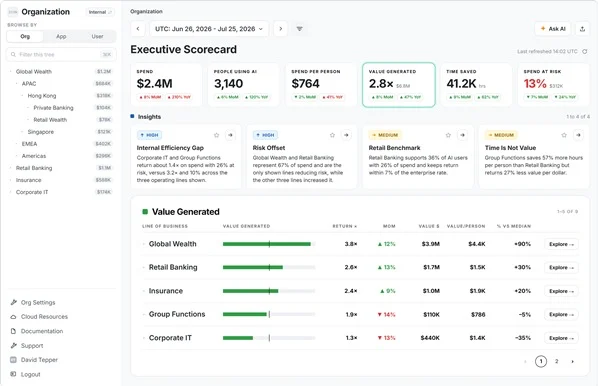
The corporate landscape has officially crossed the Rubicon. After years of frenetic AI experimentation, global enterprises are transitioning into a high-stakes era where artificial intelligence is no longer a sandbox project but a significant, recurring line item on the balance sheet. Yet, as CFOs and CIOs grapple with ballooning infrastructure costs, a critical blind spot remains: while companies can easily track token counts and API calls, they struggle to answer the fundamental question of business viability—which AI initiatives are actually generating measurable value?
Enter Ascerta, formerly known as Pay-i, which emerged from the shadows this week with a rebranding and a significant $18 million Series A funding round. Led by Dell Technologies Capital, with participation from Hitachi Ventures, BGV, Wipro Ventures, and existing investors, the round brings the company’s total funding to $22.9 million. The capital injection signals a market shift from basic AI cost-containment toward a more sophisticated discipline: Enterprise AI Management.
The Genesis of a New Category
The story of Ascerta is rooted in the deep technical expertise of its founders, all of whom are Microsoft veterans. CEO David Tepper, who spent 19 years at Microsoft leading GenAI strategy for internal Azure operations, joined forces with CTO Doron Holan—a 27-year veteran responsible for architecting hyperscale throttling infrastructure—and COO Erik Winters.
Their collective experience provided a front-row seat to the "AI economics crisis." They witnessed how quickly the financial model of an enterprise breaks down when AI deployment scales from a handful of internal users to thousands of agents and models. The team initially launched as Pay-i in May 2025, securing $4.9 million in seed funding to solve the narrow problem of AI cost management. However, as their client base grew, the founders realized that managing costs in a vacuum was a losing battle. Enterprises didn’t just need to stop the bleeding; they needed to understand the health of their AI ecosystem.
"The market is full of meaningless vanity metrics," says David Tepper. "Companies are counting tokens, lines of generated code, and agent runs, struggling to derive the impact AI has on their business. We built Ascerta to cut through the noise and give organizations the means to win in the AI era."
Chronology: From Stealth to Strategic Pivot
- May 2025: The company launches out of stealth as "Pay-i" with $4.9 million in seed funding, initially focusing solely on AI cost management and financial oversight.
- Mid-2025 – Early 2026: During this period, the company observes that its customers are successfully tracking costs but failing to correlate those costs with business outcomes. The product roadmap expands to include adoption tracking and performance metrics.
- September 2026: The company undergoes a formal rebrand to "Ascerta" to better reflect its shift from cost-tracking to holistic "Enterprise AI Management."
- September 2026: Ascerta announces an $18 million Series A round led by Dell Technologies Capital, marking its official entry into the broader management software category.
The Ascerta Engine: How It Works
Ascerta acts as a strategic layer that sits alongside an organization’s existing AI infrastructure. Rather than forcing a "rip and replace" approach, the platform integrates with homegrown applications and industry-standard tools, including Microsoft’s Copilot suite, Amazon Bedrock AgentCore, Salesforce Agentforce, and coding assistants like GitHub Copilot, Claude Code, and Codex.

The platform breaks its operations into three primary pillars, designed to move beyond passive reporting:
- Atlas (Value and ROI): This module tracks the entire lifecycle of an AI project, connecting specific workflows to business KPIs. It provides the "source of truth" for which projects are delivering returns and which are essentially "zombie" initiatives that should be deprecated.
- Forge (Engineering Productivity): Focused specifically on the developer experience, Forge measures how engineering teams utilize coding agents. It helps leadership understand if these agents are actually accelerating development or creating a technical debt burden.
- Convoy (Capacity Optimization): For organizations that provision their own GPU capacity or infrastructure, Convoy ensures maximum utilization. It allows teams to scale new use cases without the risk of system instability or production disruption.
What sets Ascerta apart is its granularity. The platform goes beyond high-level billing, tying individual model calls to specific business use cases. It factors in enterprise discounts, sub-token costs, and "hidden fees" that often escape traditional FinOps tools, providing a precise dollar figure for the ROI of a specific feature or agent.
Data-Driven Impact: Validating the Model
Ascerta’s rapid adoption is backed by quantifiable success stories. Working alongside major partners like IBM, AWS, and Slalom, the platform has demonstrated impressive metrics across its current customer base, which includes major entities like Atos and various global insurance carriers.
According to internal performance data, Ascerta users have realized:
- 47% improvement in ROI on AI initiatives.
- 24% reduction in time-to-market for launching new agents.
- 86% reduction in wasted AI spend (Shadow AI, duplicate projects, and inefficient model usage).
Florin Rotar, Group CTO and Chief AI Officer at Atos, notes that the platform has become essential to their "Sovereign Agentic Studios" model. "That requires measurable business value, not just technical capability," Rotar said. "Ascerta has been instrumental in delivering on that promise, giving us the visibility and control we need to scale AI initiatives with confidence."
Implications: The Shift from FinOps to ValOps
The implications of Ascerta’s arrival are profound for the C-suite. For years, the IT department has functioned as a cost center, but the "AI-first" enterprise demands a more nuanced approach. Traditional FinOps tools, which were designed to manage cloud storage and compute costs, are fundamentally ill-equipped to handle the non-linear nature of AI agents.
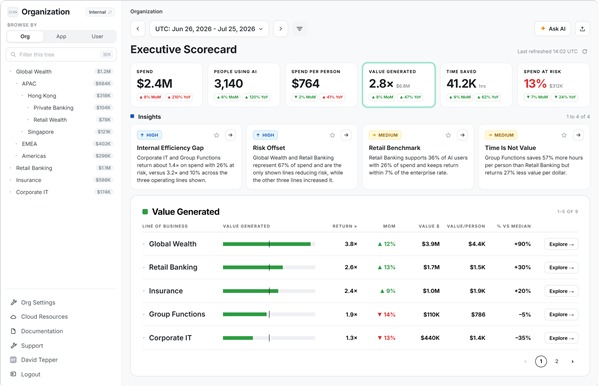
As agents begin to perform autonomous tasks—from customer service resolution to complex code refactoring—the gap between "what we spent" and "what we gained" becomes a chasm. Ascerta’s rise suggests that the next generation of enterprise software will be defined by "ValOps"—a fusion of value management and operations.
Raman Khanna, Managing Director at Dell Technologies Capital, highlights this necessity: "Most enterprises are moving beyond broad AI experimentation and focusing their investments on what delivers measurable business value. David and the Ascerta team are giving leaders the visibility and rigor they need to understand what’s working, optimize spending, and scale their most successful AI initiatives."
Future Outlook: Beyond Measurement
With the Series A funding secured, Ascerta is not planning to rest on its laurels. The company intends to scale its go-to-market team aggressively and deepen its integration stack. More importantly, the leadership team is signaling a move from measurement to active optimization.
The company is currently researching ways to move beyond simply telling leaders where they are losing money or wasting time. The goal is to provide proactive, automated recommendations that allow the platform to suggest model re-routing, agent optimization, or infrastructure adjustments in real-time.
As enterprises continue to deploy thousands of models and agents simultaneously, the "manual" era of AI management is nearing its end. Ascerta is positioning itself as the operating system for this new reality, providing a persistent, trusted, and granular view of the AI-driven corporation. In an era where AI is the primary lever for competitive advantage, the ability to discern value from noise may well be the most important capability a company can acquire.
 Basiran
 Sagoh
 Nana Wu
