
 By Dwi Wanna
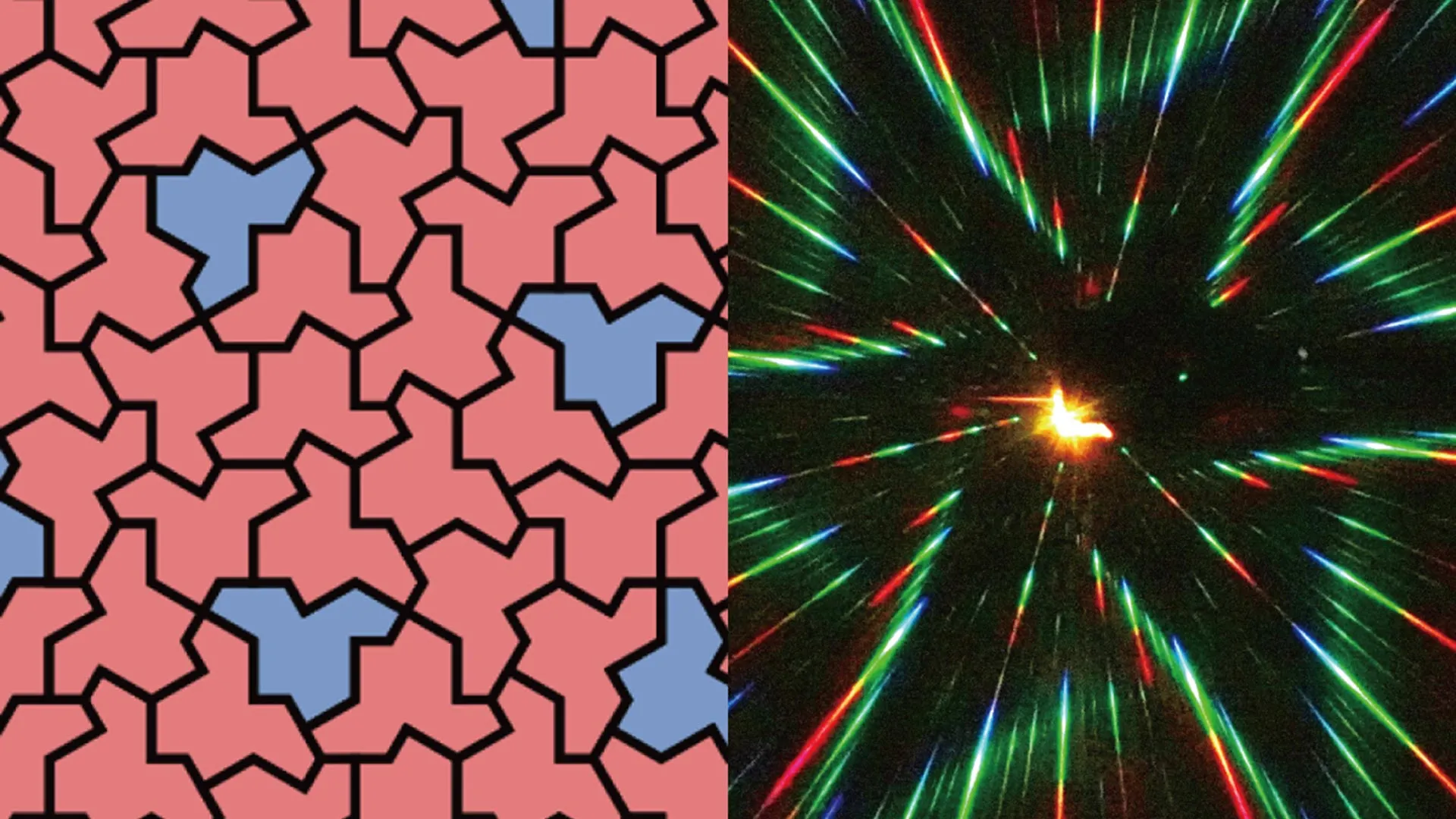
In a remarkable convergence of pure mathematics and cutting-edge photonics, a geometric shape that captured the world’s imagination by solving a decades-old puzzle is now serving as the foundation for a new era in optical physics. Researchers from the Institute of Industrial Science at the University of Tokyo, in collaboration with international partners, have demonstrated that the "Smith hat"—a monotile capable of covering a surface without ever repeating—can force light into exotic, chiral patterns. This discovery, published in Nature Communications, suggests that the complex, aperiodic geometry of the hat can manipulate light in ways previously thought impossible, opening doors to advanced light-steering technologies and novel optical devices.
The Mathematical Breakthrough: Solving the ‘Einstein’ Problem
To understand the magnitude of this discovery, one must first look at the mathematical landscape from which the "hat" emerged. For over half a century, mathematicians had been haunted by the "Einstein problem." Despite its name, the problem has nothing to do with Albert Einstein; rather, it is derived from the German ein Stein, meaning "one stone." The question was simple yet elusive: Can a single, specific shape exist that, when used as a tile, covers an infinite plane without ever creating a repeating, periodic pattern?
For decades, experts believed such a shape might not exist. While "aperiodic" tiling was possible using a set of two or more different shapes—most famously the Penrose tiles—a "monotile" (a single tile) that avoided repetition remained the "Holy Grail" of geometry.
In 2023, that mystery was finally solved. An international team of mathematicians, led by David Smith, discovered the "hat" tile. This 13-sided polygon, a simple-looking shape resembling a fedora, proved capable of tiling the plane aperiodically. It was a sensation that transcended academic circles, appearing in media outlets globally as the definitive answer to a long-standing mathematical conundrum. However, for physicists, the hat represented more than just a tiling triumph; it represented a new, unexplored blueprint for the physical world.
The Chronology of Discovery: From Paper to Nanoscale
The journey from a geometric curiosity to a physical optical device began shortly after the Smith hat’s publication. Yuto Moritake and his colleagues at the University of Tokyo began to investigate the structural properties of the hat. They observed that, while the hat tiling appears disordered, it is built upon an underlying honeycomb lattice—a structure familiar to physicists but now rearranged into a unique, non-repeating configuration.
"We wanted to see whether this unique shape could also produce any unexpected physical phenomena," said lead author Yuto Moritake.
The research team proceeded through a rigorous, multi-stage process:
- Conceptualization (Mid-2023): Theoretical modeling confirmed that the aperiodic nature of the hat tile creates a unique symmetry environment.
- Nanofabrication (Late 2023): Using advanced electron beam lithography, the team imprinted these hat patterns onto silicon nitride films. The precision required was immense, as the patterns had to be crafted at the nanoscale to interact with the wavelength of laser light.
- Experimental Verification (Early 2024): The team illuminated these silicon nitride structures with laser light. By observing the diffraction patterns, they were able to map how the "hat" landscape interacted with the photons.
- Analysis and Peer Review (Mid-2024): The results were compiled, revealing that the diffraction patterns were not merely random scatter, but highly ordered, chiral pinwheels.
Supporting Data: Symmetry, Chirality, and Light
The core of the research lies in the concept of "chirality." In the context of physics, chirality refers to an object’s "handedness." Much like a left hand cannot be perfectly superimposed over a right hand, a chiral structure has a mirror image that is structurally distinct.
When the researchers shone laser light through their Smith-hat-patterned silicon nitride films, the resulting diffraction patterns formed distinct, pinwheel-like structures. Crucially, these patterns were inherently chiral. When the researchers flipped the underlying physical pattern, the optical response mirrored that change perfectly.
Key Findings:
- Aperiodicity vs. Periodicity: Unlike conventional crystals, which exhibit regular, predictable diffraction points, the Smith hat produces a complex, non-repeating diffraction landscape.
- Symmetry-Controlled Behavior: The light’s behavior is strictly governed by the mirror symmetry (or lack thereof) in the tiling. The study found that the diffraction patterns lacked mirror symmetry because the tiling itself lacked it.
- Directional Sensitivity: The diffraction intensity and structure changed significantly depending on the angle and polarization of the incident light. This sensitivity suggests that the Smith hat acts as a highly sophisticated "filter" for light.
This data suggests that the hat tile does not just passively allow light to pass through; it actively shapes the light’s polarization and spatial distribution in a way that conventional crystalline materials cannot.
Official Responses and Expert Commentary
The significance of the work has resonated throughout the scientific community, with the researchers themselves emphasizing the transformative potential of the study.
"We found that the diffraction patterns themselves become chiral because the structure lacks mirror symmetry," explained senior author Masaya Notomi. "This kind of optical response is fundamentally different from that observed in conventional quasicrystalline materials."
The academic community views this as a vital "proof-of-concept." By bridging the gap between abstract mathematical tiling and physical material science, the team has provided a new methodology for researchers in nanophotonics.
"These results open a new direction of research on the fusion of quasiperiodic order and chirality," Moritake remarked. "Monotile patterns provide a platform for exploring optical phenomena that emerge from the interplay of symmetry, chirality, and aperiodicity."
Outside observers have noted that this research could be the first of many applications for the Smith hat. While the hat was once purely a curiosity for mathematicians, it is now being viewed as a "functional material," a structural building block that could redefine how we design optical hardware.
Implications for the Future of Photonics
The implications of this discovery are vast, stretching from basic physics to high-end industrial application.
Controlling Polarization
Modern telecommunications and advanced sensors rely heavily on the ability to manipulate the polarization of light. Current devices often use bulky, complex optical components to achieve this. The research suggests that a thin film imprinted with a Smith-hat pattern could perform these functions with much higher efficiency and a smaller footprint, potentially leading to ultra-compact, high-performance optical components.
Advanced Optical Devices
Because the Smith hat allows for a unique, non-repeating arrangement, it offers a level of complexity that periodic structures cannot match. This could be used to create "optical fingerprints"—unique patterns that could be used for secure authentication or in highly sensitive imaging technology.
A New Frontier in Materials Science
Beyond optics, the success of the Smith hat in this study suggests that other aperiodic monotiles could be used to influence other physical properties, such as thermal conductivity, electronic band structure, or acoustic wave propagation. We are moving toward a future where we do not just rely on the atomic makeup of a material, but on the geometric arrangement of its surface to dictate its behavior.
Conclusion
The transformation of the Smith hat from an abstract solution to an optical tool is a testament to the unpredictable nature of scientific progress. What began as a question about how to cover a floor without a pattern has evolved into a study of how to control the very nature of light.
By demonstrating that mathematical concepts—even those that seem entirely divorced from reality—can manifest in the physical world to produce tangible, useful effects, the team at the University of Tokyo has opened a new chapter in photonics. As we continue to explore the "Einstein" monotile, we may find that the true value of the hat was never in the tiling of a surface, but in the potential to unlock new dimensions of light manipulation. The Smith hat, it seems, still has many secrets to reveal, and the scientific community is only just beginning to put it on.
 Ali Ikhwan
 Reynand Wu
 Ammar Sabilarrohman
