
 By rifanmuazin
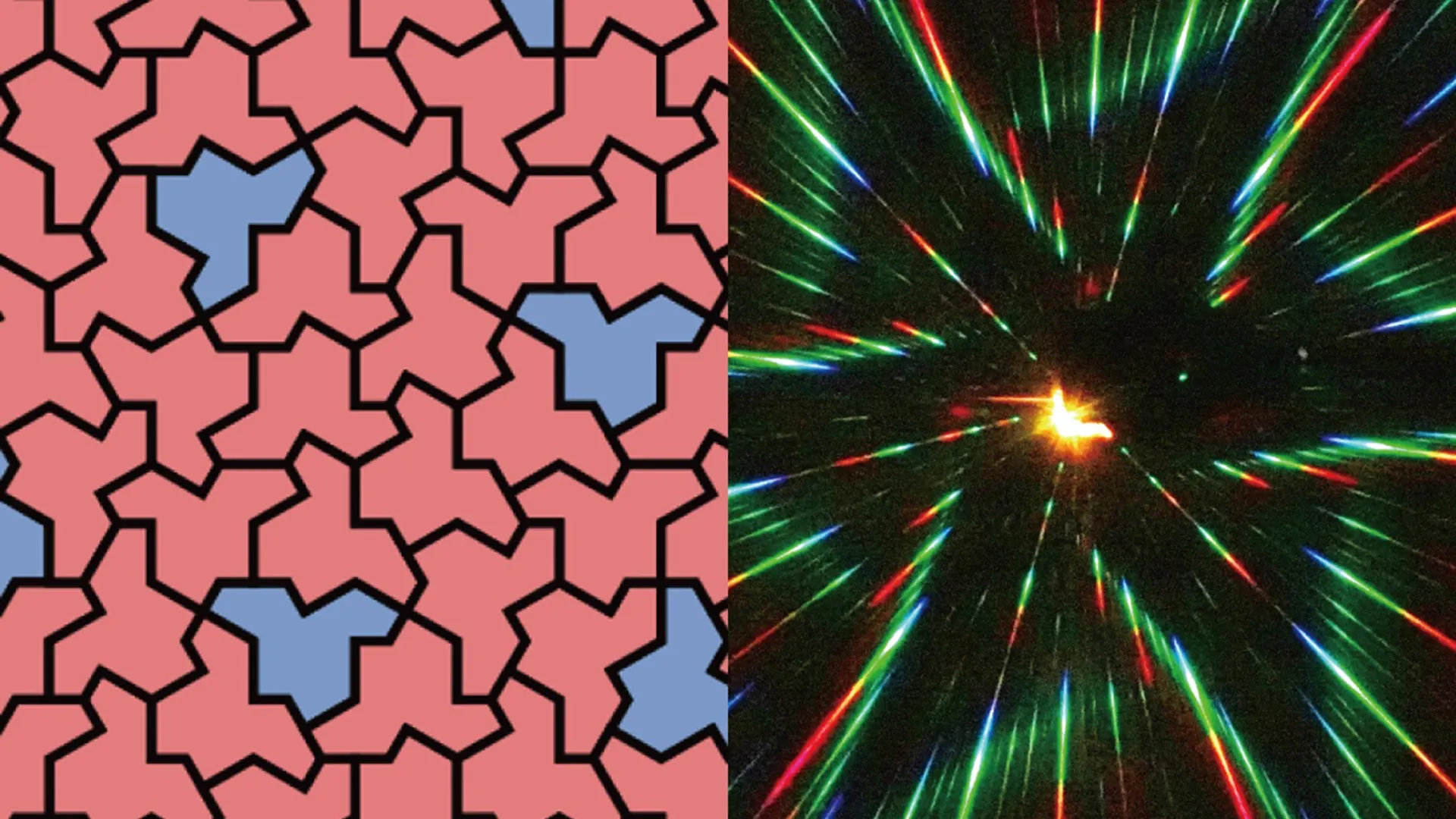
In the rarefied world of geometry, some problems are so stubborn they become legendary. For decades, the "Einstein problem"—a quest to find a single, non-repeating tile capable of covering an infinite plane—haunted mathematicians. When the "Smith hat" was unveiled in 2023 as the long-sought "monotile" solution, it was hailed as a triumph of pure mathematics. Yet, in a startling development, this abstract shape has escaped the pages of geometry journals and entered the laboratory, where it is now revealing profound, unexpected secrets about the nature of light.
Researchers from the Institute of Industrial Science at the University of Tokyo, in collaboration with international partners, have demonstrated that nanoscale structures based on the Smith hat can manipulate light in ways previously thought impossible. By etching these aperiodic, "hat-shaped" patterns into silicon nitride, the team has forced light to adopt chiral, pinwheel-like diffraction patterns, bridging the gap between abstract tiling theory and advanced photonics.
The Chronology of a Geometric Revolution
To understand the magnitude of this discovery, one must look back at the history of the Einstein problem. For nearly half a century, mathematicians wondered if a single shape—an "aperiodic monotile"—could tessellate a plane without ever settling into a repeating, periodic pattern. Traditional tiles, like the squares of a checkerboard or the hexagons of a honeycomb, are periodic; they repeat in a predictable, translational symmetry.
In 2023, a team of researchers led by David Smith made global headlines by identifying the "hat" tile—a polykite shape that, when arranged, avoids repetition indefinitely. The mathematical community celebrated this as the resolution of a puzzle that had remained unsolved since the 1960s.
However, the leap from a static, two-dimensional drawing to a physical, light-manipulating device occurred rapidly thereafter. Recognizing the inherent complexity of the hat’s layout, researchers at the University of Tokyo began to investigate whether the underlying geometric order could be leveraged for optical applications. By late 2023 and early 2024, the team utilized electron-beam lithography to fabricate these patterns at the nanoscale. By mid-2024, the results published in Nature Communications confirmed that the geometry was not merely a decorative curiosity, but a powerful tool for controlling electromagnetic waves.
The Einstein Problem and the Logic of the Hat
The "Einstein" in the Einstein problem is not a reference to Albert Einstein, but a play on words: ein stein, German for "one stone" or "one tile." The challenge was to find a single shape that could tile the plane aperiodically. Before the Smith hat, mathematicians had only been able to achieve this by using a set of two or more distinct tiles, such as the famous Penrose tiles.
The Smith hat is revolutionary because it is a "monotile." Despite its seemingly chaotic appearance, it is deeply tethered to the simplicity of the honeycomb lattice. Lead author Yuto Moritake notes, "What is especially fascinating about the hat tile is that, although the resulting pattern appears irregular at first glance, it is actually constructed from the honeycomb lattice. We wanted to see whether this unique shape could also produce any unexpected physical phenomena."
This connection to the honeycomb structure is the key to its optical utility. By utilizing the hat’s specific symmetry—or rather, its lack of traditional reflectional symmetry—the researchers created a scaffold that dictates how photons interact with the material.
Experimental Methodology: Light in the Nanoscale
To translate the mathematical abstraction into a physical reality, the researchers turned to nanofabrication. They deposited thin films of silicon nitride, a material widely used in photonics due to its high refractive index and transparency. Using electron-beam lithography—a process that uses a focused beam of electrons to draw patterns with nanometer-scale precision—the team etched the Smith hat tiling onto the surface of these films.
The resulting structures were subjected to a series of laser diffraction tests. In a standard, periodic crystal, laser light diffracts into a symmetrical, predictable grid of spots. However, when the light hit the Smith hat structure, the output was radically different. The light formed intricate, pinwheel-like diffraction patterns.
This pinwheel effect is a direct visual manifestation of "chirality." In physics, chirality refers to an object that cannot be superimposed on its mirror image—like a human hand. The research team discovered that because the hat pattern lacks mirror symmetry, it forces the light itself to inherit that handedness. The light does not simply bounce off the surface; it is "twisted" by the geometric configuration of the tiles, resulting in a chiral optical response that is fundamentally distinct from that of conventional quasicrystalline materials.
The Role of Symmetry and Polarization
The implications of this study extend beyond simple diffraction patterns. The researchers discovered that the optical behavior of the Smith hat structures is highly sensitive to the polarization and direction of the incoming light.
When the team mirrored the physical structure, the optical response mirrored as well. This provided empirical evidence that the interaction between the light and the material was governed entirely by the underlying symmetry of the aperiodic monotile. Senior author Masaya Notomi explains: "We found that the diffraction patterns themselves become chiral because the structure lacks mirror symmetry. This kind of optical response is fundamentally different from that observed in conventional quasicrystalline materials."
This sensitivity suggests that the Smith hat acts as a sophisticated "geometric filter." By adjusting the incident light, researchers can modulate how the light propagates through the structure, opening the door to new methods of controlling the polarization of electromagnetic waves.
Implications for Future Technology
The fusion of quasiperiodic order and chirality presents a new frontier in materials science. While the research is currently in the experimental stage, the potential applications for these "Einstein-inspired" optical devices are significant:
- Advanced Optical Devices: The ability to manipulate light at the nanoscale using geometric patterns could lead to the development of highly efficient light-modulators, sensors, and beam-steering devices.
- Polarization Control: As modern telecommunications and computing move toward light-based (photonic) circuits, the ability to control the polarization of light with precision becomes paramount. The Smith hat provides a template for creating "chiral meta-surfaces" that could handle these tasks with lower power consumption and higher stability.
- New Metamaterials: The study validates the idea that abstract mathematical shapes can serve as blueprints for synthetic materials with physical properties that do not exist in nature. By designing the geometry, engineers can effectively "program" the material to react to light in specific, desirable ways.
Expert Perspectives: A New Direction for Photonics
The scientific community has reacted with cautious optimism, viewing this study as a landmark in the integration of mathematics and physics. By proving that the Einstein monotile can act as a bridge to new physical phenomena, the Tokyo team has demonstrated that the boundaries between these disciplines are increasingly porous.
"These results open a new direction of research on the fusion of quasiperiodic order and chirality," remarks Moritake. "Monotile patterns provide a platform for exploring optical phenomena that emerge from the interplay of symmetry, chirality, and aperiodicity."
The implications are not merely technological but also philosophical. It suggests that the mathematical universe, often perceived as a disconnected realm of pure logic, is deeply embedded in the physical laws governing matter and energy. The Smith hat, which began as a solution to a desk-top puzzle about how to cover a surface, has now become a diagnostic tool for understanding the "handedness" of light itself.
Conclusion
The journey of the Smith hat from a mathematical solution to an optical powerhouse is a testament to the power of interdisciplinary research. What started as a quest to solve a 50-year-old puzzle has blossomed into a new method for light manipulation. As researchers continue to explore the nuances of this aperiodic geometry, we may soon see the "Einstein" pattern appearing not just in textbooks, but in the sophisticated optical systems that define the next generation of technology.
By moving beyond the constraints of periodic symmetry, the Smith hat has unveiled a landscape of potential, proving that when we change how we tile our world, we change how we see the light within it.
 Ali Ikhwan
 Reynand Wu
 Ammar Sabilarrohman
