
 By Basiran
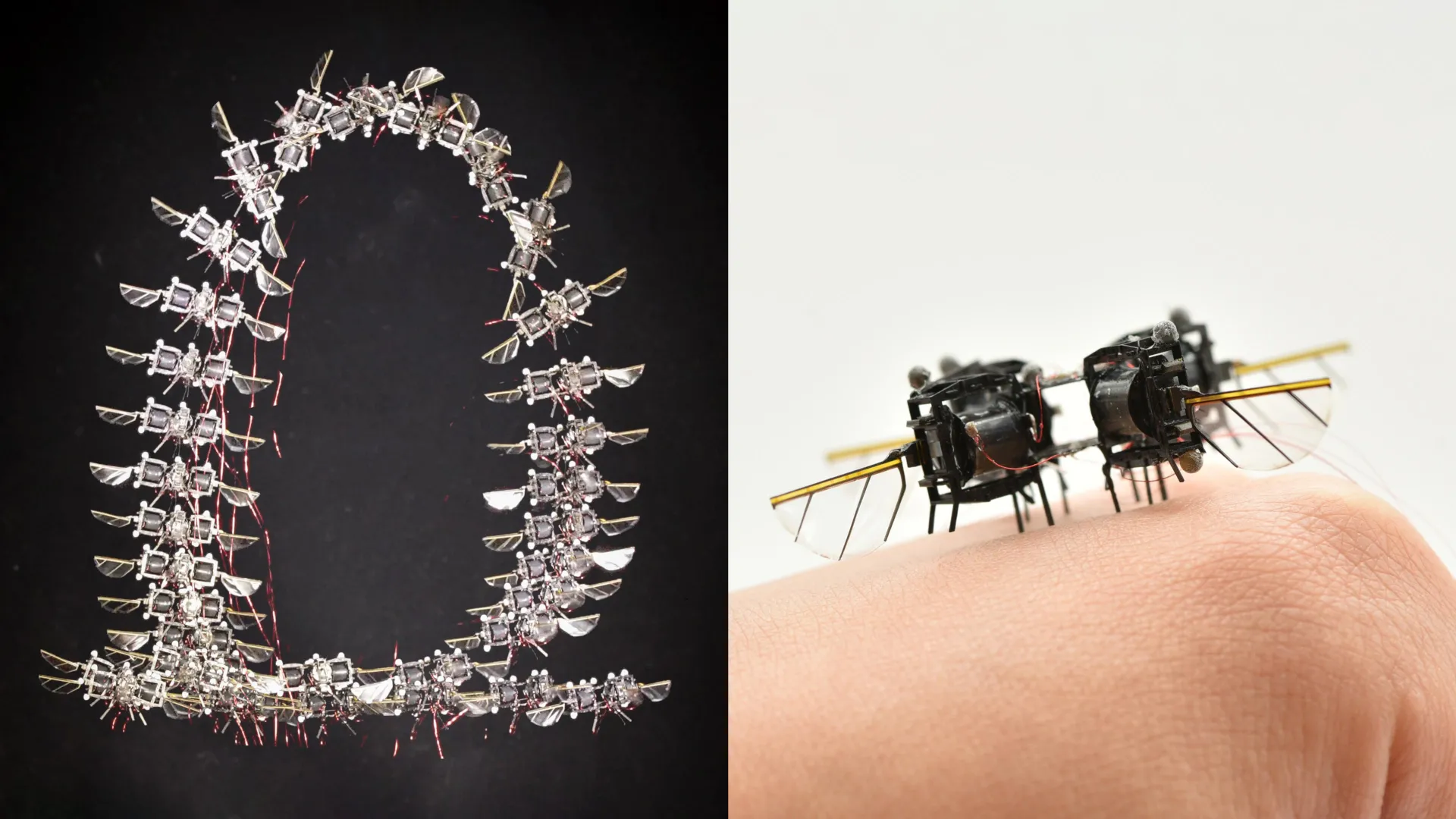
In the aftermath of catastrophic earthquakes, every second counts. Rescue teams often face the harrowing reality of victims trapped deep within the unstable, shifting remains of collapsed structures—spaces too narrow for human rescuers and too confined for standard commercial drones. For years, the vision of deploying swarms of "robotic insects" to navigate these treacherous environments has remained a staple of science fiction. Today, that vision is closer than ever to becoming a life-saving reality.
Researchers at the Massachusetts Institute of Technology (MIT) have unveiled a breakthrough in aerial microrobotics, developing an AI-based control system that endows a tiny, insect-scale flying robot with unprecedented speed and acrobatic agility. By bridging the gap between biological inspiration and computational efficiency, the MIT team has transformed a device that once moved with the sluggishness of a mechanical toy into a nimble, high-performance flyer capable of performing complex aerial maneuvers—including rapid-fire somersaults—with the precision of a housefly.
The Chronology of a Micro-Engineering Milestone
The journey toward this achievement began over five years ago within MIT’s Soft and Micro Robotics Laboratory. Led by Kevin Chen, an associate professor in the Department of Electrical Engineering and Computer Science (EECS), the team’s objective was to create a device that mirrored the flight dynamics of nature’s most efficient aerialists.
The Hardware Evolution
Early iterations of the robotic insect were physically capable but intellectually limited. The team spent years refining the machine’s physical architecture, eventually producing a model the size of a microcassette and weighing less than a paperclip. To achieve flight, the researchers utilized soft artificial muscles capable of contracting at high frequencies, driving wings that beat with enough force to overcome the limitations of micro-scale aerodynamics.
However, as the hardware matured, the "brain"—or the controller—became the primary bottleneck. Traditional control systems, often manually tuned by human operators, were insufficient to manage the unpredictable, turbulent airflow that defines flight at the millimeter scale. The robot was effectively a high-performance engine governed by a primitive steering wheel.
The Computational Breakthrough
The recent collaboration between Chen’s group and the laboratory of Jonathan P. How, the Ford Professor of Engineering in the Department of Aeronautics and Astronautics, marked the turning point. By shifting from manual control to a two-step AI-driven architecture, the researchers solved the "computation-versus-agility" paradox. This breakthrough, recently published in the journal Science Advances, allows the robot to process environmental data and execute complex, aggressive flight corrections in real time.
Supporting Data: By the Numbers
The performance gains achieved through this new control framework are not merely incremental; they are transformative. According to data provided by the research team, the integration of the AI-based controller resulted in the following performance enhancements:
- Speed: A 447 percent increase in maximum flight velocity.
- Acceleration: A 255 percent increase in the robot’s ability to gain speed.
- Stability: The robot successfully performed 10 consecutive somersaults within 11 seconds, even while subjected to external wind disturbances designed to knock it off course.
- Precision: During these maneuvers, the device maintained a flight path variance of only 4 to 5 centimeters.
These metrics demonstrate that the robot is no longer just "flying"; it is navigating. By achieving flight performance comparable to insects in terms of pitching angle and acceleration, the MIT team has effectively crossed the threshold from experimental prototype to a functional, agile tool.
The "Two-Step" AI Strategy
To achieve this level of performance, the researchers had to overcome the reality that high-end mathematical modeling is computationally "expensive." Calculating the aerodynamics of a tiny, flapping-wing robot in real time requires immense processing power—more than a tiny onboard chip can typically handle.
The Model-Predictive Controller
The first phase of the system uses a "model-predictive controller." This acts as the expert planner. It relies on a rigorous dynamic mathematical model to simulate the robot’s behavior, forecasting the best sequence of movements to reach a destination while respecting physical limits—such as the maximum torque the wings can produce without snapping. While this method is too slow to react to split-second changes in a live flight, it is essential for planning complex maneuvers like flips and sharp turns.
Imitation Learning: The "Secret Sauce"
To make this expertise available in real time, the team employed "imitation learning." They used the expert, high-power planner to train a deep-learning policy. This policy acts as a condensed, highly efficient version of the expert planner.
"The robust training method is the secret sauce of this technique," explains Professor How. Through imitation, the AI learns to mimic the complex maneuvers of the expert controller but executes them with the speed of a streamlined algorithm. When the robot is in the air, this policy takes inputs about the robot’s current position and instantly translates them into thrust and torque commands. It is the difference between a student carefully calculating a math problem on paper and an expert performing the same calculation instinctively in their head.
Official Responses and Perspectives
The research team, which includes co-lead authors Yi-Hsuan Hsiao, Andrea Tagliabue, and Owen Matteson, emphasizes that this work is a paradigm shift for the micro-robotics field.
"We want to be able to use these robots in scenarios that more traditional quadcopter robots would have trouble flying into," says Professor Kevin Chen. "Now, with our bioinspired control framework, the flight performance of our robot is comparable to insects in terms of speed, acceleration, and the pitching angle. This is quite an exciting step toward that future goal."
The significance of the work extends beyond simple flight. Co-lead author Yi-Hsuan Hsiao notes that this progress enables "multimodal locomotion," opening doors for future designs that could potentially crawl, jump, and fly. Furthermore, the team successfully demonstrated a "saccade"—a bio-mimicking maneuver where the robot pitches its body sharply to change position and then brakes rapidly. This behavior is essential for insects to stabilize their vision, and as Chen notes, it is a precursor to integrating onboard cameras and sensors.
Implications for the Future
The implications of this technology are vast. While the current prototype relies on an external motion-capture system to track its position, the team is already looking toward the next frontier: autonomy.
Beyond the Lab: Search and Rescue
The long-term goal is to equip these robots with miniaturized cameras, chemical sensors, and lidar. Once the robots can process their own surroundings without external guidance, they could be deployed in "swarms" into the rubble of collapsed buildings. Because of their size, they could weave through rebar and debris, relaying information about survivors’ locations to human rescuers who would otherwise be flying blind.
Coordination and Swarming
Looking ahead, the researchers are investigating how onboard sensing could allow groups of these robots to coordinate their movements. If a single robot can identify a structural hazard, it could theoretically signal the rest of the swarm to adjust their flight paths, creating a collective intelligence that is as resilient as it is agile.
The MIT study proves that the limitations of micro-scale flight were not necessarily a failure of physics, but a limitation of software. By teaching a machine to think like an insect, the researchers have opened a new chapter in robotics—one where the smallest machines might eventually perform the largest services for humanity. The research, supported by the National Science Foundation, the Office of Naval Research, and other prestigious institutions, stands as a testament to the power of interdisciplinary collaboration in solving the world’s most complex engineering challenges.
 Ali Ikhwan
 Reynand Wu
 Ammar Sabilarrohman
