
 By Ali Ikhwan
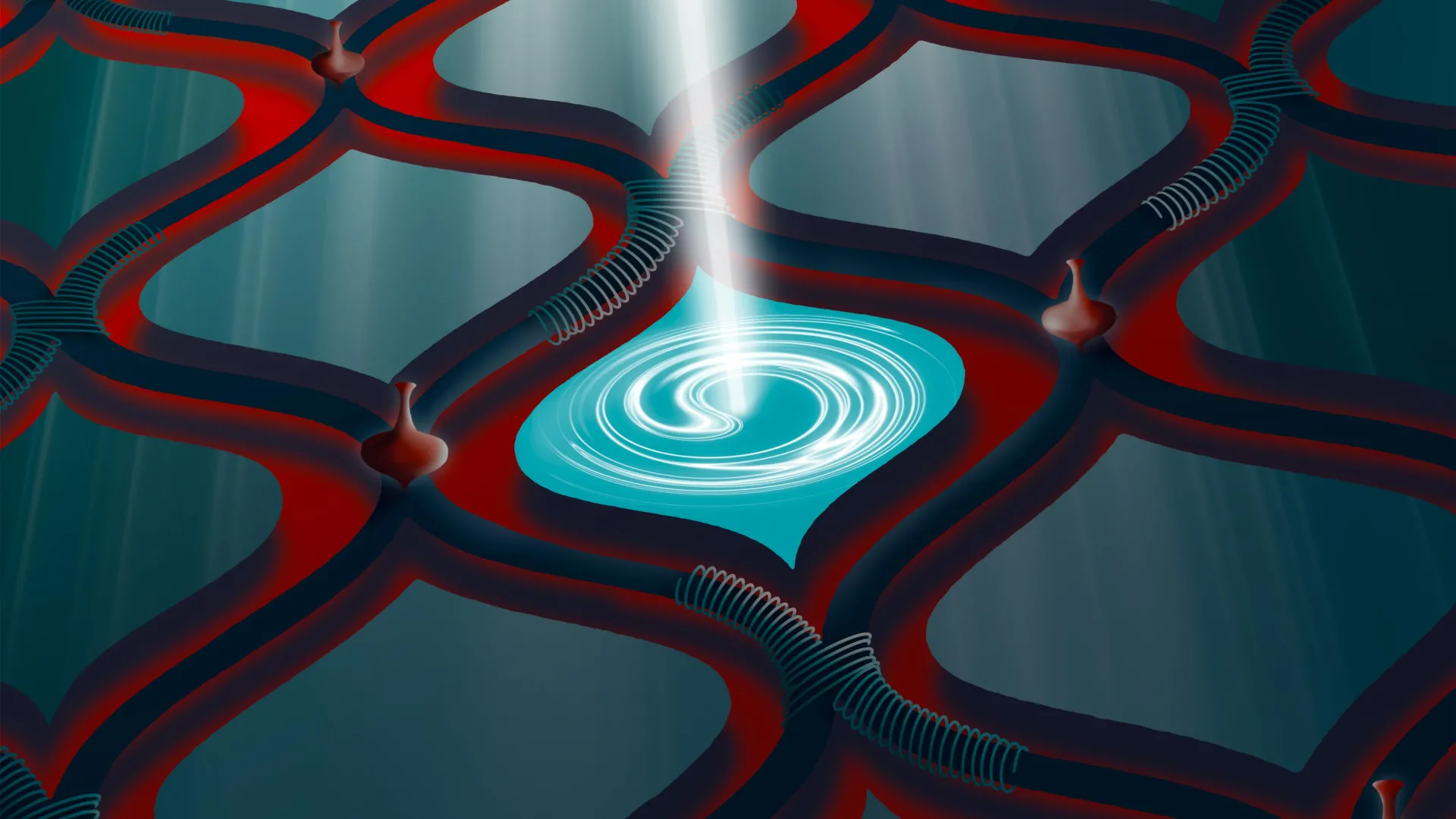
In the strange, counterintuitive landscape of quantum mechanics, objects do not always require direct contact to exert an influence. A particle can be steered, shifted, or even brought to a total standstill by a magnetic field it never actually enters. This phenomenon, known as the Aharonov-Bohm effect, has long served as a hallmark of the non-classical nature of our universe. Now, in a landmark study published in Nature Physics, researchers at the University of Oxford have successfully recreated this effect within a hybrid quantum computer, offering a new window into the fundamental interactions that govern the building blocks of reality.
The Invisible Hand: Main Facts of the Discovery
The experiment centers on the Aharonov-Bohm effect, a prediction first theorized in 1959 by Yakir Aharonov and David Bohm. The effect dictates that a charged particle traveling around a region containing magnetic flux will experience a measurable shift in its quantum state, despite remaining entirely outside the magnetic field’s physical boundaries.
The Oxford team, led by Dr. Sebastian Saner and Dr. Oana Bazavan, utilized a hybrid quantum system to simulate this effect within a "lattice gauge theory." By integrating qubits—the standard units of quantum information—with quantum oscillators representing matter, the researchers created a closed-loop system. When the researchers introduced a simulated magnetic flux into this loop, they observed a phenomenon that defied classical intuition: the quantum "tunneling" of the particle, which typically allows it to move freely between states, was completely suppressed. The magnetic influence, acting from a distance through a dynamical gauge field, effectively "froze" the particle in its tracks.
A Historical Arc: From 1959 Theory to 2024 Simulation
To understand the magnitude of the Oxford experiment, one must look at the evolution of quantum theory over the last six decades.
1959: The Theoretical Prediction
When Aharonov and Bohm first proposed their eponymous effect, it challenged the classical notion that electromagnetic forces were the only way to influence a particle’s trajectory. They argued that the "vector potential"—a mathematical construct previously thought to be merely a tool for calculation—had physical reality. They predicted that even if a particle’s path avoids the magnetic field ($B=0$), the vector potential ($A$) along its path would shift the particle’s quantum phase.
Late 20th Century: Experimental Verification
Decades later, advanced electron interferometry confirmed the theory. By passing electron beams around a microscopic solenoid, physicists demonstrated that the interference pattern shifted precisely as Aharonov and Bohm predicted. It became a foundational proof that quantum mechanics operates on rules distinct from the macroscopic world.
2022–2024: The Oxford Simulation
The project began in 2022, with the Oxford team collaborating with Dr. Alejandro Bermudez of the Instituto de Física Teórica in Madrid. The researchers sought to move beyond mere observation and into the realm of active simulation. By building a system where the gauge field was not a static background but a dynamic participant, they brought the Aharonov-Bohm effect into a controllable, programmable environment.
The Architecture of the Experiment: Supporting Data and Methodology
The Oxford team’s success hinged on their innovative use of trapped-ion quantum technology. Trapped ions—electrically charged atoms suspended by electromagnetic fields—served as the workhorse for the experiment.
The Hybrid Design
The experimental setup was divided into two distinct but interacting quantum components:
- Qubits (The Gauge Fields): Encoded in the internal states of the trapped ions, these qubits represented the forces that connect points in space.
- Quantum Oscillators (The Matter): These were created by the physical vibrations of the trapped ions, serving as the "matter" that moves across the simulated grid.
By linking these components, the researchers formed a loop—a fundamental building block of lattice gauge theories. In these theories, space is modeled as a grid; matter resides at the nodes (points), and fields reside on the "links" (the connections between points).
From Static to Dynamical
Originally, the team intended to use a fixed, unchanging magnetic flux. However, technical limitations in their hardware necessitated a more creative approach. They opted to encode the magnetic flux directly into the qubits. This proved to be a stroke of brilliance: it allowed the magnetic flux to become a "dynamical" part of the system. Instead of the particle moving through a stagnant landscape, the particle and the field evolved together, creating a feedback loop that more accurately mirrors the complexity of high-energy physics.
Official Perspectives: The Significance of Dynamical Interaction
The significance of the study lies not just in the "freezing" of the particle, but in the nature of the interaction.
"For us, the exciting step was to encode the magnetic flux in a gauge field that was itself dynamical," says Dr. Sebastian Saner. "Rather than having matter evolve in a fixed background, the matter and gauge field become part of the same quantum dynamics."
This shift in perspective is crucial for the future of particle physics. Traditional supercomputers struggle to simulate these systems because the mathematical complexity increases exponentially with every added particle or field interaction. By utilizing a quantum simulator, the Oxford team demonstrated that one quantum system can "model" another, effectively bypassing the computational bottleneck of classical machines.
The study was published alongside a complementary paper from the University of Maryland, led by Professor Norbert Linke. While the Maryland team focused on the Yukawa potential—a different mathematical framework for nuclear interactions—both teams reached a similar conclusion: hybrid quantum architectures are becoming the primary tool for peering into the fundamental "fabric" of the universe.
Broader Implications: Redefining High-Energy Physics
The ability to simulate lattice gauge theories with high fidelity has profound implications for several branches of science.
1. Advancing Particle Physics
Lattice gauge theories are the standard language of the Standard Model, the theory that describes all known fundamental particles. By simulating these theories on a quantum computer, scientists hope to solve mysteries that remain out of reach for classical hardware, such as the behavior of quarks inside protons or the exotic states of matter inside neutron stars.
2. Exploring Entanglement
The Oxford experiment relied heavily on quantum entanglement, where the qubits (fields) were linked to the oscillators (matter). This experiment provides a platform to study how entanglement spreads through a system, a key area of research for quantum information science and the development of more robust quantum computers.
3. A New Paradigm for Simulation
Perhaps the most significant takeaway is the validation of "quantum simulation" as a viable alternative to "quantum calculation." By constructing a system that mimics the rules of nature, scientists can conduct experiments that are physically impossible or prohibitively expensive to perform in a laboratory, such as recreating the conditions of the early universe or investigating high-energy particle collisions in a controlled, tabletop setting.
Conclusion
The Oxford experiment serves as a powerful reminder that the quantum world is not just a collection of abstract mathematical rules, but a tangible, observable reality that we are only beginning to harness. By successfully recreating the Aharonov-Bohm effect in a dynamic, hybrid quantum system, Dr. Saner, Dr. Bazavan, and their colleagues have done more than just verify a 65-year-old prediction; they have built a bridge to the next generation of physical discovery.
As quantum hardware continues to mature, we are moving toward an era where we can "program" the laws of physics to see what happens when they are pushed to their limits. The invisible magnetic influence that stopped a particle in its tracks at Oxford today may well be the key to unlocking the mysteries of the subatomic world tomorrow.
 Reynand Wu
 Ammar Sabilarrohman
